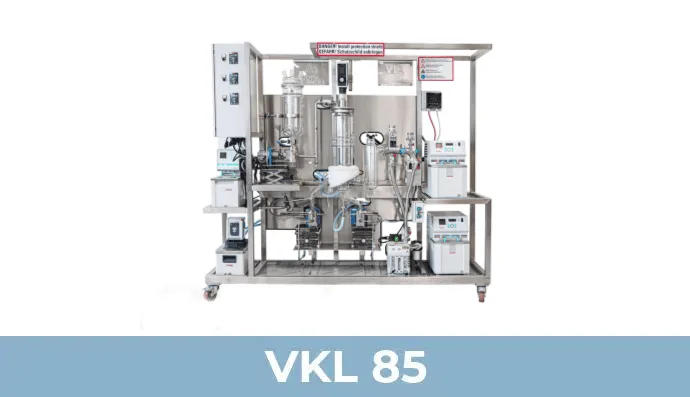
VKL 85 Wiped-Film Short Path Distillation System
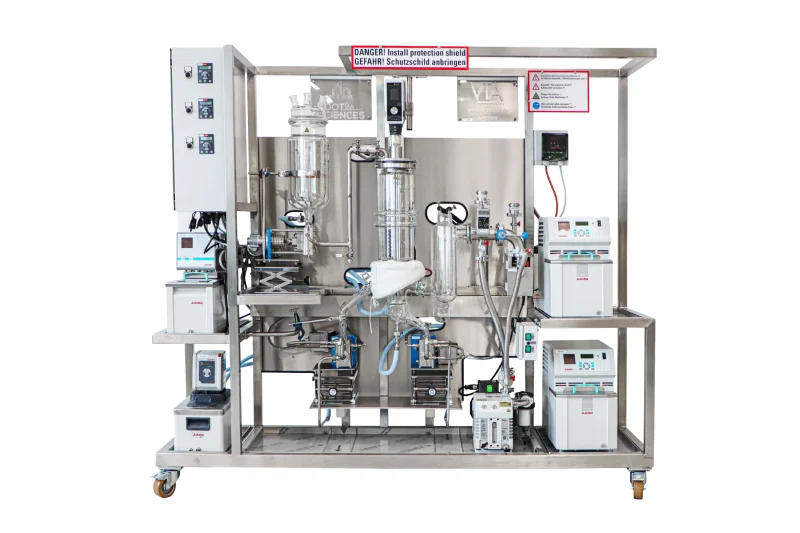
VKL 85, Cannabis Distillation Equipment

Wiped-Film Distillation for Growing Operations

The VKL 85 is a wiped-film short-path distillation system designed to process larger volumes of cannabis and hemp crude oil with reliable, continuous throughput around 3 L/h, supporting steady refinement as production needs grow.

System Highlights
  • German-engineered by VTA
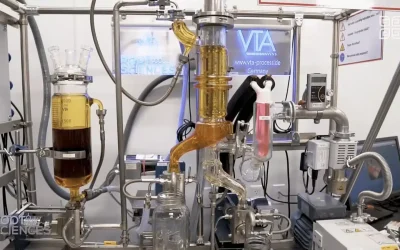
  • High-visibility glass components
  • Continuous wiped-film operation
  • Integrated short-path condenser
  • Centralized system controls
  • Compact, lab-friendly footprint
  • Consistent commercial throughput
  • Designed for long-term reliability
  • Easy integration into processing lines
Equipment Specifications
Maximum Feed Rate:4.25 L/h
Typical Throughput:2.8 L/h
Evaporator Surface Area:0.15 m²
Stages:Single
Power Requirements:1 Φ, 230 V, 60 Hz
Dimensions (L x W x H):7.2’ x 2.0’ x 7.5’
Materials Used:316 SS, borosilicate glass, PTFE glass fiber reinforced rollers
Warranty:1 year (excluding glass and vacuum system)
Certifications
  • UL ready (all necessary individual components are UL listed)
Options
  • 10 L feed vessel

  • Immersion chiller for cold trap

  • Separate heater for residue discharge arm

  • GMP package to include IQ, OQ, FAT, SAT

  • Heated transfer hose to connect multiple units in series

The VKL 85: Scaling Wiped-Film Distillation for Commercial Processing

Supporting consistent cannabinoid refinement at higher production levels

The VKL 85 is a wiped-film short-path distillation system used in cannabis and hemp processing to refine crude extracted oil into more uniform distillate by separating cannabinoids from heavier compounds under controlled temperature and vacuum conditions. It is designed for larger-volume refinement compared with smaller systems, allowing material to be spread as a thin film across heated surfaces while operating continuously, which supports steady processing and clearer separation of components.


In practice, the VKL 85 fits into post-extraction workflows where refined distillate will be used in downstream products such as vape formulations, tinctures, or edibles, helping processors maintain consistent output as production needs grow. Its use of visible glass components and integrated controls makes it possible for operators to observe processing conditions in real time, and its throughput capabilities are balanced for commercial environments that require reliable, repeatable results without unnecessary complexity.

What is wiped-film short path distillation?

Wiped-film short-path distillation is a refinement method used in the cannabis and hemp processing industry to separate cannabinoids from heavier compounds after extraction. In this process, crude oil is spread into a thin film along a heated surface using internal wipers, which increases surface area and allows cannabinoids to evaporate efficiently at lower temperatures under vacuum.

As the vaporized cannabinoids travel a very short distance to an internal condenser, they are quickly cooled and collected as distillate. The short vapor path helps reduce thermal exposure and limits degradation, making this approach well-suited for temperature-sensitive cannabis and hemp oils. Wiped-film short-path distillation is commonly used by commercial processors seeking consistent cannabinoid concentration, improved clarity, and repeatable results in post-extraction workflows.

How does it work?

In wiped-film short-path distillation, extracted cannabis or hemp oil is fed into a heated chamber where it is immediately spread into a thin, even film along the interior surface. Internal wipers continuously move the material, ensuring uniform contact with the heated wall and preventing buildup as the oil flows through the system.

As the thin film travels downward, cannabinoids evaporate under reduced pressure at controlled temperatures. The vapor moves only a short distance before reaching an internal condenser, where it is cooled and collected as refined distillate. Heavier compounds that do not evaporate continue through the system and are removed separately.

This continuous, thin-film approach allows processors to maintain stable operating conditions while supporting consistent separation from batch to batch. The short vapor path and controlled exposure help preserve cannabinoid quality, making wiped-film short-path distillation a commonly used refinement step in commercial cannabis and hemp processing workflows.

Key Applications

Wiped-film short-path distillation is commonly used in cannabis and hemp processing as a post-extraction refinement step. It is applied after initial extraction and winterization to concentrate cannabinoids and remove heavier components, helping transform crude or partially refined oil into a more uniform distillate.

Distillate produced through wiped-film distillation is used across a wide range of downstream applications, including vape formulations, edibles, tinctures, topicals, and infused products. The process supports consistent cannabinoid concentration, which is important for manufacturers that require predictable inputs for formulation and dosing.

In commercial processing facilities, wiped-film distillation is often integrated into continuous production workflows where reliability and repeatability are essential. Its ability to operate steadily over time makes it suitable for processors refining cannabis and hemp oils at scale while maintaining consistent output quality.

Advantages of wiped-film short path distillation
  • Supports efficient cannabinoid separation through thin-film evaporation
  • Operates under reduced pressure, allowing lower processing temperatures
  • Short vapor path helps limit thermal exposure during distillation
  • Continuous operation supports steady, repeatable processing
  • Clear separation of cannabinoids from heavier compounds
  • Suitable for temperature-sensitive cannabis and hemp oils
  • Enables consistent distillate quality across production runs
  • Integrates easily into post-extraction processing workflows
  • Provides stable performance for day-to-day commercial use
FAQs

1. Where does the VKL 85 typically fit within a cannabis or hemp processing workflow?

The VKL 85 is commonly used after extraction and winterization as a primary refinement step for producing distillate at higher volumes. It is often selected by facilities that have outgrown smaller wiped-film systems and need more consistent throughput without moving into large industrial-scale equipment.

2. How does the VKL 85 differ from smaller wiped-film distillation systems?

Compared to smaller systems, the VKL 85 is designed to handle higher feed rates and sustained operation while maintaining the same wiped-film short-path principles. This makes it better suited for processors running longer production schedules or refining larger quantities of oil on a regular basis.

3. What types of processing facilities typically use the VKL 85?

The VKL 85 is commonly used by mid- to large-scale cannabis and hemp processors operating commercial distillation labs. It is well suited for facilities focused on steady daily production rather than intermittent or batch-style refinement.

4. How does feedstock preparation affect performance on the VKL 85?

Proper upstream preparation, such as effective winterization, filtration, and removal of residual solvents, plays an important role in how smoothly material runs through the system. Consistent feedstock preparation supports stable operation and predictable distillate output.

5. Why is wiped-film distillation often preferred at this scale?

Wiped-film distillation allows material to be processed continuously as a thin film, which supports efficient separation and repeatable results. At higher processing volumes, this approach helps maintain control and consistency compared to batch-based distillation methods.

6. How does operator visibility support day-to-day operation?

The VKL 85 includes visible process components that allow operators to observe film behavior and general operating conditions in real time. This visibility can assist with process understanding, adjustments, and maintaining stable performance over longer runs.

7. How is the VKL 85 typically integrated into existing lab infrastructure?

The system is usually paired with external vacuum systems, heaters, feed pumps, and downstream collection equipment. Its layout allows it to be incorporated into established processing lines without requiring major facility redesign.

8. What should processors consider when choosing a higher-capacity wiped-film system?

Processors often evaluate available floor space, desired throughput range, staffing and operator experience, and long-term production goals. Understanding how distillation fits into overall workflow planning is key when moving to higher-capacity systems.

9. How does the VKL 85 support consistent distillate quality over time?

When operated under stable conditions with consistent feed material, the VKL 85 is designed to support repeatable separation across ongoing production runs. This consistency is important for downstream formulation and product manufacturing.

10. Is the VKL 85 better suited for continuous or batch processing environments?

The VKL 85 is typically used in continuous or semi-continuous processing environments where predictable output and steady operation are preferred over batch-style distillation.

Considering the VKL 85 for Commercial Refinement

If you’re evaluating wiped-film distillation for higher-volume cannabis or hemp processing, the VKL 85 supports consistent refinement as production demands increase. Our team can help you understand how this system fits within your existing workflow and long-term processing goals.