
Dewaxing, Color Remediation, and Efficient Solvent Recovery
Root Sciences offers advanced membrane nanofiltration systems engineered for cannabis and hemp oil refinement. This cutting-edge technology enables processors to selectively separate cannabinoids, pesticides, lipids, and solvents with high efficiency—streamlining purification and improving extract quality. Ideal for winterization, solvent recovery, and cannabinoid isolation, our membrane nanofiltration equipment supports scalable production with minimal thermal degradation. Whether you’re looking to boost throughput or enhance your product purity, our systems deliver consistent results for cannabis and hemp extraction facilities worldwide.
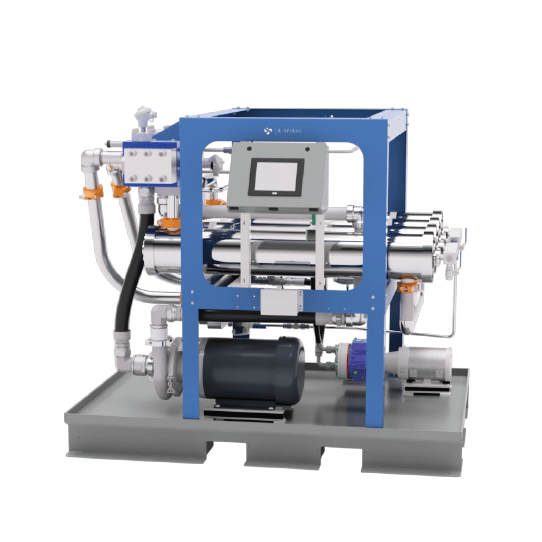
Lab Scale

X-Spiral 2.5
The X-Spiral 2.5 is a membrane nanofiltration unit designed for cannabis and hemp processors who need a compact yet capable solution for solvent recovery and in-line dewaxing. This system helps remove lipids, pigments, and sugars from ethanol-based extracts without relying on traditional winterization methods, which are time-consuming and resource-intensive. It also improves downstream efficiency by reducing buildup in distillation equipment and lowering maintenance demands. Suitable for smaller operations or facilities just beginning to implement nanofiltration into their workflow, the X-Spiral 2.5 offers flexibility with a modular design that can scale as production needs grow.
Commercial Scale

X-Spiral 4
The X-Spiral 4 provides mid-scale cannabis and hemp processors with an efficient option for improving extract clarity, color, and stability. Using organic solvent nanofiltration, it enables cold ethanol extraction at low temperatures—helping preserve cannabinoids and terpenes while removing unwanted components like waxes and chlorophyll. By integrating dewaxing and solvent recovery in one step, the system helps streamline post-extraction processing while lowering energy consumption and reducing the need for large evaporators or extensive chilling systems. The X-Spiral 4 is well-suited for facilities looking to scale up while maintaining quality control and reducing overall operational costs.
Industrial Scale

X-Spiral 8
Designed for high-volume cannabis and hemp operations, the X-Spiral 8 supports large-scale solvent recovery and filtration using organic solvent nanofiltration. It efficiently removes impurities such as waxes, sugars, and pigments, which not only improves product appearance and purity but also prevents common issues in downstream equipment, such as clogging and coking. By maintaining low operating temperatures, the X-Spiral 8 preserves the integrity of cannabinoids and allows for consistent, high-throughput processing without the risk of thermal degradation. Its fully integrated system design supports demanding production environments and is ideal for processors focused on maximizing yield while minimizing maintenance and energy usage.
| Specification | X-Spiral 2.5 | X-Spiral 4 | X-Spiral 8 |
|---|---|---|---|
| Solvent Recovery Rate | 30–120 gal/h | 180–360 gal/h | 800–1,600 gal/h |
| Winterization Rate | 360 gal/h (10% saturation) | 1,080 gal/h (10% saturation) | 1,080 gal/h (10% saturation) |
| Color Remediation Rate | 30 gal/h (10% saturation) | 90 gal/h (10% saturation) | 90 gal/h (10% saturation) |
Membrane nanofiltration, often referred to as organic solvent nanofiltration, is a separation method that uses specially designed membranes to gently filter solvents from heavier compounds. Instead of relying on heat or evaporation, the process uses pressure to guide the solvent through the membrane while keeping cannabinoids, waxes, pigments, and other larger molecules on the opposite side. This creates a cleaner, more selective form of separation that helps preserve sensitive components often affected by high temperatures.
In cannabis and hemp processing, this approach is especially valuable because it supports solvent recovery, winterization, and purification without exposing material to harsh conditions. By allowing only certain molecules to pass through, membrane nanofiltration gives processors a controlled and consistent way to refine extracts while reducing energy use and minimizing thermal degradation. The result is a streamlined, reliable method for handling post-extraction tasks with improved product quality and smoother lab operations.
Organic Solvent Nanofiltration (OSN) works by using specialized membranes to separate solvents from larger molecules at low temperatures, creating a gentle and efficient alternative to heat-based recovery methods. Instead of evaporating or boiling the solvent, the process uses pressure to guide the solvent through the membrane while retaining cannabinoids, waxes, pigments, and other compounds that are too large to pass through. This selective separation preserves the integrity of sensitive plant components and helps maintain consistent extract quality.
Because OSN operates without phase changes, it significantly reduces energy demands while supporting smooth, continuous operation. The same membrane platform can also be adapted for winterization or targeted purification, allowing facilities to handle multiple post-extraction steps with a single system. For cannabis and hemp processors, OSN offers a scalable approach that improves efficiency, protects product profiles, and supports cleaner, more sustainable workflows from lab scale to full industrial production.
Membrane technology offers several benefits for cannabis and hemp processors compared with traditional solvent recovery methods. Because the process works at low temperatures and avoids evaporation, it helps protect sensitive cannabinoids and terpenes from degradation. This gentler approach also reduces the overall energy load, making day-to-day operation more efficient and cost-effective. The system runs smoothly without the constant heating and cooling cycles seen in other equipment, which contributes to longer lifespan and easier maintenance. Another advantage is the flexibility—membranes can be selected or swapped to support different goals such as winterization or color remediation. Altogether, membrane filtration provides a cleaner, more controlled, and more sustainable way to manage solvent recovery and purification in extraction labs.
1. What is Organic Solvent Nanofiltration (OSN)?
OSN is a membrane-based separation method that filters solvents from larger compounds at low temperatures, allowing processors to recover and purify solvents without relying on heat. This makes it ideal for protecting cannabinoids, terpenes, and other sensitive plant components.
2. How does OSN benefit cannabis and hemp processors?
OSN supports cleaner separation, reduces energy use, and preserves product quality by avoiding thermal degradation. It also helps streamline post-extraction workflows by combining solvent recovery, winterization, and purification on the same platform.
3. What’s the difference between the X-Spiral 2.5, 4, and 8?
The three systems mainly differ in throughput and scale. The X-Spiral 2.5 is designed for lab-scale production, the X-Spiral 4 supports commercial operations, and the X-Spiral 8 is built for continuous industrial-scale processing.
4. What solvents can OSN handle?
The technology is compatible with a wide range of organic solvents commonly used in cannabis and hemp extraction workflows, including those used in ethanol, hydrocarbon, and other solvent-based processes.
5. Does OSN replace falling-film evaporators?
For many facilities, yes. Because OSN recovers solvents without heat or evaporation, it can provide comparable or higher throughput with significantly lower energy requirements and gentler handling of plant compounds.
6. Can OSN perform winterization?
Yes. With the appropriate membranes, OSN systems can remove fats and waxes at cold temperatures, allowing winterization to occur on the same platform used for solvent recovery.
7. Can OSN assist with color or pesticide remediation?
Certain membrane configurations enable selective removal of pigments and unwanted impurities, making OSN a flexible technology for additional cleanup steps after extraction.
8. Is OSN suitable for both R&D and large-scale production?
Yes. The X-Spiral lineup covers lab-scale, commercial-scale, and industrial-scale needs, making OSN a fully scalable solution for evolving cannabis and hemp operations.
9. How difficult is installation?
Installation is straightforward. Each X-Spiral system is skid-mounted and designed to integrate easily with existing tanks, pumps, and utility connections.
10. How much maintenance is required?
Maintenance is minimal and typically involves routine membrane monitoring and basic cleaning. The lack of heating and cooling cycles reduces system wear compared to traditional evaporators.
11. Do OSN systems qualify for energy-efficiency rebates?
Yes. Because OSN systems use far less energy than heat-based recovery equipment, many facilities qualify for utility rebates that can significantly offset upfront costs.
12. Can OSN technology scale with production growth?
All X-Spiral units feature modular, expandable designs, allowing facilities to add membrane racks or upgrade capacity as throughput needs increase.