
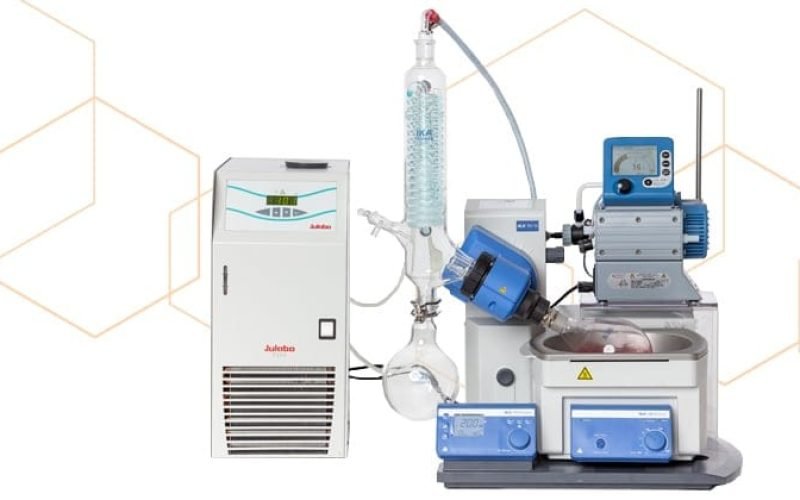
Rotary evaporation is one of the most widely used techniques in modern laboratories for the efficient removal and recovery of solvents. Whether you are working in pharmaceutical research, chemical synthesis, food science, or cannabis processing, understanding the rotary evaporator principle is fundamental to getting accurate, repeatable, and safe results. This guide breaks down exactly how a rotary evaporator works, its key components, operating parameters, and practical tips to help you get the most out of the instrument.
Sections
ToggleWhat Is a Rotary Evaporator?
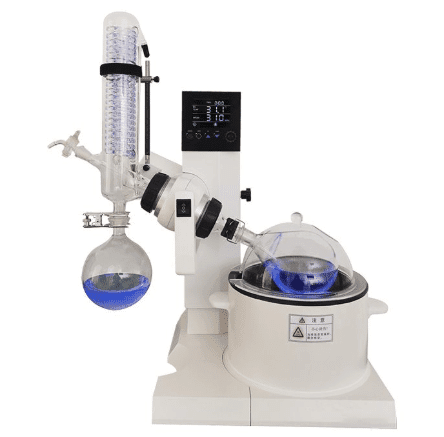
A rotary evaporator, commonly called a rotovap or rotavap, is a laboratory instrument engineered for the efficient, gentle removal of solvents from solutions through evaporation under reduced pressure. Found in pharmaceutical labs, research institutions, chemical plants, and even molecular gastronomy kitchens, it is one of the most versatile and frequently used pieces of equipment in modern science.
Today, rotary evaporators are available in sizes ranging from 2-liter bench-top units for small-scale laboratory work to 50-liter industrial models for pilot plant and production-scale operations.
The Core Principle of Rotary Evaporation
The rotary evaporator works on the synergy of three scientific principles working simultaneously: reduced pressure, continuous rotation, and controlled heat. Understanding each one is essential for operating the instrument correctly and troubleshooting problems when they arise.
1. Reduced Pressure: Lowering the Boiling Point
The foundation of the rotary evaporator principle is vacuum-assisted pressure reduction. At atmospheric pressure (760 torr), every solvent has a fixed boiling point. Ethanol boils at 78°C, water at 100°C, hexane at 69°C. However, the boiling point of any liquid is not a fixed constant; it is directly tied to the ambient pressure above it.
When a vacuum pump reduces the pressure inside the system, the boiling point of the solvent drops significantly. For example:
- Ethanol boils at approximately 30 to 35°C under a vacuum of 40 to 50 mbar
- Water boils at approximately 40°C under a vacuum of 55 mbar
- Acetone boils at approximately 20°C under 240 mbar
This means the solvent can be evaporated at far lower temperatures, protecting heat-sensitive compounds such as active pharmaceutical ingredients (APIs), natural product extracts, essential oils, and biological samples from thermal degradation.
2. Flask Rotation: Creating a Thin Evaporation Film
The rotating flask is what distinguishes a rotary evaporator from a standard vacuum distillation setup. As the flask spins, typically at 20 to 280 rpm, two forces act on the liquid inside:
- Centrifugal force pushes liquid outward against the flask wall
- Frictional force between the liquid and the warm glass wall pulls liquid upward
Together, these forces spread the solvent into a thin, uniform film across the entire inner surface of the flask. This thin-film formation dramatically increases the surface area available for evaporation compared to a still liquid sitting at the bottom of a vessel. Greater surface area means more solvent molecules can escape into the vapor phase per unit of time, making the process significantly faster and more efficient than conventional evaporation.
Rotation also prevents bumping. In standard distillation, superheated liquid can suddenly release large vapor bubbles, causing violent splattering that can contaminate or destroy a sample. Continuous rotation keeps the liquid homogeneous and well-distributed, suppressing this problem.
3. Controlled Heat Supply
The evaporation flask is partially submerged in a thermostated heating bath, typically filled with water for temperatures up to 95°C or silicone oil for higher temperature applications. The bath provides a uniform, indirect heat supply to the rotating flask.
Controlled heating provides the kinetic energy that solvent molecules need to transition from the liquid phase to the vapor phase. By setting an exact bath temperature and combining it with a precise vacuum level, operators can target specific solvents for removal while leaving non-volatile compounds, the desired product, behind in the flask.
4. Condensation and Solvent Recovery
Once solvent molecules vaporize, they travel up the vapor duct and into the glass condenser. The condenser is cooled by circulating cold water, a chiller, or dry ice and isopropanol mixtures. As hot vapor contacts the cold condenser surface, it rapidly condenses back into a liquid and drips into the receiving flask.
The recovered solvent can often be reused in subsequent experiments, reducing both waste and cost. This closed-loop solvent recovery is a major practical and environmental advantage of rotary evaporation over open evaporation methods.
The Delta T Rule: For best condensation efficiency, a temperature difference of at least 40°C between the heating bath and the condenser cooling medium is recommended. If the bath is set at 50°C, the condenser coolant should be at or below 10°C.
Key Components of a Rotary Evaporator
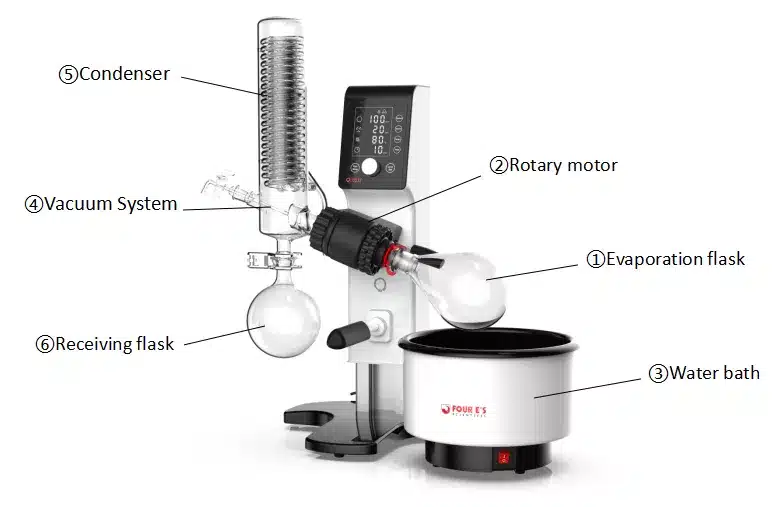
Every component in a rotovap system serves a specific role. A failure in any one part will degrade the performance of the whole system.
| Component | Function |
| Evaporation Flask | Round-bottomed glass flask that holds the sample; available in 100 mL to 50 L sizes |
| Heating Bath | Water or oil bath that provides uniform, controlled heat to the flask |
| Drive Motor | Rotates the evaporation flask at a constant, adjustable speed |
| Vapor Duct | Sealed glass or PTFE tube that channels solvent vapor from the flask to the condenser |
| Condenser | Spiral glass tube cooled by circulating water or refrigerant; converts vapor back to liquid |
| Vacuum Pump | Reduces system pressure; can be a water aspirator or mechanical pump for deep vacuum |
| Vacuum Controller | Regulates and monitors pressure; digital controllers allow precise, repeatable settings |
| Receiving Flask | Collects the condensed solvent for recovery or disposal |
| Motorized Lift | Raises and lowers the flask in and out of the heating bath safely |
| Bump Trap | Prevents foaming or bumping solutions from contaminating the condenser |
DC brushless motors provide superior speed consistency, are maintenance-free for up to 10 years, and offer smoother rotation than AC or stepper motors, a key consideration when processing viscous or foaming samples.
How to Use a Rotary Evaporator: A Brief Overview
While full operating procedures vary by instrument model, the core sequence follows this logic:
1. Prepare: Check all seals, joints, and glassware for damage. Ensure condenser cooling is running and the heating bath is filled.
2. Load: Fill the evaporation flask no more than 50 to 70% of capacity. Attach securely to the vapor duct.
3. Start rotation first: Begin rotating at 100 to 150 rpm before applying vacuum or heat. This creates the thin film before boiling begins and reduces bumping risk.
4. Apply vacuum gradually: Never apply full vacuum suddenly. Bring pressure down slowly to the target level based on your solvent.
5. Set temperature: Dial in the bath temperature 20 to 30°C above the solvent boiling point at your chosen vacuum level. Monitor condensate dripping into the receiving flask as confirmation that evaporation is active.
6. Shut down in the correct order: Turn off heat first, then vent to atmosphere, then stop rotation, then lift the flask, then turn off the vacuum pump. Reversing this order risks liquid suck-back into the sample.
Critical Operating Parameters and Optimization
1. Bath Temperature
Set the bath temperature 20 to 30°C above the solvent boiling point at your chosen vacuum level. Too high risks thermal degradation of your compound; too low stalls evaporation entirely.
2. Vacuum Pressure
The lower the pressure, the lower the boiling point. However, very deep vacuum can also trigger bumping or co-evaporation of your product. Work at the minimum vacuum needed for efficient evaporation rather than chasing maximum vacuum.
3. Rotation Speed
Most protocols start at 100 to 150 rpm. Viscous samples benefit from higher speed to thin the film. Foaming samples need slower speed to reduce foam generation. There is an optimal speed for each viscosity and faster is not always better.
4. Condenser Temperature
Maintain at least a 40°C difference between the heating bath and the condenser coolant. Insufficient cooling is the single most common cause of poor solvent recovery.
Solvent Reference Table
| Solvent | BP at Atmosphere | Approx. BP at 50 mbar | Suggested Bath Temp |
| Diethyl ether | 35°C | 0°C | 25 to 30°C |
| Acetone | 56°C | 15°C | 35 to 40°C |
| Dichloromethane | 40°C | 5°C | 30 to 35°C |
| Ethanol | 78°C | 30°C | 50 to 55°C |
| Ethyl acetate | 77°C | 28°C | 50°C |
| Water | 100°C | 38°C | 60 to 65°C |
| DMF | 153°C | 76°C | 90 to 95°C |
Types of Rotary Evaporators
- Standard Laboratory Rotary Evaporators are bench-top units for general solvent removal and concentration in research labs. These are the most commonly found instruments in university and industrial laboratories.
- Industrial and Scale-Up Rotary Evaporators ranging from 20 to 50 liters are designed for pilot plants and production-scale operations with enhanced heating and cooling capacity and the ability to run in continuous mode.
- Digital Rotary Evaporators feature electronic control panels for precise, repeatable control of rotation speed, bath temperature, and vacuum level, ideal for validated or regulated processes.
- Vacuum-Controlled Rotary Evaporators use automated pressure regulation, often with boiling point detection, to dynamically adjust vacuum and prevent bumping or sample loss.
- Cold Trap Rotary Evaporators incorporate deep-cooling traps between the condenser and vacuum pump, capturing highly volatile compounds that would otherwise escape into the pump, critical for toxic or highly volatile solvents.
- Parallel Rotary Evaporators allow multiple independent evaporation units to operate simultaneously, designed for high-throughput screening in pharmaceutical and agrochemical research.
Rotary Evaporator Applications by Industry
Rotary evaporators serve critical functions across a wide range of industries beyond academic chemistry:
- Pharmaceutical Research and Manufacturing: API purification, natural product extraction, crystallization studies, and drug discovery workflows
- Biotechnology: Concentration of biological extracts and removal of extraction solvents from sensitive samples
- Chemical Industry: Solvent recovery, concentration of reaction products, and high-purity intermediate preparation
- Food, Beverage and Flavor Industry: Aroma concentration, flavor extract production, essential oil isolation, and alcohol removal
- Cannabis and Hemp Processing: Solvent recovery after winterization, ethanol removal post-extraction, and concentrate purification
- Polymer Research: Removal of residual monomers or processing solvents from manufactured polymers
- Cosmetics: Concentration of active botanical extracts for formulation use
- Education: Demonstration of vacuum distillation and evaporation principles in university teaching labs
- Molecular Gastronomy: Preparation of distillates, flavor extracts, and aromatic waters at low temperatures
Rotary Evaporator vs. Simple Distillation vs. Freeze Drying
| Criterion | Rotary Evaporator | Simple Distillation | Freeze Drying |
| Temperature Used | Low (20 to 80°C) | High (70 to 200°C) | Very low (-40 to -80°C) |
| Pressure | Reduced vacuum | Atmospheric | Deep vacuum |
| Heat-Sensitive Compounds | Excellent | Risk of degradation | Excellent |
| Speed | Fast (minutes to hours) | Moderate | Slow (hours to days) |
| Solvent Recovery | Yes | Yes | No |
| Best For | Solvent removal and concentration | Separation by boiling point | Drying aqueous and biological samples |
| Cost | Moderate | Low | High |
Troubleshooting Common Problems
| Problem | Likely Cause | Solution |
| Evaporation too slow | Vacuum too low, bath temp too low, rotation too slow | Increase vacuum, raise bath temp, increase RPM |
| Sample bumping | Vacuum applied too fast, flask overfilled | Apply vacuum gradually, reduce fill volume, add boiling chips |
| Solvent escaping to pump | Condenser cooling insufficient | Increase coolant flow, lower condenser temp, add cold trap |
| Vacuum not holding | Leaking seals or cracked glassware | Inspect and replace O-rings, check all joints and clamps |
| Foaming | Sample contains surfactants or proteins | Reduce rotation speed, lower vacuum, use anti-foaming agent |
| Liquid suck-back | Pump turned off before venting | Always vent to atmosphere before switching off the vacuum pump |
| Poor condensate collection | Delta T below 40°C | Upgrade cooling or switch to a chiller |
Conclusion
The rotary evaporator principle is built on three interdependent forces working together: reduced pressure to lower the boiling point, continuous rotation to create a thin evaporation film, and controlled heat to drive the phase change from liquid to vapor. When these three elements are properly balanced, the result is a fast, gentle, and highly efficient solvent removal process that protects even the most heat-sensitive compounds.
Understanding the principle is only the starting point. Knowing how to optimize bath temperature, vacuum pressure, rotation speed, and condenser cooling for your specific solvent and sample is what separates reliable, reproducible results from inconsistent ones. Use the solvent reference table and troubleshooting guide in this article as your go-to reference whenever you encounter issues or are setting up a new protocol.
Whether you are operating a small bench-top rotovap in a university lab or running a 50-liter industrial unit in a production facility, the core principles remain the same. Master them, and the rotary evaporator becomes one of the most powerful and dependable tools in your laboratory workflow.
FAQs
A: The rotary evaporator works on the principle of reduced-pressure distillation combined with thin-film evaporation. A vacuum lowers the boiling point of the solvent, flask rotation spreads the liquid into a thin film to maximize surface area, and a controlled heating bath drives evaporation. The solvent vapor is then condensed and collected in a receiving flask.
A: Rotation spreads the sample liquid across the entire inner surface of the flask, dramatically increasing the evaporation surface area. It also prevents localized overheating and bumping, making the process faster, more uniform, and safer.
A: Set the bath temperature 20 to 30°C above the solvent boiling point at your chosen vacuum level. For ethanol at approximately 50 mbar, a bath temperature of 50 to 55°C is typical. Always stay below the degradation temperature of your target compound.
A: The 40°C Delta T rule states that the temperature difference between the heating bath and the condenser coolant should be at least 40°C to ensure efficient condensation. Insufficient Delta T leads to poor solvent recovery and vapor escaping into the vacuum pump.
A: Bumping occurs when superheated liquid suddenly releases large vapor bubbles. It is caused by applying vacuum too quickly, overfilling the flask, or running too high a bath temperature. Prevention involves filling flasks no more than 50 to 70%, applying vacuum gradually, starting rotation before applying vacuum, and using boiling chips if necessary.
A: In batch mode, a fixed volume of sample is loaded and evaporation proceeds until complete. In continuous mode, fresh sample is fed into the flask at the same rate solvent is removed, allowing 2 to 4 times higher solvent recovery throughput. Continuous mode is preferred for large-volume applications such as cannabis extract processing.
A: Not if used correctly. By reducing pressure to lower the boiling point, solvents can be removed at 30 to 50°C rather than 80 to 150°C, safely preserving thermally labile compounds such as APIs, natural product extracts, and biological materials.
A: Simple distillation operates at atmospheric pressure and requires high temperatures, making it unsuitable for heat-sensitive samples. Rotary evaporation operates under vacuum at much lower temperatures, provides faster solvent removal, and achieves more complete removal including trace residual solvent elimination.