
Temperature Control in Cannabis Processing: Why Heating and Cooling Matter
When people talk about cannabis processing equipment, the conversation usually centers on the big pieces: the extractor, the wiped-film distillation system, the reactor, or the evaporator.
The temperature control units running alongside them rarely get the same attention.
They should.
Heating and cooling are involved in nearly every stage of cannabis and hemp processing, and the ability to reach, maintain, and reliably control temperature can directly affect how well the rest of the process performs. A powerful chiller or heater alone isn’t necessarily enough, either. What matters is whether the temperature control system can meet the actual demands of the application.
That makes temperature control less of an accessory and more of a fundamental part of designing a reliable cannabis processing workflow.
Temperature Isn’t Just a Setpoint
Setting a temperature on a controller is the easy part. Maintaining that temperature while material is moving through a process is where things get more complicated.
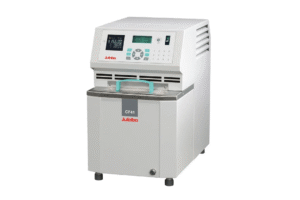
A temperature control unit, or TCU, circulates a heat-transfer fluid through equipment such as a jacketed vessel, condenser, evaporator, cold trap, or extraction system. Depending on the application, the TCU may remove heat, add heat, or do both.
But process conditions aren’t static.
Material enters the system. Solvents evaporate and condense. Flow rates change. Equipment heats up. Production runs get longer. All of these variables can change the thermal load placed on the system.
A properly sized TCU has to keep up.
This is why processors shouldn’t evaluate cannabis extraction chillers or heating circulators based solely on the lowest or highest temperature printed on a specification sheet. Cooling capacity, heating capacity, circulation rate, pump performance, heat-transfer fluid, equipment size, and process conditions all matter.
In other words, reaching the right temperature is only part of the job. Holding it when the process is actually running is what counts.
Where Temperature Control Shows Up in Cannabis Processing
Follow a cannabinoid from plant material to a refined ingredient, and you’ll find heating and cooling equipment throughout the workflow.
Depending on the extraction and post-processing methods being used, temperature control can support:
- Ethanol, hydrocarbon, and CO₂ extraction
- Winterization and filtration
- Solvent recovery
- Decarboxylation
- Falling film evaporation
- Short path and wiped film distillation
- Condensation and cold traps
- Isolation and crystallization
Different processes place very different demands on a temperature control system. That’s why there isn’t one universal “cannabis chiller” that makes sense for every application. JULABO, for example, identifies heating circulators, refrigerated circulators, recirculating chillers, and dynamic temperature control systems across different cannabis extraction and post-processing applications.
Understanding the application comes first.
Extraction: Sometimes Colder Really Is Better
Temperature can influence extraction long before crude oil ever reaches a distillation system.
In ethanol extraction, for example, processors commonly use low temperatures as part of the extraction strategy. Hydrocarbon systems also depend heavily on cooling and heating at different stages of the process. With CO₂ extraction, temperature works alongside pressure to control the state and behavior of the solvent.
The important point isn’t that every extraction process needs to be as cold as possible. It doesn’t.
The goal is controlled conditions appropriate for the solvent, equipment, biomass, and desired extract.
And once production scales, maintaining those conditions becomes more demanding. Cooling a small laboratory vessel is one thing. Continuously removing heat from a production-scale process is another.
That’s where cooling capacity becomes especially important.
A chiller may technically have a working range that reaches the desired temperature, but processors also need to know how much cooling capacity it can deliver at that temperature. Cooling performance generally changes as operating temperatures drop, meaning the number on the front of the brochure doesn’t tell the entire story.
Distillation Is a Balancing Act
Temperature control becomes even more visible during cannabis distillation.
In wiped film distillation, crude oil travels across a heated evaporator surface as a thin film under vacuum. Volatile compounds evaporate and are subsequently condensed and collected, while heavier material continues through the system.
Several thermal zones may be working simultaneously.
The feed may need to be heated. The evaporator needs controlled heating. The internal condenser needs its own temperature conditions. Cold traps may require significantly colder temperatures to capture compounds before they reach the vacuum system.
Those zones aren’t independent of the rest of the process. Temperature works alongside feed rate, vacuum depth, material composition, and residence time to influence separation and system performance. JULABO similarly notes that wiped film process optimization involves the relationship between feed rate, vacuum, and temperature.
This is also one of the reasons wiped film distillation is so useful for cannabinoid processing. Creating a thin film increases exposure to the heated surface while keeping residence time relatively short, helping processors perform separation without unnecessarily extending the material’s exposure to elevated temperatures.
The heater isn’t simply making the evaporator “hot.”
It’s helping create and maintain one of the operating conditions that makes the separation possible.
Don’t Forget the Condenser
Heating gets a lot of attention during distillation, but condensation is just as important.
After a compound evaporates, it needs somewhere to go.
The condenser provides the temperature conditions necessary to turn those vapors back into a liquid so they can be collected. If the condenser temperature isn’t appropriate for the process, separation and collection can suffer.
The same principle applies to cold traps. These systems help capture volatile compounds before they continue downstream toward the vacuum pump.
So while an operator may be watching evaporator temperature closely, the cooling side of the system is doing equally important work.
A good distillation setup isn’t simply hot on one side and cold on the other. It’s a series of intentionally controlled temperature zones working together.
Winterization, Solvent Recovery, and Crystallization Have Their Own Demands
Temperature control doesn’t stop after extraction or distillation.
During winterization, cooling helps facilitate the precipitation of unwanted waxes and lipids so they can be removed through filtration.
During solvent recovery, heat is used to evaporate solvent while cooling supports condensation and collection.
Crystallization introduces another challenge entirely. Jacketed reactors allow processors to control temperature as cannabinoids begin to nucleate and form crystals. Cooling rate, temperature stability, agitation, concentration, and time can all influence the crystallization process.
The common thread is repeatability.
Processors aren’t heating and cooling material simply because a procedure calls for it. They’re creating controlled process conditions that they need to reproduce batch after batch.
Choosing a Temperature Control Unit: Look Beyond the Temperature Range
It’s tempting to start equipment selection with one question:
“How cold does it get?”
Or:
“How hot does it get?”
Those are important questions, but they shouldn’t be the only ones.
When sizing temperature control equipment for cannabis or hemp processing, processors should also consider the required heating or cooling capacity at the actual operating temperature, the volume and type of heat-transfer fluid being circulated, pump flow and pressure, hose length and diameter, equipment jacket volume, ambient conditions, desired ramp-up or pull-down time, electrical requirements, and whether the application requires heating, cooling, or both.
Even the thermal fluid matters. Its viscosity and heat-transfer characteristics change across temperature ranges and can affect circulation and system performance. JULABO specifically notes that viscosity, oxidation characteristics, and heat-transfer properties should be considered when pairing thermal fluids with temperature control equipment.
This is why simply matching a TCU’s temperature range to an equipment specification can lead to problems.
Two units capable of reaching -40° C on paper may behave very differently when connected to a real process under load.
The Right TCU Depends on the Process
There is no single temperature control configuration that makes sense for every cannabis processing facility.
A benchtop R&D setup has very different requirements from a commercial extraction operation. A wiped-film evaporator doesn’t place the same thermal demands on a TCU as a crystallization reactor. And a processor running continuously needs to think differently about capacity than a facility running occasional batches.
Root Sciences offers temperature control solutions from JULABO and Huber across laboratory, pilot, and production-scale applications. Our available equipment includes refrigerated heating circulators, heating circulators, chillers, and dynamic temperature control systems designed for a range of cannabis and hemp processing requirements.
For example, compact refrigerated/heating circulators can provide both heating and cooling for applications where space is limited, while larger or more dynamic systems may be necessary when the process introduces substantial thermal loads or requires faster temperature changes. Root Sciences’ current temperature control lineup spans equipment with considerably different temperature ranges, pump capacities, and heating and cooling capabilities for exactly this reason.
The objective isn’t to buy the biggest chiller or most powerful heater available.
It’s to properly match the temperature control system to the process.
Better Temperature Control Starts With Understanding the Whole System
Temperature control equipment tends to sit quietly beside the more visually impressive machinery in a processing facility. But when it isn’t sized correctly, processors notice quickly.
Slow cooldown times, difficulty maintaining setpoints, inconsistent condensation, extended warm-up periods, and process instability can all point back to the thermal side of the system.
That’s why temperature control should be considered when the process is being designed, not after every other piece of equipment has already been selected.
The extractor, reactor, evaporator, condenser, vacuum system, pumps, and TCUs all have to operate as a system.
When those pieces are properly matched, temperature becomes something operators can control rather than something they’re constantly chasing.
And in cannabis and hemp processing, that kind of control is what helps turn a process that works into a process that works consistently.