
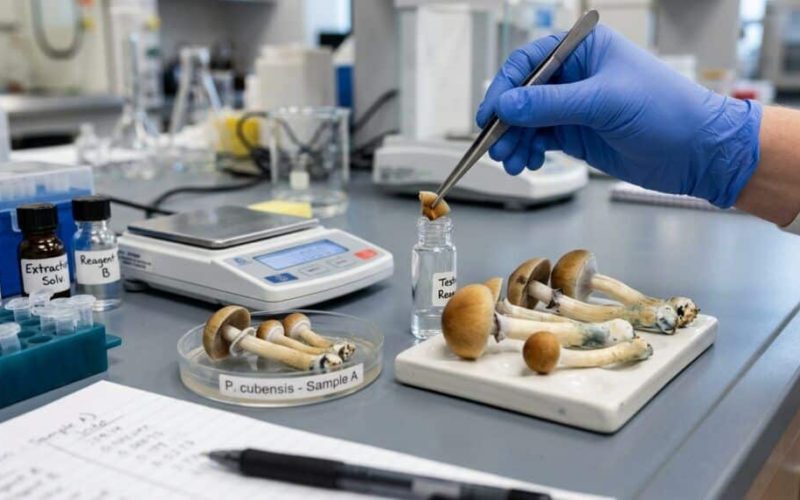
Weighing mushrooms has never been the same as dosing them. Two products that look identical, come from the same strain, and weigh the same gram for gram can produce completely different experiences. The only variable that actually determines what someone receives is the concentration of active compounds in that specific batch and that is exactly what psilocybin potency testing measures.
As regulated markets in Oregon and Colorado mature, as clinical trials expand globally, and as harm reduction becomes a more mainstream conversation, accurate potency data has moved from a nice-to-have to a legal requirement and a clinical necessity. This guide covers everything you need to know about how testing works, what your lab report is actually telling you, which analytical methods labs use and where each one falls short, what full compliance testing requires in 2026, and how to spot a COA that should not be trusted.
Please Note: Regulations, testing standards, and compliance requirements in the psilocybin space are evolving rapidly. While we have done our best to reflect the most current information available, rules can change and vary by jurisdiction. We strongly recommend verifying any regulatory details, formulas, thresholds, or compliance requirements directly with the relevant authority, such as Oregon Psilocybin Services, your state’s regulatory body, or a qualified legal or scientific professional, before making any business, clinical, or compliance decisions based on this content.
Sections
ToggleWhy Psilocybin Potency Cannot Be Predicted by Weight Alone
The core problem with weight-based dosing is that mushrooms are biological products, not pharmaceutical tablets. A tablet contains a measured quantity of active ingredient added during manufacturing. A mushroom produces its active compounds through a biological process that is shaped by dozens of variables, none of which are visible on the outside.
Strain genetics set the baseline range for how much active compound a mushroom can produce. Different strains of the same species can sit at very different ends of that range. Two products that are both Psilocybe cubensis and both dried to the same moisture content can still deliver completely different potency levels depending on which strain they came from and how they were grown.
Growing conditions shape what genetics can actually express. The substrate the mushrooms develop on, the temperature during cultivation, humidity levels, CO2 concentration, and light exposure all interact with genetics to determine the final alkaloid profile. The same strain cultivated under different conditions will not reliably test the same.
Harvest timing introduces another layer of variability. Mushrooms that are harvested earlier in their development tend to carry higher concentrations of active compounds. Allowing them to grow longer increases yield but often reduces concentration per gram. This creates a direct trade-off that producers manage through testing rather than guesswork.
The part of the mushroom matters too. Caps consistently carry higher concentrations of active compounds than stems. A product made primarily from stems will not deliver the same potency as one made predominantly from caps, even at identical weights.
Storage and drying conditions affect how stable the active compounds remain after harvest. Products that were not properly dried or have been stored in warm, humid, or light-exposed conditions can lose potency over time. This means a batch that tested correctly at production may not test the same months later if storage was not controlled.
All of this adds up to a simple reality. Weight is not dose. Potency testing is the only way to know what a product actually contains.
What Psilocybin Potency Testing Actually Measures
A potency test returns compound concentrations, typically expressed as milligrams per gram or as a percentage of dry weight. But those numbers only tell the full story if you understand which compounds were measured and what each one represents.
Psilocybin and Psilocin: Why Both Must Be Reported Separately
Psilocybin is the compound that occurs naturally in the mushroom in its highest concentrations. It is a prodrug, meaning the body converts it into psilocin after ingestion through a process called dephosphorylation. Psilocin is the active form that produces the psychedelic effects through serotonin receptor activity in the brain.
On a lab report you want both listed as separate values because they are not equivalent and their ratio varies between products and batches. Psilocybin is stable and holds up well in properly dried and stored mushroom material. Psilocin is less stable and degrades more readily when exposed to oxygen, light, or heat. Fresh mushrooms, poorly dried batches, or products with inadequate storage may carry significant psilocin content while well-dried and properly stored products typically show much lower psilocin levels alongside their psilocybin concentration.
A report that only lists psilocybin and ignores psilocin may be underreporting total active content for any product where psilocybin-to-psilocin conversion has occurred. Oregon’s rules address this directly. Under OAR 333-333, labs must report psilocybin analyte and psilocin analyte as separate values expressed in milligrams per gram and must calculate Total Potential Psilocin, which estimates the full amount of psilocin that will be available to the user after conversion. Product labels must include psilocybin content in milligrams and the Total Potential Psilocin value is published in the Product Information Document for each batch.
Baeocystin, Norbaeocystin, and the Minor Tryptamine Alkaloids
Most psilocybin-containing mushrooms also carry smaller amounts of structurally related compounds including baeocystin and norbaeocystin. These are analogue compounds found in lower concentrations and their individual pharmacological contributions are still being studied.
Oregon requires both to be included in a compliant potency panel. Even in markets where reporting is not yet mandated, a thorough potency profile includes them because two products with identical psilocybin readings but different minor alkaloid profiles can produce meaningfully different experiences. As regulated markets mature, full tryptamine alkaloid panels are becoming the standard rather than the exception.
Total Potential Psilocin: The Number Oregon Requires
Heads up: The formula and reporting requirements below are based on Oregon’s administrative rules as understood at the time of writing. These rules are subject to ongoing review and revision by Oregon Psilocybin Services. Before relying on this for compliance purposes, verify the current formula directly at oregon.gov/psilocybin or with your ORELAP-accredited laboratory.
Oregon’s administrative rules define a specific formula for calculating Total Potential Psilocin. It is calculated as: milligrams per gram psilocin analyte plus 0.719 multiplied by milligrams per gram psilocybin analyte. This formula accounts for the molecular weight conversion and estimates how much psilocin will ultimately be available to the user after full metabolic conversion of the psilocybin present. This is the figure that determines session duration guidance and safety parameters under the Oregon program.
Understanding this formula matters for producers because it means a product with a high psilocybin analyte reading and a low psilocin reading will still carry a significant Total Potential Psilocin value once the conversion factor is applied.
How a Psilocybin Potency Test Actually Works: The Step-by-Step Process
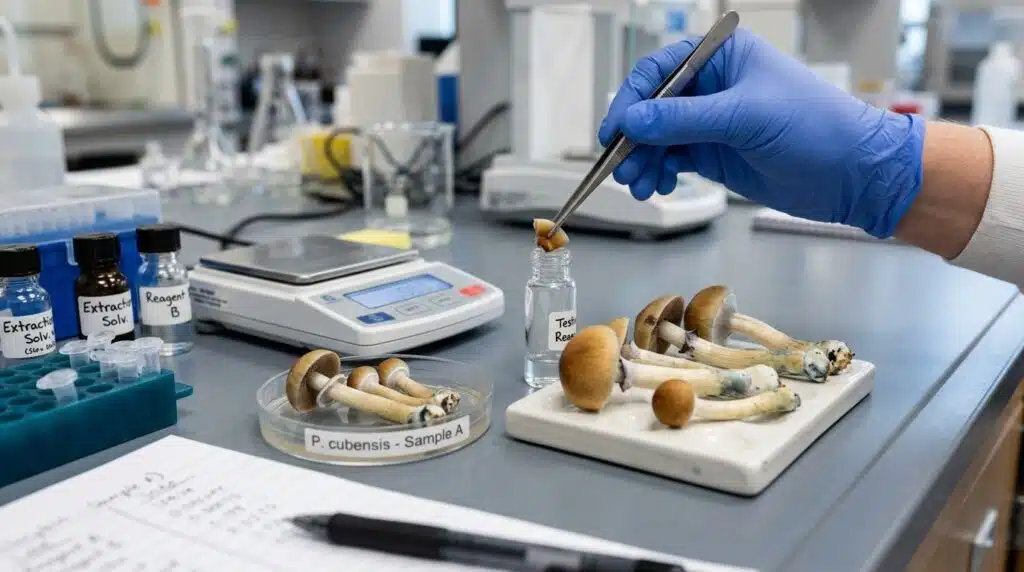
Understanding the lab workflow from sample collection through final report helps you evaluate whether your lab is running the process correctly and catch problems before they become compliance failures.
Step 1: Batch Sampling
The sampling process is where most potency errors originate. Because individual mushrooms within the same batch vary in concentration, testing a single mushroom only tells you about that mushroom. It tells you nothing reliable about the rest of the batch.
Oregon’s rules are specific on this point. The details below reflect our understanding of current OAR 333-333 requirements. Since Oregon’s testing rules are actively updated, always confirm the latest batch size limits, sampling procedures, and submission requirements directly with OPS or your accredited lab before submitting a product for compliance testing.
Manufacturers are responsible for ordering compliance tests and can only submit one test per harvest lot or process lot. Whole dried fungi must be separated into batches no larger than one kilogram before sampling. Sampling must be carried out by personnel employed by an ORELAP-accredited laboratory. Each sample must be labeled with the harvest or process lot number and the laboratory name.
For products outside regulated markets, the principle is the same. A representative sample should be drawn from across the full batch, not from a single mushroom or a single section of the batch.
Step 2: Homogenization
Once the sample arrives at the lab, it is ground into a fine, uniform powder before any analysis begins. This homogenization step is critical because it averages out the natural concentration differences between individual mushrooms in the sample. Testing before homogenization, or testing a sample that was not drawn representatively from across the batch, are the two most common causes of potency results that do not reflect the actual product.
For edibles, extracts, and processed products, homogenization requirements vary based on the product format, but the principle of ensuring a representative, evenly distributed sample applies across all product types.
Step 3: Extraction
The homogenized material is treated with a solvent to pull the active compounds into solution. Methanol and aqueous methanol mixtures are the most common extraction solvents for psilocybin work. Oregon’s rules specify approved solvents for manufacturers and the same logic applies to extraction in testing contexts. The extraction process typically takes several hours and is designed to maximize compound recovery while leaving the mushroom matrix behind.
Psilocin stability is a genuine concern during this step. Because psilocin is more prone to oxidation than psilocybin, labs need to control light exposure, temperature, and the time elapsed between extraction and analysis to ensure the psilocin reading reflects what was actually present in the sample rather than a degraded fraction.
Step 4: Chromatographic Analysis
The prepared extract is injected into the analytical instrument. In HPLC-based methods, the instrument passes the extract through a column where compounds separate based on their chemical interactions with the column and mobile phase. Each compound elutes at a characteristic time and is detected by its UV light absorbance, with psilocybin and psilocin detected at specific wavelengths. The instrument produces a chromatogram with distinct peaks for each compound that the software identifies and quantifies.
In LC-MS/MS workflows, this separation step is followed by mass spectrometric detection. Each compound is identified not only by its retention time but by its molecular mass and fragmentation pattern. This double confirmation makes LC-MS/MS more specific and more sensitive than UV detection alone.
Step 5: Quantification and Reporting
The instrument compares each detected peak against a calibration curve built from certified reference standards at known concentrations. The accuracy of the final result depends on the quality of those reference standards, the validation of the method across the relevant concentration range, and the lab’s documented quality management procedures.
Under Oregon rules, the final report must include psilocybin analyte and psilocin analyte values in milligrams per gram, the calculated Total Potential Psilocin, the analytical method used, the batch and lot identifiers, and the lab’s accreditation details. Results must be reported within 24 hours of data review for failed tests. Labs must hold a DEA Schedule I researcher registration to legally handle psilocybin-containing samples anywhere in the United States.
Analytical Methods Compared: HPLC, LC-MS/MS, GC-MS, and Beyond
The method your lab uses is not a minor technical detail. It determines what can and cannot be accurately measured and whether the results are defensible for compliance or clinical purposes.
1. HPLC with UV or Diode Array Detection
HPLC-UV and HPLC-DAD are the most widely deployed methods for routine psilocybin potency testing across both compliance and research settings. The method separates psilocybin and psilocin as distinct peaks in a single run and can simultaneously measure baeocystin and norbaeocystin without requiring the sample to be chemically modified beforehand. It is practical, well-validated for mushroom matrices, and the method behind most portable in-house testing devices.
The key advantage over GC-MS is that HPLC does not expose the sample to high temperatures. Psilocybin and psilocin are thermally sensitive and degrade at the temperatures required for gas chromatography. HPLC keeps compounds in the liquid phase throughout separation, which preserves their integrity and allows accurate independent quantification of both.
2. LC-MS/MS
Liquid chromatography with tandem mass spectrometry is the gold standard for precision and specificity. It provides compound identification based on molecular mass and fragmentation patterns in addition to chromatographic retention time, which makes it far more resistant to interference from co-eluting compounds in complex mushroom matrices. This is the method used in clinical trial settings and pharmaceutical development where results must meet regulatory submission standards.
The trade-off is higher instrumentation cost and the need for operators with specialized expertise in mass spectrometry. For routine compliance testing at scale, HPLC-DAD is often more practical. For any use case where results will be submitted to a regulatory authority or used to establish clinical dosing protocols, LC-MS/MS is the appropriate choice.
3. GC-MS: Why It Is Not the Right Tool Here
Gas chromatography-mass spectrometry is a powerful analytical technique but it has a well-documented limitation for psilocybin work that makes it unsuitable as a primary method. The high temperatures required for gas chromatography cause psilocybin to thermally degrade into psilocin before it can be measured. This means a GC-MS method cannot accurately quantify psilocybin and psilocin independently in the same run without derivatization steps that add complexity and introduce additional sources of analytical error.
If a lab tells you they are running GC-MS as their primary method for psilocybin potency testing, that is a flag worth asking about. LC-based methods are the established and appropriate choice.
4. UPLC and UHPLC
Ultra-Performance and Ultra-High-Performance Liquid Chromatography are higher-pressure variants of standard HPLC that use finer particle sizes to achieve faster separation with equivalent or better resolution. For high-volume labs running large numbers of compliance samples, the throughput advantage is meaningful. The instrumentation is more demanding and requires higher operating pressures, but the underlying analytical chemistry is the same as standard HPLC.
5. Colorimetric and Reagent Tests
Color-change reagent tests can indicate whether psilocybin is present in a sample but they cannot tell you how much. They are useful for basic field screening and harm reduction contexts where the goal is presence or absence rather than quantification. They are not appropriate for compliance reporting, clinical dosing, or any context where a specific concentration value is needed.
Beyond Potency: What a Complete Compliance COA Requires
A certificate of analysis for a regulated market product covers more than just the active compound concentrations. Oregon’s framework specifies the full panel that must be completed before a product can reach a service center.
- Species Identification is required in Oregon to confirm that the product contains Psilocybe cubensis. The first harvest of the year requires specification testing and monthly testing thereafter to verify species identity. Oregon’s program only permits Psilocybe cubensis as the approved species for regulated products.
- Heavy Metals including lead, cadmium, arsenic, and mercury must be tested upon written request from the Oregon Health Authority. Mushrooms are known bioaccumulators, meaning they absorb metals from their growing substrate. A batch that fails heavy metals testing must be destroyed under Oregon rules.
- Pesticide Residues testing is required upon written request. Wood-based substrates and other growing media can carry pesticide residues that transfer to the fruiting body. Oregon prohibits manure in psilocybin production and requires fecal contamination assessment including E. coli testing if any is found.
- Solvent Residues are tested for products that involved extraction during manufacturing. Oregon specifies approved solvents including water, vegetable glycerin, acetic acid, ethanol, and methanol.
- Microbiological Safety covers pathogen screening and contamination levels. Improperly dried or stored mushroom products carry genuine microbial risk and failing microbiological testing results in batch destruction.
The Regulatory Landscape for Psilocybin Testing in 2026
Important: Regulatory programs for psilocybin are among the fastest-changing areas of law and policy globally. The information below reflects our best understanding as of mid-2026. Requirements in Oregon, Colorado, Australia, and other jurisdictions are subject to revision. Always verify current rules with the relevant regulatory authority or a qualified compliance professional before making any decisions based on this section.
Oregon: The Most Developed State Framework
Oregon operates the most mature state-level psilocybin regulatory framework in the United States under Measure 109, now codified as ORS 475A. All psilocybin products must be tested by laboratories that hold both an Oregon Psilocybin Services laboratory license and ORELAP accreditation before reaching licensed service centers.
The required potency panel reports psilocybin analyte and psilocin analyte separately in milligrams per gram, plus the calculated Total Potential Psilocin figure. Batch sizes for whole dried fungi are capped at one kilogram. Only one compliance test per harvest or process lot is permitted. Failed tests must be reported to the tracking system within 24 hours. Products may not exceed a psilocybin content of 20%.
In 2026, Oregon convened a Psilocybin Product Potency Workgroup specifically to address potency formula considerations and safety concerns related to high-psilocin products. The workgroup included licensed manufacturers, laboratories, and ORELAP representatives, signaling that Oregon’s testing framework continues to evolve.
1. Colorado: Natural Medicine Access Program
Colorado’s program under Proposition 122 created licensed healing centers for supervised adult sessions. The Department of Regulatory Agencies oversees testing requirements and the state issued its first licenses in early 2025. Testing requirements align broadly with Oregon’s framework.
2. New Mexico
New Mexico passed legislation in 2025 establishing a therapeutic psilocybin program. Testing standards are still being developed.
3. Australia
Australia became the first country to authorize psilocybin as a nationally scheduled controlled medicine under the Therapeutic Goods Administration framework. Authorized psychiatrists can prescribe it for treatment-resistant depression. Products used under this framework must meet pharmaceutical quality and testing standards.
4. Canada
Health Canada’s Special Access Program allows access for patients with serious conditions when conventional treatments have failed. Clinical trial products must meet Health Canada’s pharmaceutical testing requirements under a separate Clinical Trial Authorization.
International Clinical Trials
Clinical trials conducted under regulatory oversight including the European Medicines Agency must meet pharmaceutical-grade testing standards for characterization, impurity profiling, stability, and manufacturing controls for the investigational product regardless of whether it is synthetic or derived from mushrooms.
In-House Testing vs. Third-Party Accredited Labs: Which Is Right for Your Operation
This is a practical decision that affects both workflow efficiency and compliance.
Third-party accredited laboratory testing is mandatory for regulatory compliance in Oregon and Colorado. It is also the only appropriate choice for clinical research, pharmaceutical development, and any situation where results will be submitted to a regulatory body. Accredited labs provide validated methods, certified reference standards, documented quality management systems, and independence that in-house results cannot provide for official purposes. In the United States, the lab must also hold DEA Schedule I researcher registration to legally handle and test psilocybin-containing samples.
In-house testing using portable HPLC instruments makes practical sense for producers doing ongoing quality monitoring, strain selection, harvest timing decisions, and production-stage quality control where the purpose is operational decision-making rather than regulatory submission. The upfront cost of an in-house instrument is higher than a single third-party test, but for operations running frequent checks across multiple batches, the per-sample cost over time is substantially lower.
The most practical approach for licensed producers is to use in-house screening throughout the production and cultivation cycle and send each final batch to an accredited third-party lab for the compliance COA required before product release.
How to Read Your COA: What to Look For and What to Question
Note: The COA requirements listed below are based on Oregon’s compliance framework and general industry best practices. Requirements differ between jurisdictions and may have been updated since this was written. If you are operating in a regulated market, confirm the exact COA requirements with your licensing body or accredited testing laboratory before product release.
Knowing what a trustworthy COA looks like helps you catch problems before they become compliance issues or safety concerns.
What a complete and trustworthy COA includes:
The lab’s full name and ORELAP accreditation number should be clearly stated. The report should list psilocybin analyte and psilocin analyte as separate milligrams per gram values, not combined. The Total Potential Psilocin calculation should be present for Oregon compliance products. The batch ID, lot number, sample weight, and date of sample receipt should all be confirmed. The analytical method should be referenced by name. Limits of quantitation should be listed for each analyte, and compounds detected below the LOQ should be flagged as such rather than simply reported as zero or absent.
What should prompt further questions:
A COA that only lists a combined psilocybin figure with no separate psilocin value is incomplete. Missing baeocystin and norbaeocystin on a COA intended for Oregon compliance means it does not meet the required panel. No accreditation details or method reference means the results cannot be independently verified. Potency figures without a moisture content or dry-weight basis statement make the numbers ambiguous. Any United States lab without DEA Schedule I registration cannot legally handle psilocybin samples and results from such a lab are not valid for any regulated market purpose.
Conclusion
Psilocybin potency cannot be assumed, estimated by weight, or guessed from a strain name. The only way to know what a product actually contains is to test it properly, with the right method, a representative sample, and a lab that is accredited and legally authorized to handle it.
As regulated markets grow and clinical applications expand, accurate potency data is becoming the foundation that everything else is built on. Producers need it for compliance. Clinicians need it for dosing. Patients and consumers need it for safety.
Use this guide as your starting point, but always verify the specifics for your jurisdiction directly with the relevant regulatory authority before acting on anything compliance related. The rules in this space move fast and the stakes are too high to rely on any single source.
FAQs
Psilocybin potency testing is the laboratory analysis of mushroom or mushroom-derived products to measure the concentration of active compounds, primarily psilocybin and psilocin, along with minor alkaloids including baeocystin and norbaeocystin. Results are used to establish accurate dosing parameters, verify batch-to-batch consistency, meet regulatory labeling requirements, and support clinical research protocols.
LC-MS/MS offers the highest level of specificity and sensitivity and is the standard for clinical research and pharmaceutical development. HPLC with UV or diode array detection is more widely used for routine compliance testing because it is practical, well-validated, and capable of independently quantifying psilocybin, psilocin, and the minor alkaloids in the same run without requiring sample derivatization.
In Oregon and Colorado, testing by an accredited laboratory is required before any product can enter the licensed regulated market. Australia requires pharmaceutical-grade testing for therapeutically authorized psilocybin products. Clinical trial materials must meet regulatory testing standards in any jurisdiction where trials are conducted. In most other jurisdictions testing is not yet legally mandated for all uses, but it is standard practice for clinical research and expected for any commercial product in an emerging regulated market.
A complete certificate of analysis should include the lab’s name and accreditation number, the batch and lot identifiers with sample receipt date, separate milligrams per gram values for psilocybin analyte and psilocin analyte, the calculated Total Potential Psilocin, baeocystin and norbaeocystin values for full compliance panels, heavy metals results, pesticide residues, solvent residues where applicable, microbiological safety data, moisture content, and the analytical method reference.