
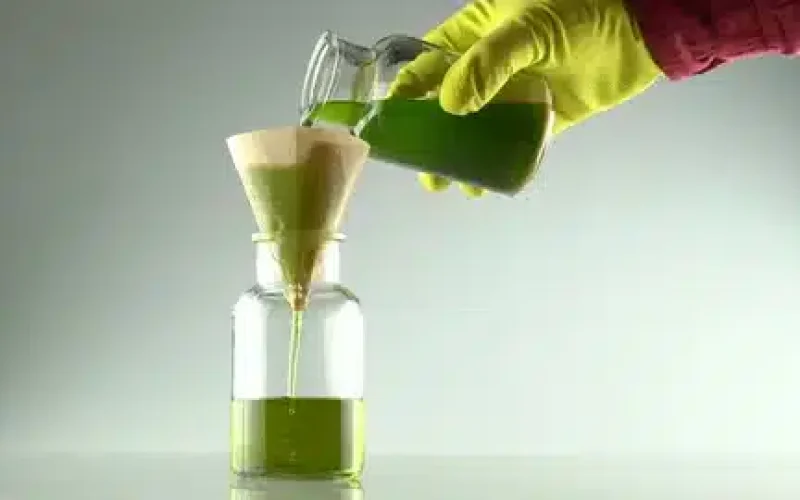
Cannabis Extraction Filter media selection should be driven by the finished product’s requirements, fine diatomaceous earth for shatter-grade clarity, coarser media for live resin to preserve terpenes, activated carbon or bleaching earth for color remediation, and sequential DE, carbon, and membrane filtration for isolate-grade purity, rather than a single default media used across every product line.
This guide breaks down which media fits which goal, the mechanics behind why, and how to combine media across a multi-stage filtration sequence.
Sections
ToggleKey Takeaways
- Filter media choice should start from the finished product’s requirements, clarity, terpene retention, color, or purity, not from whatever media is already on hand.
- Finer micron ratings improve clarity and purity but reduce flow rate and can strip more terpenes along with the impurities being targeted.
- Activated carbon works by adsorption, not straining, which is why dose and contact time matter as much as the carbon’s micron rating for color remediation.
- Membrane nanofiltration (OSN) operates at a molecular scale far finer than traditional filter media, suited to isolate-grade purity rather than routine winterization filtration.
- Most commercial operations use a staged sequence of media, coarse to fine, rather than relying on a single filter media to hit every quality target in one pass.
Filter Media by Product Goal at a Glance
Product Goal | Recommended Media | Typical Micron Range |
Maximum clarity (shatter, sauce) | Fine diatomaceous earth (DE), polishing pads | 1-5 microns |
Terpene preservation (live resin) | Coarse to medium DE, minimal carbon | 10-25 microns |
Color remediation (vape, distillate feedstock) | Activated carbon, bleaching earth, or a carbon/DE blend | 5-25 microns, carbon dose-dependent |
Isolate-grade purity | Sequential DE, carbon, and membrane nanofiltration | Sub-5 micron down to molecular-scale (OSN) |
Maximum Clarity: Shatter and Sauce
Shatter and sauce are judged visually as much as by potency, so the filtration target here is removing every trace of particulate that would cloud the final product. This generally means:
- Fine-grade diatomaceous earth: in the 1 to 5 micron range, fine enough to catch particulate that coarser media passes through
- A polishing pass: a final fine-media pass after the primary filtration stage, specifically to catch what the first pass missed
- Minimal carbon: used only if color is also an issue, since carbon adsorbs more than pigment and can affect the terpene profile that gives sauce its character
The tradeoff at this end of the spectrum is flow rate: finer media clogs faster and processes more slowly, which is a reasonable cost for a product where visual clarity is the primary value driver.
Terpene Preservation: Live Resin
Live resin’s value is built almost entirely on terpene retention, which flips the filtration priority compared to shatter: the goal is removing just enough particulate for a clean product without stripping the compounds that make the product worth a premium in the first place
- Coarser DE grades: in the 10 to 25 micron range, enough to clear particulate without the aggressive surface area of finer media
- Avoid carbon unless necessary: activated carbon’s broad adsorption profile removes terpenes along with pigment, working against the product’s core value proposition
- Shorter contact time: minimizing how long the extract sits in contact with any filter media reduces cumulative terpene loss across the process
Color Remediation: Vape and Distillate Feedstock
For product lines where color and clarity matter more than preserving a specific terpene profile, activated carbon and bleaching earth are the standard tools, and understanding how they actually work changes how they should be used. Peer-reviewed research on activated carbon’s microporous structure has found that chlorophyll removal happens through adsorption, pigment molecules binding to the carbon’s internal surface area, rather than physical straining, which means carbon dose and contact time matter as much as the carbon’s particle size for effective color remediation.
- Activated carbon: targets chlorophyll and other pigment compounds through adsorption; effectiveness scales with dose and contact time, not just quantity used
- Bleaching earth: often used alongside carbon rather than instead of it, since the two adsorb somewhat different compound classes
- DE as a carrier layer: frequently blended with carbon to improve flow through the filter bed, since carbon alone can be too fine and slow on its own
Isolate-Grade Purity
Isolate and high-purity crystalline products need filtration that goes beyond what traditional DE and carbon media can achieve alone, which is where membrane nanofiltration becomes relevant. Organic solvent nanofiltration (OSN) separates at a molecular scale, a comprehensive review in Chemical Reviews describes OSN as capable of separating molecules in roughly the 200 to 1,000 dalton range within organic solvents, well beyond the particulate-scale separation traditional filter media performs.
For cannabis processing specifically, this translates to separating cannabinoids, pesticides, and lipids from solvent with much finer control than a DE or carbon pass can offer, at lower thermal exposure than distillation-based separation.
- Sequential traditional media first: DE and carbon still handle the bulk particulate and color removal before finer separation is worth applying
- Membrane nanofiltration for final purity: applied after traditional media has done the coarse work, not as a replacement for it; Root Sciences’ membrane nanofiltration equipment is built specifically for this final-stage role rather than as a general-purpose filtration system
- Lower thermal exposure: membrane separation runs without the heat distillation requires, an advantage for heat-sensitive minor cannabinoids
Filter Media Types Explained
Beyond DE, carbon, and membranes, a handful of other media show up regularly across post-processing equipment workflows in cannabis filtration, each with a specific role:
- Diatomaceous earth (DE): fossilized diatom remains forming a porous filter cake; the most widely used media for winterization filtration given its wide micron range and low cost
- Activated carbon: adsorbs pigments and odor compounds through its high-surface-area porous structure rather than physically straining them out
- Activated bentonite clay and bleaching earth: adsorbent clays used for color and impurity removal, often in combination with carbon
- Silica gel: used less commonly, typically for specific polishing applications where its adsorption profile fits the target compound
- Membrane nanofiltration: molecular-scale separation for high-purity applications, distinct in mechanism from the adsorptive and particulate-straining media above
According to a European Food Safety Authority assessment of activated carbon decontamination processes in oil refining, an industry with decades more regulatory scrutiny than cannabis processing, the effectiveness of an adsorptive filtration process depends on demonstrated, documented performance data specific to the process, not just the general properties of the media used, a standard worth holding cannabis filtration media selection to as well.
Micron Rating and Flow Rate Tradeoffs
Finer micron ratings and flow rate work directly against each other, and this tradeoff should be weighed against the actual product goal rather than defaulting to the finest available media. Root Sciences’ Infinity Filter Table uses a proprietary DE blend rated across a 5 to 25 micron range specifically to give operators that range within one system, rather than requiring separate equipment for coarse and fine filtration. A few practical implications worth planning around:
- Finer media clogs faster: more frequent media changes at the fine end of the range, which adds labor and processing time
- Coarser media processes faster but catches less: acceptable when the product goal doesn’t require maximum clarity or purity
- Batch size affects the tradeoff’s real-world impact: a slower flow rate matters more at industrial batch sizes than at craft scale, where absolute processing time differences are smaller
Combining Media in a Multi-Stage Filtration Sequence
Most commercial operations don’t rely on a single media pass to hit every quality target; they stage media from coarse to fine, each stage handling what it’s best suited for rather than asking one media type to do everything. A typical sequence for a high-purity product line:
- Stage 1, coarse DE: clears the bulk of precipitated waxes and particulate from winterization, protecting finer media downstream from premature clogging
- Stage 2, carbon or bleaching earth: targets color and pigment once the bulk particulate load is already cleared
- Stage 3, fine DE polish: catches remaining fine particulate for final clarity
- Stage 4, membrane nanofiltration (if isolate-grade purity is the target): applied last, once traditional media has already removed everything it’s capable of removing
Staging this way protects the more expensive fine media and membrane stages from bearing a particulate load they weren’t designed to handle efficiently, which is also why cannabis isolation and crystallization equipment built for this kind of sequential purification typically integrates filtration directly into the reactor rather than treating it as a separate standalone step.
Conclusion
Filter media selection is a product decision before it’s an equipment decision: shatter needs fine DE and minimal carbon, live resin needs coarse DE and almost no carbon at all, color remediation needs carbon or bleaching earth with dose and contact time managed deliberately, and isolate-grade purity needs traditional media staged ahead of membrane nanofiltration rather than either alone.
Matching media to the actual product goal, rather than running every batch through the same default filtration setup, is what separates consistent, on-spec output from one product line to the next.
FAQs
Can the same filter media be reused across multiple batches, or does it need to be replaced every run?
Most filter media, particularly DE and carbon, are single-use given how they work: DE forms a cake that becomes clogged with the material it filtered out, and carbon’s adsorption capacity is finite and doesn’t regenerate without specialized reactivation processes most facilities don’t perform in-house. Membrane filters are a partial exception, often cleanable and reusable for a defined number of cycles before replacement.
Does using activated carbon always reduce potency along with color?
Not necessarily, but it depends heavily on dose and contact time. Carbon’s adsorption is somewhat selective toward pigment and certain non-cannabinoid compounds, but excessive dose or extended contact time increases the risk of adsorbing cannabinoids along with the target pigments, which is why controlled, documented carbon dosing matters more than simply using enough carbon to guarantee color removal.
Is there a filter media that works for every product goal, simplifying inventory for a smaller operation?
A mid-range DE blend, similar to the 5 to 25 micron range common in commercial filter tables, functions as a reasonable general-purpose choice for operations not yet specializing heavily by product line. It won’t optimize any single product goal as well as a purpose-matched media choice, but it avoids the cost and complexity of stocking multiple specialized media for a facility still establishing its core product lines.
How does biomass quality affect filter media selection and consumption?
Lower-quality biomass, higher in plant lipids, chlorophyll, or particulate, increases the load on whichever filter media is used, meaning more media consumed per batch and more frequent stage changes regardless of which product goal is being targeted. Improving biomass quality and winterization efficiency upstream reduces filtration media cost more reliably than optimizing media selection alone.
Do different extraction methods (hydrocarbon, ethanol, CO2) require fundamentally different filter media, or does the same media work across methods?
The same core media types generally apply across methods, but the load each method presents differs: ethanol crude typically carries more chlorophyll and lipid load requiring heavier winterization and filtration, while hydrocarbon and CO2 crude generally need lighter filtration given their more selective extraction chemistry. Media selection principles by product goal stay consistent; the volume and staging needed shifts based on how much the extraction method itself already cleaned up.