
Removing residual solvents from cannabis concentrates takes more than leaving an extract under vacuum. Washington’s rule, for example, allows 5,000 ppm for butanes, propane, and ethanol but only 290 ppm for hexanes, so the same purge can pass for one solvent and fail for another.
This guide explains why concentrates hold on to solvent, how removal works in stages, and how to confirm that a purge has finished.
Key Takeaways
This guide covers how processors remove residual solvents and how they check the result.
- Thick, viscous extract traps solvent, so a thin layer, heat, and deep vacuum do most of the work.
- Removal happens in stages: bulk recovery first, then purging, then a final step if the result still fails.
- Retailer guidance puts the layer at 3 to 5 mm and the vacuum at -25 to -29 inHg, repeated over 3 to 5 cycles.
- Ethanol is removed in bulk first, usually by rotary evaporation, because a vacuum oven alone is slow and can leave solvent deep in the material.
- A solvent panel confirms the purge, and ND does not mean zero.
The table lists the limits for selected solvents under Washington’s rule, which is used here as one worked example.
| Solvent | Limit (ppm) |
|---|---|
| Butanes (sum of isomers) | 5,000 |
| Propane | 5,000 |
| Ethanol | 5,000 |
| Pentanes (sum of isomers) | 5,000 |
| Methanol | 3,000 |
| Xylenes (sum of isomers) | 2,170 |
| Toluene | 890 |
| Dichloromethane | 600 |
| Hexanes (sum of isomers) | 290 |
| Benzene and chloroform | 2 |
Solvents not on the list fail above 5,000 ppm for class 3, 50 ppm for class 2, and 2 ppm for class 1.
Why Concentrates Retain Residual Solvents
A concentrate keeps solvent because the solvent is trapped inside a thick, sticky material and can only escape by moving to the surface and evaporating. Anything that slows that movement leaves more solvent behind.
- Thickness: solvent in the middle of a slab has the longest way out, so the center can hold solvent after the surface tests clean.
- Viscosity: cold, dense extract is stiff, so solvent moves through it slowly.
- Vacuum: a weak pump or a leaking chamber gives a shallow or uneven vacuum, so less solvent is pulled out.
- Time and handling: a short purge removes only the easy portion, and an extract that is not flipped or re-spread keeps solvent on its underside.
- Moisture: water in the extract keeps bubbling under vacuum and slows the purge.
Retention comes from the form of the extract and the way the purge is run, not from the solvent alone.
How Solvent Removal Works in Stages?
Removing solvent in one step is slow and unreliable, because a concentrate that starts out mostly solvent behaves very differently from one with only traces left. Processors split the job into stages, and each stage is built for a different amount of solvent.
Stage 1: Bulk Recovery
The aim is to take out as much solvent as possible while the extract is still fluid. Reduced pressure lets the solvent boil off at a low temperature, so the cannabinoids are not exposed to heat. For ethanol, a rotary evaporator typically runs at roughly 30 to 35°C under 40 to 50 mbar. In a closed-loop hydrocarbon system, the same job is done during collection: heating the collection pot pushes butane back to the cold solvent tank, where it is recovered for reuse. Bulk recovery brings the solvent load down from the main component to a small remainder, and it is where most of the solvent leaves.
Stage 2: Purging
What is left is held inside the thickened concentrate and cannot be boiled off in bulk. A purge handles it with a thin layer, gentle heat, and deep vacuum, held over repeated cycles. A common working range is a layer of 3 to 5 mm and a vacuum of -25 to -29 inHg. The purge removes the remainder slowly, which is why it only works well when Stage 1 has already done the heavy lifting.
Stage 3: A Final Step, If Needed
A batch that still fails after purging can be refined further. Distillation strips remaining solvent and refines the product at the same time, so it suits distillate more than shatter, wax, or sauce, where the aim is to keep the form and terpene profile.
Why the Order Matters
Each stage depends on the one before it. A purge asked to remove bulk solvent runs long and still risks a failed panel, while a purge that starts with a small remainder can finish on schedule. Running the stages in order also keeps heat on the product to a minimum.
Vacuum Purging
A vacuum purge uses a combination of heat, vacuum, surface area, and time. Lowering the pressure lets solvent leave at a lower temperature, so the extract does not have to be heated hard.
A working range for a vacuum oven is to spread the extract no thicker than 3 to 5 mm, preheat gently to 35 to 40°C if the material needs it, and pull a vacuum of -25 to -29 inHg. Hold the vacuum for 15 to 30 minutes until vigorous bubbling settles, then repeat the cycle 3 to 5 times as needed. These figures vary by equipment, so they work best as a starting point. The hydrocarbon extraction guide reports that shatter is spread thin on Teflon sheets and purged for at least 48 hours.
The same article gives a sense of scale. A 5-cubic-foot oven holds about 1,200 grams of concentrate, and each purge takes 48 hours, which it estimates would take at least six ovens to keep up with one extractor’s weekly output. Oven capacity becomes a production constraint.
Texture matters too. Wax is whipped for a couple of hours to release butane, and some operators blend propane with butane because it purges more efficiently, though it strips more terpenes.
Removing Ethanol With Rotary Evaporation
Ethanol is usually taken out in bulk before any purge. The rotary evaporator guide explains how reduced pressure lowers the boiling point, so ethanol leaves at roughly 30 to 35°C under 40 to 50 mbar. It recommends a bath 20 to 30°C above the solvent’s boiling point at the chosen vacuum and a 40°C gap between bath and condenser.
The reason to start here is that an extract with a high ethanol load is hard to finish in an oven. The material foams, bubbles persist, and the purge runs long. Removing the bulk first leaves the oven with a much smaller job.
Choosing equipment for solvent recovery and purging? Explore Root Sciences solvent recovery equipment.
Wiped Film Distillation as a Final Step
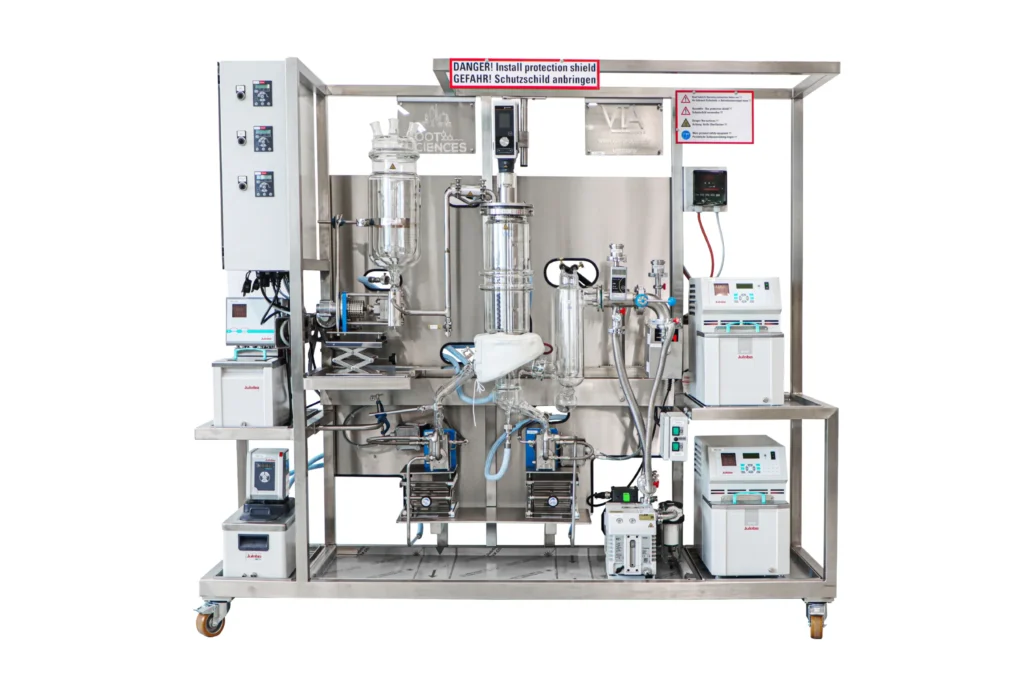
Some processors finish with distillation. The Cannabis Industry Journal column argues that vacuum ovens can leave solvent trapped deep in the material and that wiped film distillation is the appropriate final step. This is the author’s view and not a measured comparison. The wiped film distillation equipment suits distillate, where the product is refined as well as stripped.
Distillation changes the product, so it fits a distillate workflow. For a shatter, wax, or sauce, where the aim is to keep the form and terpene profile, a purge remains the working method.
Choosing a Method by Solvent and Product
The table summarizes where each method fits, based on the sources above.
| Method | Best for | Notes |
|---|---|---|
| Closed-loop recovery | Hydrocarbon systems during collection | Heating the collection pot returns butane to the tank |
| Rotary evaporation | Bulk ethanol removal | Roughly 30 to 35°C at 40 to 50 mbar for ethanol |
| Vacuum purge | Hydrocarbon concentrates such as shatter and wax | 3 to 5 mm layer, -25 to -29 inHg, repeated cycles |
| Wiped film distillation | Distillate and final stripping | Refines the product as well as removing solvent |
Knowing When the Purge Is Done
A purge is finished when the lab says so. Visual signs such as bubbling stopping are a guide to when to test, not a result.
Labs measure residual solvents mainly by headspace gas chromatography. A Restek chemist writing for Cannabis Industry Journal describes headspace as the most common technique: the sample is dissolved in a high-boiling solvent, heated to equilibrium, and about 1 mL of vapor is injected into the instrument.
Read the report carefully. Weedmaps notes that ND does not necessarily mean zero, since it means the amount was below the lab’s limit of quantitation, and a result should be matched to the correct batch. Processors who want faster feedback can build testing capacity, as the in-house cannabis testing guide explains.
Common Purging Mistakes
Most failed purges trace back to a few causes.
- Spreading the extract too thick, which traps solvent in the middle.
- Skipping flips or re-spreads, so one side keeps its solvent.
- Relying on a weak pump or a leaking chamber, which gives inconsistent vacuum.
- Cutting the purge short, or stopping after one cycle.
- Starting with too much bulk solvent still in the material.
- Packaging before the product has stabilized.
Matching the Method to the Product
Removing residual solvents is a staged job. Recover the bulk, purge what remains in a thin layer under deep vacuum, add a final step if needed, and confirm the result with a solvent panel.
A processor that picks the method by solvent and product, and that tests before a batch leaves the building, fails fewer panels and wastes less time in the oven.
Need help clearing residual solvents from your concentrates? Talk to the Root Sciences team about equipment for your process.
Frequently Asked Questions
Why is thickness so important in a vacuum purge?
Solvent has to travel through the extract to reach the surface before it can evaporate. In a thick slab, the solvent in the middle has the longest way out, so the center can still hold solvent when the surface tests clean. A layer of about 3 to 5 mm shortens that path. Flipping or re-spreading the extract during the purge also exposes fresh surface, so the underside keeps losing solvent too.
Should ethanol be removed before the vacuum oven?
Yes, in most cases. Ethanol is used in volume, so the extract starts out mostly solvent, and an oven alone is slow at clearing that much. A rotary evaporator removes the bulk at about 30 to 35°C under 40 to 50 mbar, which leaves the oven with a small remainder to deal with. The purge then finishes faster and with less heat on the product.
Does an ND result mean a concentrate has no solvent?
No. ND means “not detected,” which means the amount was below the lab’s limit of quantitation. That limit differs between labs, so a clean-looking result from one lab is not always the same as from another. The report should also be matched to the right batch before it is relied on, and a retest after any further purging confirms the change.
Why are some solvent limits so much lower than others?
Limits are set solvent by solvent, according to how much of each is considered acceptable in the finished product. Under Washington’s rule, butanes, propane, and ethanol are limited to 5,000 ppm, hexanes to 290 ppm, and benzene and chloroform to 2 ppm. A purge that clears butane can therefore still fail on a lower-limit solvent, so the solvent used in extraction sets the target for the purge.