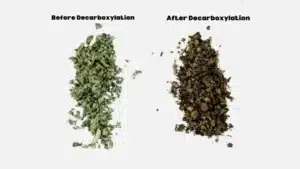
Getting cannabis decarboxylation temperature wrong is the fastest way to ruin potency. Too hot and THC degrades. Too low and the cannabinoids never fully activate – leaving you with weak, disappointing results.
Decarboxylation is the critical step that transforms raw cannabis from its acidic form (THCA) into psychoactive THC. Without this process, even the highest-quality flower won’t deliver the effects you’re expecting. Precision matters: temperature, timing, moisture content, grind consistency, and even airflow can all influence the final potency and flavor profile.
This guide breaks down the ideal temperature ranges, exact timing recommendations, preparation methods, advanced decarbing techniques, and storage best practices, so you can activate your cannabis efficiently, preserve terpenes, and achieve consistent, repeatable results every time.
Sections
ToggleWhat Is the Ideal Cannabis Decarboxylation Temperature and Time?
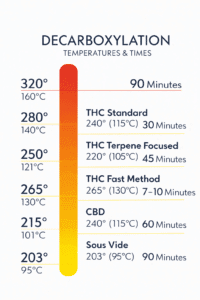
The ideal Cannabis Decarboxylation Temperature depends on whether you are activating THC or CBD and whether terpene preservation is a priority.
For most home users, 240°F is considered the optimal decarboxylation temperature for THC activation. It provides a reliable balance between potency and terpene retention.
Quick Reference Chart
Target Compound | Temperature | Recommended Time | Result |
THC Standard | 240°F (115°C) | 30 to 40 minutes | Balanced potency and flavor |
THC Terpene Focused | 220°F (105°C) | 45 to 60 minutes | Better aroma preservation |
THC Fast Method | 265°F (130°C) | 7 to 10 minutes | Faster activation with higher degradation risk |
CBD | 240°F (115°C) | 60 to 90 minutes | Longer activation required |
Sous Vide | 203°F (95°C) | 90 to 120 minutes | Maximum terpene retention |
Maintaining a stable Temperature matters more than rushing the process. If the temperature exceeds 300°F, cannabinoids begin degrading rapidly.
Want a full step-by-step guide?
Read our detailed tutorial on how to decarboxylate cannabis properly to learn the exact preparation, oven setup, and common mistakes to avoid.
What is Decarboxylation and its Benefits?
Decarboxylation is a chemical reaction triggered by heat. During this reaction, a carboxyl group is removed from cannabinoid acids, releasing carbon dioxide and converting them into active compounds.
Benefits include:
- Psychoactive activation of THC
- Improved medicinal effects of CBD
- More efficient oil infusions
- Greater control over potency
Correct temperature control is essential for achieving these benefits consistently.
The Different Methods of Decarbing Cannabis
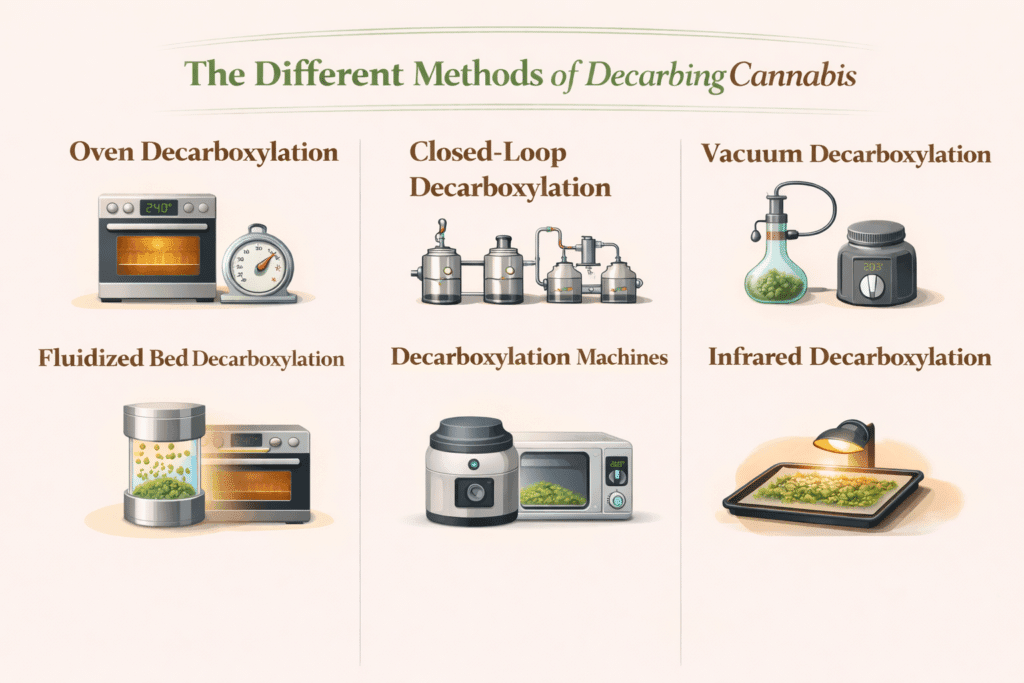
There are multiple ways to decarb cannabis. Each method relies on accurate Temperature control.
Oven Decarboxylation:
The most common method. Heat at 240°F for 30 to 40 minutes. Stir gently every 10 to 15 minutes to maintain even temperature exposure.
Closed-Loop Decarboxylation:
Used in commercial extraction systems. Cannabis is heated in sealed reactors where temperature and pressure are precisely controlled to reduce terpene loss.
Vacuum Decarboxylation:
Performed under reduced pressure, allowing activation at slightly lower Temperature while preserving volatile compounds.
Fluidized Bed Decarboxylation:
Hot air circulates around cannabis particles for uniform heating. Precise Temperature regulation improves consistency in large scale processing.
Decarboxylation Machines:
Specialized appliances designed for home users. They automatically maintain a stable decarboxylation temperature and minimize odor.
Infrared Decarboxylation:
Infrared heat penetrates material quickly. Temperature must be closely monitored to prevent uneven heating.
Microwave-Assisted Decarboxylation:
This method is fast but difficult to control. Uneven Temperature distribution can degrade cannabinoids, making it less reliable.
How to Store Your Decarbed Cannabis Properly
Once cooled, store cannabis in an airtight glass container.
Best practices:
- Keep in a cool, dark place
- Avoid moisture exposure
- Limit oxygen contact
- Maintain stable room Temperature
Proper storage preserves cannabinoids and terpenes for months.
Conclusion
Mastering Cannabis Decarboxylation Temperature is the foundation of effective cannabis cooking and extraction. A steady Temperature, correct timing, and careful preparation ensure full activation without degrading valuable compounds. When done correctly, decarboxylation transforms raw cannabis into a powerful and predictable ingredient.