
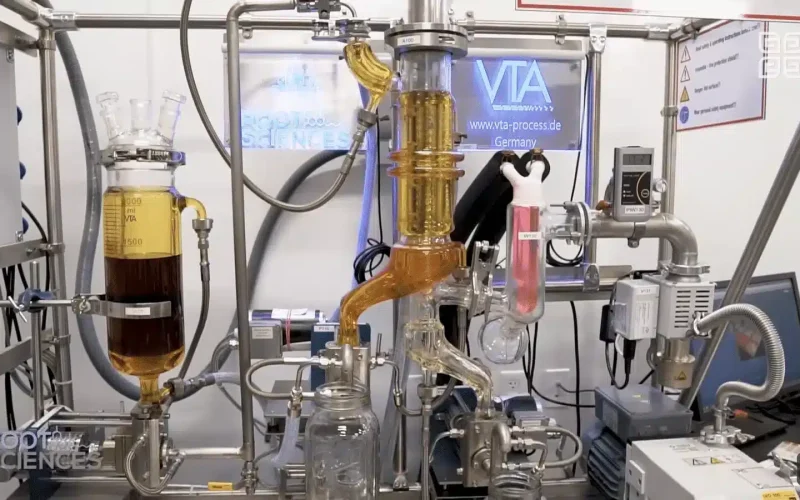
Cannabis distillation systems typically range from $20,000-$75,000 for entry-level craft units, $75,000-$250,000 for mid-scale systems, up to $250,000-$1,000,000+ for industrial-scale lines, with ROI driven primarily by matching throughput capacity to actual, validated production volume rather than by the equipment’s price alone.
This guide breaks down real costs by throughput tier, the methodology for calculating payback period and break-even throughput, and the budget factors that go well beyond the machine’s sticker price.
Sections
ToggleKey Takeaways
- Distillation equipment cost scales with throughput tier, roughly $20,000-$75,000 entry-level, $75,000-$250,000 mid-scale, and $250,000-$1,000,000+ industrial, but the machine itself is only one line item in the full budget.
- ROI should be calculated using payback period, cost-per-liter of finished distillate, and break-even throughput, not estimated from the purchase price alone.
- Facility classification, automation level, staffing, and service contracts frequently add 30-50% or more on top of the equipment’s purchase price before a system is actually operational.
- Overbuying throughput capacity relative to validated demand is one of the most common and expensive budgeting mistakes; capacity sitting idle doesn’t generate the return the purchase decision assumed.
- Traditional bank financing is largely unavailable to cannabis businesses, which materially affects how a distillation system purchase should be budgeted and timed relative to available capital.
Cannabis Distillation System Costs by Throughput Tier
Throughput Tier | Typical System Type | Typical Cost Range | Primary Use Case |
Entry-level / craft | Benchtop or small short-path unit (e.g., 4-5 L/shift) | $20,000-$75,000 | R&D, pilot production, low-volume craft brands |
Mid-scale | Compact wiped-film system (e.g., ~5 L/hr) | $75,000-$250,000 | Established processors scaling beyond pilot volume |
Industrial | High-throughput wiped-film line (e.g., 200+ L/shift) | $250,000-$1,000,000+ | Large processors and toll manufacturers running continuous production |
Throughput tier is the single biggest driver of equipment cost, but the relationship isn’t perfectly linear, moving up a tier buys more than just more liters per hour, it typically also buys more automation, more consistent output, and lower labor cost per liter produced. Understanding what’s actually different between tiers, not just the price tag, is what makes a budgeting decision defensible rather than just a guess.
Entry-Level and Craft Systems
Entry-level distillation systems, typically benchtop or small short-path units processing somewhere in the range of 4 to 5 liters per shift, generally run $20,000 to $75,000. Root Sciences’ VKL 70-S, the entry point in the VTA line, falls into this tier. Cost within this range is driven mainly by build quality, automation level (manual versus semi-automated), and whether the system includes integrated vacuum and heating components or requires them sourced separately.
This tier suits R&D work, pilot-scale validation before a larger buildout, and craft brands whose product volume genuinely doesn’t justify more throughput yet. The mistake to avoid at this tier is treating it as a permanent solution when production plans call for meaningfully higher volume within a year or two; entry-level systems don’t scale, they get replaced, which means the capital spent here should be weighed against how soon a second purchase becomes necessary.
Mid-Scale Systems
Mid-scale systems, generally compact wiped-film units processing around 5 liters per hour or more, run roughly $75,000 to $250,000. This is where most established processors that have outgrown pilot-scale operation actually land, and it’s also where the UIC line (a lower-cost alternative to VTA’s flagship models) becomes relevant for processors who want continuous wiped-film operation without paying industrial-scale pricing.
Cost variation within this tier comes down to automation (continuous feed and automated temperature/vacuum control cost more than semi-manual operation), condenser design, and whether the system integrates cleanly with existing upstream extraction and winterization equipment or requires workflow adjustments to fit. This tier generally offers the best cost-per-liter economics for a processor with validated, consistent demand that isn’t yet at industrial scale.
Industrial-Scale Systems
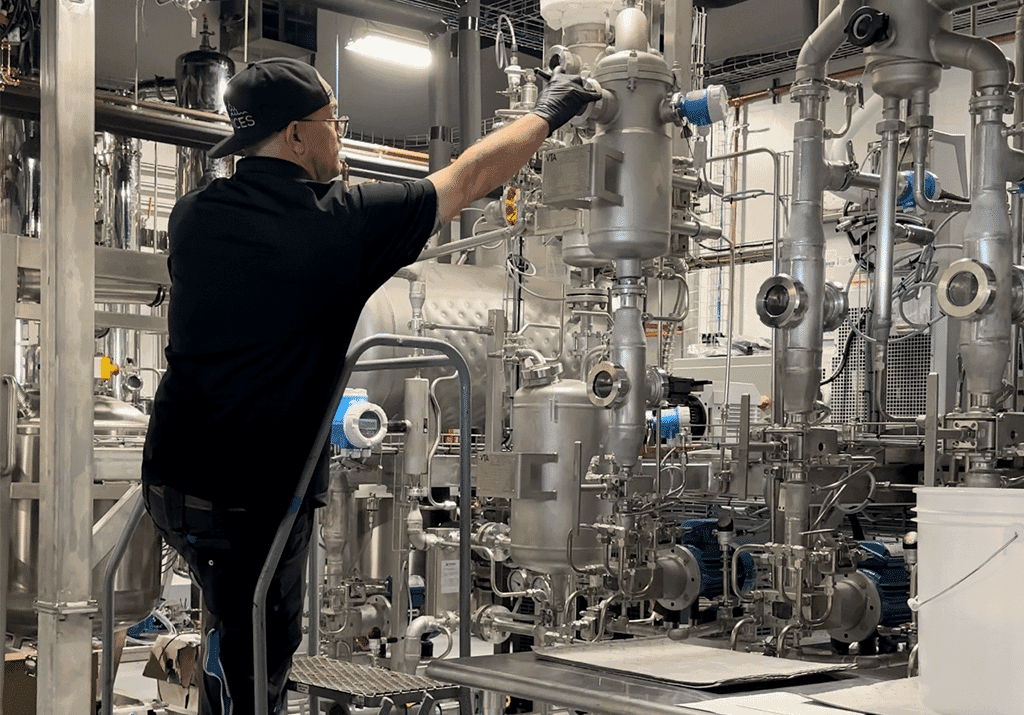
Industrial systems, capable of 200+ liters per shift, run from roughly $250,000 up to $1,000,000 or more depending on configuration. Root Sciences’ VK 200-40, sits at this end, built for continuous, high-volume operation rather than batch-driven processing.
At this scale, cost is driven less by the base unit and more by full-line integration, feed systems, automated process controls, and often custom configuration to match a specific facility’s layout and throughput targets across the whole production chain, not just the distillation step in isolation. This tier only makes financial sense against genuinely validated, high-volume demand; the fixed cost of an industrial line doesn’t shrink if the throughput isn’t actually being used.
Calculating ROI: Payback Period, Cost-Per-Liter, and Break-Even Throughput
A purchase price comparison alone doesn’t answer whether a distillation system is a good investment, that requires an actual return calculation, and payback period is the most commonly used and easiest to calculate of the standard capital budgeting methods, measuring how long it takes for an investment’s returns to cover its initial cost. Three specific numbers make this concrete for a distillation purchase:
- Payback period: total investment (equipment plus facility and integration costs) divided by projected net monthly cash flow from the additional distillate volume the system produces; most processors should be looking for a payback period measured in months to low single-digit years, not longer
- Cost-per-liter: total cost of ownership over the equipment’s expected service life, divided by total liters of finished distillate it’s expected to produce over that life; this is what actually determines whether a more expensive, higher-throughput system beats a cheaper one on a per-unit basis
- Break-even throughput: the minimum production volume, in liters per month, needed for the system’s output value to cover its full monthly cost (financing, energy, labor, maintenance); comparing this number against realistic, validated production volume is what actually tells you whether a given tier is the right fit
Running a sensitivity check on these numbers, what happens to payback period if production volume comes in 20% below projection, is worth doing before finalizing a purchase, since the throughput assumption is usually the most optimistic input in the whole calculation.
What Actually Drives Cost Beyond the Machine Itself?
The distillation unit’s purchase price is rarely the full story, and treating it as the whole budget is one of the more common planning mistakes. Facility classification, automation level, staffing, and service commitments routinely add 30-50% or more on top of the equipment’s sticker price before a system is fully operational:
- Facility and utility work: adequate power, ventilation, and often chilled water supply need to be confirmed or built out to support the equipment’s actual operating requirements, particularly at the mid and industrial tiers
- Automation level: moving from semi-manual to fully automated process control adds meaningfully to upfront cost but reduces ongoing labor cost, a tradeoff that needs to be run through the same payback and cost-per-liter math as the base equipment purchase
- Staffing and training: skilled operator time, and the ramp-up period before a new hire reaches full productivity, is a real and recurring cost that’s easy to leave out of an initial budget
- Service contracts and spare parts: ongoing maintenance agreements and stocked spare parts protect uptime, and their cost should be budgeted as a recurring line item, not treated as an occasional surprise expense
Financing these costs also comes with a structural constraint specific to this industry: federally backed loans are generally unavailable to cannabis businesses, and SBA policy treats direct marijuana businesses as ineligible for its lending programs while marijuana remains a controlled substance under federal law.
This pushes most distillation system purchases toward private or cannabis-specialized financing, which typically carries different terms than conventional equipment financing and should be factored into the payback period calculation itself, not treated as a separate consideration.
How Throughput Tier Should Actually Match Your Production Volume
The most expensive mistake in this entire budgeting process isn’t picking a system that’s too small, it’s buying more throughput than validated demand actually supports. Idle capacity doesn’t just fail to generate the return it was purchased for, it also carries ongoing facility, financing, and maintenance costs regardless of whether it’s being used.
MJBizDaily reporting on production equipment costs has found that operators frequently cite equipment costs as a smaller factor than expected relative to facility build-out and ongoing operating costs, underscoring that the purchase price is genuinely the easier number to get right; matching capacity to real, confirmed demand is the harder judgment call. A practical rule worth applying: size the system to current confirmed volume plus a modest, specific growth buffer, not to an optimistic multi-year projection, and revisit the next tier up only once actual production data supports it.
A guide to sizing a distillation unit covers the throughput-matching methodology itself in more depth; the ROI math above is what turns that sizing decision into an actual financial case.
Conclusion
Budgeting a distillation system purchase well means treating it as a financial model, not a shopping decision: the equipment’s price is the starting point, not the total cost, and the tier that makes sense financially is the one matched to validated production volume rather than to future ambitions.
Payback period, cost-per-liter, and break-even throughput turn a purchase decision into something that can actually be tested against real numbers before capital is committed, which is worth the extra hour of math relative to the size of the mistake it prevents.
FAQs
1. Does buying a larger system than currently needed ever make financial sense as a hedge against future growth?
It can, but only when growth is reasonably certain and near-term, not aspirational. The math should specifically account for the carrying cost of unused capacity (financing, facility, and maintenance costs on capacity that isn’t yet generating revenue) against the cost of a second purchase later; in many cases, buying appropriately sized equipment now and planning a phased upgrade path is the more defensible financial decision.
2. How does leasing versus buying a distillation system change the ROI calculation?
Leasing generally lowers the upfront capital requirement but changes the payback period calculation, since lease payments are an ongoing operating cost rather than a one-time capital outlay recovered over time. Whether leasing or buying produces a better ROI depends heavily on the specific lease terms and interest rate available, which for cannabis businesses are usually less favorable than conventional equipment leasing given limited access to traditional financing.
3. What’s a realistic payback period to expect for a mid-scale distillation system?
This varies significantly by facility, product mix, and market pricing, so there’s no single universal number, but processors evaluating a purchase should be running their own specific numbers through the payback period, cost-per-liter, and break-even throughput calculations rather than relying on an industry rule of thumb, since local biomass cost and finished product pricing affect the outcome as much as the equipment itself does.
4. Does upgrading from a mid-scale to an industrial system typically require replacing the mid-scale unit, or can both run in parallel?
Both approaches are used in practice. Running the existing mid-scale unit alongside a new industrial system can smooth the transition and provide redundancy, but it also means carrying the cost of both systems during the overlap period, which should be included in the ROI calculation for the new purchase rather than treated as a separate decision.
5. How much does automation level actually change the payback period for a given throughput tier?
Automation typically raises upfront cost by a meaningful margin within the same throughput tier but lowers ongoing labor cost per liter produced, which can shorten payback period at higher production volumes where labor savings compound faster, while potentially lengthening it at lower volumes where the automation premium isn’t offset by enough labor savings to matter. This is worth running as its own sensitivity check against actual projected volume rather than assumed as a universal improvement.