
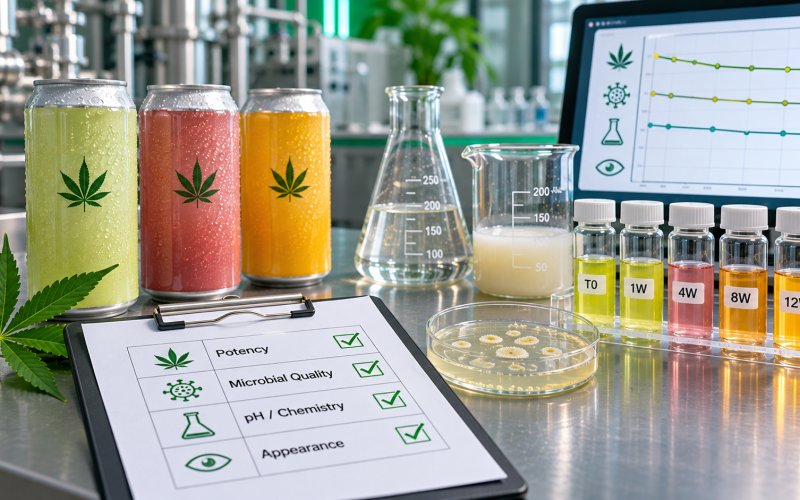
Shelf stability is the length of time a cannabis-infused beverage stays within its specifications for potency, safety, and quality. It is measurable, and it is not permanent. In a preliminary test of CBD-infused water stored for 84 days, CBD fell from 100 to 90.6 percent while microbial counts rose from under 10 to about 190 CFU/mL.
This guide explains what shelf stability covers, why it matters to a brand, and how to test it and set the end of shelf life.
Key Takeaways
This guide covers what shelf stability means for a cannabis-infused beverage and how to measure it.
- Shelf stability has several parts: potency, microbial quality, chemistry, and appearance. The first one to fail ends the shelf life.
- Microbial stability is time-limited and is often tested less than potency.
- A shelf-life test needs a defined package, storage conditions, time points, and pass-fail limits set in advance.
- Each product and package is its own test. No widely agreed protocol exists yet, and a proposed ASTM guide aims to fill that gap.
- Stability data should be updated whenever the formula, emulsifier, or package changes.
The table lists the parts of shelf stability and how each is checked.
| Dimension | Question it answers | How it is checked |
|---|---|---|
| Potency | Does cannabinoid content stay within the label claim? | Cannabinoid potency testing at each time point |
| Microbial quality | Do microbial counts stay acceptable? | Microbial counts at each time point |
| Chemistry | Is the drink’s chemistry holding steady? | pH and related measurements |
| Appearance | Does the drink still look as intended? | Visual checks in the final package |
What Shelf Stability Means for a Cannabis-Infused Beverage?
Shelf life is not a fixed property of a beverage. It is how long the product stays within its own specification. Most cannabinoids degrade naturally, and the industry still has no widely agreed stability protocol. That leaves each brand to define and prove its own shelf life, usually by tracking potency and microbial quality under both normal and accelerated storage conditions.
A practical definition follows from this: shelf life ends when the first measured property falls outside its limit. Potency, microbial count, emulsion stability, and appearance each change at their own rate. A drink that holds its THC content can still fail on microbial quality, and a microbially clean drink can still lose potency. Developers should know how quickly their active compound degrades. They should also pair release testing with ongoing shelf-life testing, so the end of shelf life is set by data rather than by assumption.
Why does Shelf Stability Matter?
The first reason is label accuracy. A survey of 40 CBD beverages found label accuracy ranging from 0 to 132 percent, with an average of 26.2 percent below the label claim. Dosing is central to safe, consistent products, and cannabinoid content needs to be consistently accurate within claimed value.
The second reason is the market. The ASTM rationale describes stable potency as a way for the category to build consumer trust, and says distributors, retailers, and regulators request stability data for each SKU. A brand without that data has nothing to show when asked.
The third reason is planning. Stability data tells a brand how long product can sit in distribution, and whether a reformulation or package change affects that window.
The Part Brands Overlook: Microbial Stability
Potency gets most of the attention, but a drink is also a place where microbes can grow. In CBD-infused water held at 25 °C, total viable counts rose from under 10 CFU/mL at the start to about 190 CFU/mL by day 84. The author describes that level as acceptable but notes it could exceed drinking-water guidelines depending on the threshold applied, and concludes that microbiological stability is time-limited under those conditions.
Three points follow for a processor. First, a clean result at filling does not show how counts behave later, so microbial testing belongs at every time point. Second, the test measured total viable count only, with no yeasts, molds, or specific pathogens, so a full program should cover more than a single count. Third, the potency fell and the pH drifted from 6.82 to 6.59 over the same period, which shows that the dimensions change together and have to be tracked together.
The ASTM guide lists microbial testing alongside potency for this reason. A potency-only study cannot support a shelf-life claim.
Building shelf stability in from the emulsion stage? Explore Root Sciences nanoemulsification equipment.
How to Design a Shelf-Stability Study
A shelf-life study answers one question: how long does this exact product stay within specification? Five design decisions shape the answer.
| Decision | Example from published work | What to record |
|---|---|---|
| Product and package | The ASTM draft covers containers from 1 oz to 750 mL in PET, HDPE, glass, aluminum can, and Tetra Pak | SKU, package type, fill size, lot |
| Storage conditions | Ambient and accelerated storage in the ASTM draft; 25 ± 2 °C in the CBD water test | Temperature, light exposure, duration |
| Time points | Days 0, 14, 28, 42, 56, 70, and 84 in the CBD water test | Date and result of each sample |
| Replicates | Three batches in the CBD water test | Batch number and replicate results |
| Measurements and limits | Potency, pH, and microbial counts, with limits set before testing | Pass-fail criteria and method used |
The sources also give practical guidance on methods. Developers should choose test methods that are accessible and reasonably cheap, according to Food Safety Magazine, so that testing can be repeated at every time point. The same publication advises vetting outside labs against in-house validated data, since many third-party labs lack validated cannabinoid methods.
A schedule for a real-time study can follow the same pattern as the published work, which sampled every two weeks for 84 days. The following outline is a suggested starting point to adapt to the product and the claimed shelf life.
- Day 0: baseline potency, pH, microbial count, and appearance for every batch.
- Every two weeks for the first three months: the same four measurements, with the early samples catching fast changes.
- Monthly after that, up to the shelf life being claimed and a margin beyond it.
- At each point, store the sample in the final package at the planned storage condition, and record any deviation.
For a processor building this capability, the guides to cannabinoid potency testing and in-house cannabis testing explain how the potency side works.
Setting the End of Shelf Life
Once data exist, the end of shelf life is where the first measured property crosses its limit. Each dimension has its own curve, and the earliest crossing decides the date.
- A few practices make that date defensible. These are suggested practices, not published rules.
- Set limits for potency, microbial counts, and pH before the first sample is taken.
- Test enough batches that one unusual batch does not set the date.
- Choose a labeled shelf life shorter than the longest period tested, so the claim is covered by data.
- Repeat testing whenever the formula, emulsifier, supplier, or package changes.
Caution matters here. The author of the 84-day CBD water test describes the work as preliminary, with three batches, distilled water, and a single microbial measure, and says it does not support claims of long shelf life. A claim should only be as long as the data behind it.
What Can Extend Shelf Life?
Most shelf-life gains come from controlling the conditions that break cannabinoids down: oxygen, light, heat, and the packaging itself. Cannabinoids oxidize over time, so reducing dissolved oxygen and headspace during filling, often with nitrogen dosing, slows potency loss. Opaque cans or amber glass block light, and cool storage further slows degradation.
Formulation matters just as much. A stable emulsion with small, uniform droplets keeps the oil-based cannabinoids evenly dispersed, which prevents separation, ringing at the neck, and inconsistent dosing. Antioxidants such as tocopherols can add protection. Packaging choice is easy to overlook: cannabinoids can bind to some can liners and plastics, so potency drops even when nothing has degraded. Testing the formula in its final container shows whether this is happening. On the microbial side, the usual beverage controls still apply, including low pH, suitable preservatives, and pasteurization or another kill step. Each change should be confirmed through shelf-life testing rather than assumed to work.
Making Shelf Stability Part of Production
Shelf stability is not a single test at the end of development. It is a body of data that grows with every formula change, new package, and new supplier.
A brand that defines its specification, tests at planned intervals, and records the results can state a shelf life it can support. One that does not has potency and microbial quality that are unknown after the day of filling.
Planning a shelf-stable cannabis beverage? Talk to the Root Sciences team about the right equipment for your line.
Frequently Asked Questions
Is one batch enough for a shelf-life study?
A reliable study needs at least three batches, ideally made on different days. One batch cannot tell a true product trend apart from a one-off batch quirk. Record the batch number with every result so any outlier can be traced back to its source.
Can potency testing alone support a shelf-life claim?
A shelf-life claim needs both potency and microbial testing. The two change on separate timelines, so a beverage can hold its cannabinoid content while microbial counts rise, or stay microbially clean while potency falls. Track both across the full study period.
Do accelerated tests replace real-time storage tests?
Accelerated tests support early decisions, while real-time storage confirms the final claim. Higher temperatures give a faster estimate of shelf life, which helps when choosing between formulations. Every claim printed on a label should rest on real-time data.
Do different package sizes and materials need separate testing?
Every SKU needs its own testing. Container size, material, liner, and headspace all affect oxygen exposure, light exposure, and how much cannabinoid binds to the packaging. Retest whenever the size or material changes.