Identify a cannabis extraction bottleneck by mapping actual throughput at every production stage, extraction, winterization, filtration, distillation, and packaging, rather than assuming the most visible stage is the constraint, then match the fix to the stage the data points to instead of the stage that’s easiest to blame.
This guide covers how to diagnose which stage is actually limiting output and the specific fixes, process and equipment, that resolve each one.
Sections
ToggleKey Takeaways
- The stage that looks like the bottleneck (usually extraction, since it’s the most visible and heavily used equipment) is frequently not the actual constraint; downstream stages like winterization and distillation are the more common hidden bottleneck.
- Mapping throughput at every stage, not just the one under suspicion, is the only reliable way to find the true constraint before spending on new equipment.
- A true bottleneck shows up consistently across multiple production cycles; a single slow batch is more often a temporary variable (staffing, biomass quality) than a structural constraint.
- Winterization and dewaxing are the single most common hidden bottleneck in solvent-based operations, since hold times don’t shrink as extraction output grows.
- Not every bottleneck needs new equipment; staffing gaps, scheduling, and SOP inconsistencies cause a meaningful share of throughput problems that get misdiagnosed as capacity issues.
Bottleneck Symptoms at a Glance
Symptom | Likely Bottleneck Stage | First Diagnostic Check |
Crude backing up before winterization | Winterization / dewaxing | Compare crude output rate to winterization batch capacity and hold time |
Filters clogging faster than usual | Filtration | Check wax/lipid load feeding into filtration from the prior stage |
Finished crude sitting before distillation | Distillation | Compare crude volume produced per day to distillation throughput capacity |
Extraction running fine but shipments still late | Packaging / fulfillment | Time finished product from distillation to shipped order |
Everything slows evenly across stages | Utilities or staffing | Check power draw, water supply, and staffing coverage across shifts |
Pressure climbing during extraction runs | Extraction (media/hardware) | Check differential pressure across filters and packed bed condition |
How to Identify Cannabis Extraction Process Bottlenecks?
Finding the real constraint takes more discipline than it sounds like it should, mainly because the most visible stage isn’t always the limiting one. These three steps, done in order, consistently surface the actual bottleneck rather than the assumed one.
1. Map Throughput at Every Stage Before Assuming Where the Problem Is
This step is worth doing formally, with actual numbers on paper or in a spreadsheet, rather than relying on impressions of which stage feels the busiest. A stage that looks constantly active isn’t necessarily the constraint; it might just be the stage with the most manual handling, which makes it feel busier without actually limiting total output. Record actual output, not rated capacity, at each stage over at least several consecutive production cycles:
- Extraction: lbs of biomass processed per day, and how that compares to the equipment’s rated capacity. Note whether the gap between actual and rated capacity is due to the equipment itself or to loading/unloading time between runs
- Winterization/dewaxing: hold time per batch and how many batches can run in parallel given tank or freezer space. This is the stage most likely to be underestimated, since a 12-24 hour hold doesn’t show up as “busy” equipment the way a running extractor does
- Filtration: volume processed before media needs changing, and how long that change takes, including setup and cleanup time, not just the swap itself
- Distillation: crude volume distilled per day against crude volume produced per day upstream, tracked separately for each pass if multiple passes are used to hit target purity
- Packaging/fulfillment: finished product volume shipped per day against finished product volume produced, since a gap here often hides behind otherwise healthy production numbers
Whichever stage has the lowest actual throughput relative to what feeds into it is the bottleneck, by definition, regardless of which stage looks busiest or gets the most attention day to day. It helps to express each stage’s throughput in the same unit (lbs of biomass-equivalent per day, or per shift) so the comparison across stages is apples to apples rather than comparing a batch count to a weight figure.
2. Read the Symptoms That Point to Each Stage
Specific operational symptoms reliably point back to a specific stage, which makes triage faster once you know the pattern. Treat these as a starting hypothesis to confirm against the throughput data above, not a substitute for it:
- Crude sitting in storage waiting for the next step: the stage immediately after that storage point is the constraint, not the stage that produced the crude. It’s easy to misdiagnose this as an extraction problem simply because extraction produced more than the next stage can absorb
- Filters needing replacement more often than the schedule accounts for: points to filtration capacity or, further upstream, insufficient winterization removing wax before it reaches the filter. Check the wax load in the crude first before assuming the filter media itself is undersized
- Rising differential pressure during extraction runs: points to media blinding, packed bed compression, or fines migration within the extraction step itself, rather than a downstream issue. This symptom is specific to the extraction stage and shouldn’t be confused with a filtration bottleneck further down the line, and it’s also a signal worth taking seriously from a safety standpoint, since OSHA’s pressure vessel standard treats any pressurized vessel operating above 15 psig as subject to code requirements, so an unexplained pressure climb isn’t purely a throughput question
- On-time extraction and distillation but late shipments: points to packaging or fulfillment, a stage that’s easy to overlook because it doesn’t involve the extraction equipment at all and rarely gets the same attention in production meetings
- Solvent recovery taking longer than expected between runs: points to recovery capacity capping how quickly the extraction vessel can be reloaded, which shows up as slow overall extraction throughput even though the extraction step itself runs at normal speed
- Extract color or clarity varying batch to batch with no change in starting material: often points to inconsistent winterization hold time or temperature rather than a true capacity bottleneck, worth ruling out before assuming a throughput issue
3. Distinguish a True Bottleneck from a Temporary Slowdown
Not every slow week is a structural bottleneck. A true bottleneck shows up consistently across multiple production cycles regardless of staffing or biomass variation; a temporary slowdown is usually explained by a specific, identifiable one-off cause:
- Staffing gaps: a single trained operator out sick or on leave can look like an equipment bottleneck for a week without being one, particularly at facilities with only one or two people cross-trained on a given stage
- Biomass quality variation: unusually wet, moldy, or low-quality input material slows every downstream stage without any equipment actually being undersized; this shows up as a slowdown that tracks with a specific incoming batch rather than persisting across batches
- Maintenance downtime: scheduled or unscheduled maintenance on one piece of equipment creates a temporary backlog that clears once maintenance is done, and shouldn’t be confused with the equipment being undersized for normal operation
- Seasonal or order-driven demand spikes: a facility that only strains at capacity during a predictable seasonal peak may not need permanent additional capacity, a temporary second shift or outsourced overflow can be more cost-effective than a full equipment upgrade
Spending capital on new equipment to solve what’s actually a one-off staffing or material issue is a common and expensive misdiagnosis. Confirm the pattern holds across at least three to four production cycles, ideally under otherwise normal staffing and biomass conditions, before committing to an equipment fix. If the slowdown consistently reappears even with good staffing and good input material, that’s the signal the constraint is structural rather than situational.
How to Fix the Most Common Bottlenecks by Stage?
Once the actual bottleneck stage is confirmed, the fix usually falls into one of a few categories specific to that stage.
Stage | Common Cause | First Fix to Try |
Extraction | Undersized recovery line or column relative to throughput target | Active recovery kit with full-bore lines before replacing the whole system |
Winterization / dewaxing | Long hold time (12-24+ hrs) not matched to extraction output | Cold or cryogenic extraction upfront to reduce co-extracted wax load |
Filtration | Single filter stage carrying full particulate and wax load | Staged filtration: coarse capture before fine polishing media |
Distillation | Crude output rate exceeds wiped-film or short-path throughput | Add a second distillation pass or upsize to a higher-throughput unit |
Packaging / fulfillment | Manual, single-operator packaging step | Semi-automated filling/labeling before adding headcount |
1. Extraction Bottlenecks
When extraction itself is the confirmed constraint, the fix depends on which part of the extraction process is limiting throughput, and it’s worth separating the extraction step itself from the recovery step that follows it, since they fail differently.
Undersized recovery lines and passive (rather than active) recovery are common culprits in hydrocarbon extraction equipment, where full-bore active recovery kits often resolve the bottleneck without replacing the extraction vessel itself, since the constraint is how fast solvent can be pulled back out, not how fast it dissolves cannabinoids on the way in.
Column size and batch cycle time are the other common constraint: if the vessel itself is undersized for target throughput, no amount of recovery-line optimization closes that gap, and the fix is genuinely a larger or additional extraction vessel.
For ethanol extraction equipment running warm extraction, moving to cold or cryogenic extraction can address a bottleneck at its source by reducing the wax load that slows every stage downstream, rather than only speeding up extraction itself. This is worth calling out specifically because it’s a case where the fix for an extraction-stage bottleneck actually lives in how the extraction is run, not in bigger equipment.
Continuous-feed system design is also worth understanding as a category: industry patent filings on biomass extraction and centrifugation describe how multi-tank continuous feed systems avoid the staging delay inherent to single-batch designs, where material has to move through an intermediate storage container between steps rather than flowing directly, a structural difference worth understanding when evaluating whether an extraction bottleneck is fixable with a component upgrade or actually requires a different system architecture.
2. Winterization and Dewaxing Bottlenecks
This is the single most common hidden bottleneck in solvent-based operations, since a 12-to-24-hour (or longer) hold time doesn’t shrink just because extraction output increased, and it’s the stage most operators underestimate specifically because it doesn’t require active operator attention while it’s running.
There are two fundamentally different ways to fix it: add parallel tank or freezer capacity so multiple batches hold simultaneously, or reduce how much wax needs to be removed in the first place so the hold time itself shortens. Cryogenic ethanol extraction equipment, for example, is specifically designed to leave lipids and waxes behind during extraction itself, which can cut a winterization-driven bottleneck from days down to hours rather than simply adding more winterization tank capacity to run in parallel.
Facilities running warm ethanol extraction that can’t switch to cold extraction entirely can still reduce the winterization burden by increasing the solvent-to-biomass ratio during extraction, which dilutes wax concentration and can shorten the hold needed to reach target clarity, though this trades against solvent recovery time on the back end.
3. Filtration Bottlenecks
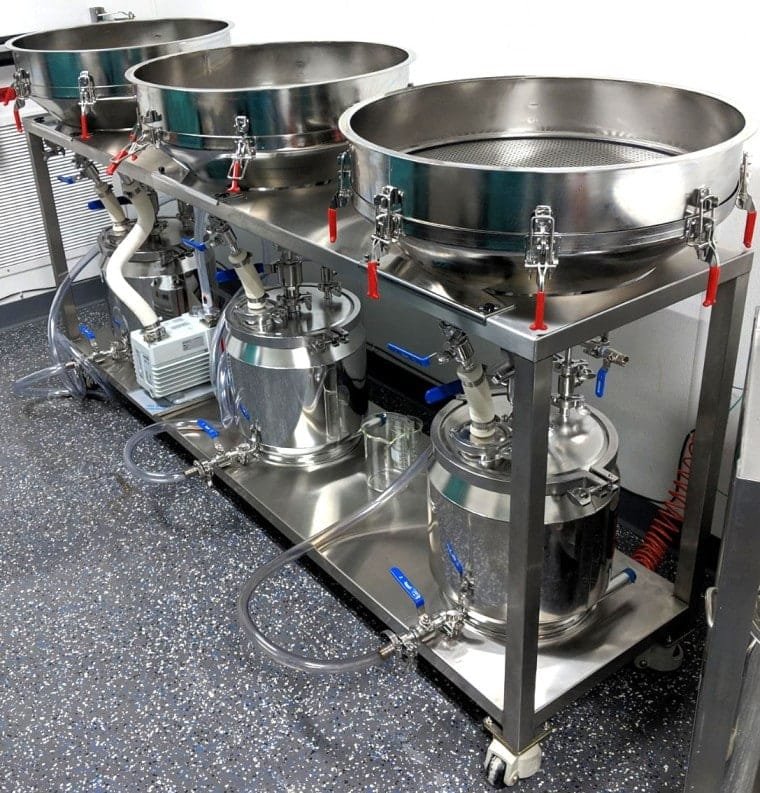
Filtration bottlenecks are usually a symptom of an upstream problem rather than an isolated filtration issue: insufficient winterization or dewaxing pushes more wax and particulate load onto the filter than it’s sized to handle efficiently.
The underlying science here isn’t cannabis-specific, peer-reviewed research on winterization published in the Journal of the American Oil Chemists Society established the lipid-precipitation mechanism decades ago in the context of edible oil processing, and the same solubility principle, chilling a solution to precipitate out higher-melting-point fats so they can be filtered away, applies directly to cannabis crude.
Before changing anything about the filtration equipment itself, confirm whether the wax load reaching the filter is actually normal for the biomass and process being run, since fixing filtration in isolation doesn’t help if winterization upstream is the real source of the problem. Once filtration itself is confirmed as the constraint, a few specific fixes apply: staged filtration, coarse media capturing the bulk of particulate before finer polishing media, extends the life of the expensive fine media and reduces how often the line stops for a media change.
Increasing filter surface area also lowers flux (flow per unit area), which directly reduces how fast pressure builds and media blinds during a run. Tracking differential pressure before and after each filtration stage over time also helps distinguish a media that’s simply due for replacement from a genuine undersizing issue that recurs even with fresh media.
4. Distillation Bottlenecks
When crude oil is backing up waiting for distillation capacity, the fix depends on whether the constraint is raw throughput or purity requirements driving multiple passes. If it’s raw throughput, the fix is either adding a second unit to run in parallel or upgrading to higher-throughput cannabis distillation equipment sized to the target volume.
If the constraint is actually the number of passes needed to hit target purity, the more cost-effective fix is often improving crude quality upstream rather than adding distillation capacity: cleaner, better-winterized crude typically needs fewer passes to reach the same purity, which increases effective distillation throughput without touching the distillation equipment at all.
Feed consistency also matters here specifically, batch-to-batch variation in crude quality forces operators to run more conservative (and slower) parameters to avoid degrading inconsistent material, so stabilizing upstream quality can unlock throughput that looks like a distillation bottleneck but isn’t one.
5. Solvent Recovery Bottlenecks
A slow solvent recovery cycle limits how quickly the extraction vessel can be reloaded for the next run, which caps daily throughput even if the extraction step itself is fast, and this is one of the easier bottlenecks to miss since the extraction equipment itself appears to be running normally. Solvent recovery and decarboxylation equipment sized to match extraction throughput, rather than treated as a fixed-capacity afterthought, prevents recovery from becoming the constraint that limits how many runs a facility can complete per day.
Recovery speed is also affected by solvent choice and boiling point: a solvent recovery system that was appropriately sized for one solvent may become a bottleneck if the facility switches solvents without re-evaluating recovery capacity against the new solvent’s properties.
6. Packaging and Fulfillment Bottlenecks
This stage gets overlooked because it doesn’t involve extraction equipment at all, but a manual, single-operator packaging step can bottleneck an otherwise well-running production line just as effectively as an undersized extraction vessel.
Semi-automated filling and labeling equipment is usually the more cost-effective fix before adding headcount, particularly for high-SKU-count operations where manual packaging variability also affects consistency and where switching between product formats consumes setup time that automated systems handle faster.
Facilities running a narrow product line with stable format and volume often get more value from optimizing the manual process (better workstation layout, clearer handoff points between production and packaging) than from automation, since the capital cost of automation is harder to justify against a smaller throughput gain.
When the Fix Is Process, Not Equipment
Not every bottleneck is solved by buying something. A meaningful share of throughput problems trace back to process issues that no equipment upgrade fixes on its own. Batch-to-batch inconsistency in particular is often treated as a quality problem when it’s really a process bottleneck in disguise: recent industry commentary in MJBizDaily has argued that splitting extraction into standardized, testable intermediate products, rather than running each batch to a slightly different informal target, is what actually resolves the kind of variability that otherwise gets chased with equipment changes that don’t address the underlying process gap.
- Inconsistent SOPs across shifts or operators: different operators running the same equipment with different parameters produces variable throughput that looks like an equipment problem
- Scheduling gaps between stages: equipment sitting idle waiting for the previous stage’s output, rather than running continuously, can look like a capacity shortfall when it’s actually a coordination issue
- Maintenance deferred past its schedule: gradually declining throughput that looks like undersized equipment is sometimes just equipment overdue for scheduled maintenance
- Cross-training gaps: a bottleneck that only appears on certain shifts or when a specific operator is out points to a staffing and training issue, not a hardware one
Ruling out these process causes before committing capital to new equipment is usually the faster and cheaper diagnostic step, and it’s worth doing even when a hardware fix seems obvious.
Conclusion
Fixing a bottleneck starts with correctly identifying it, and that takes mapping actual throughput at every stage rather than assuming the most visible piece of equipment is the constraint. Winterization and distillation are the stages most often overlooked in favor of blaming extraction, and process issues, staffing, scheduling, deferred maintenance, cause a meaningful share of what gets misdiagnosed as an equipment problem.
Confirming the pattern holds across multiple production cycles before spending on a fix avoids the expensive mistake of upgrading equipment that was never actually the constraint.
FAQs
1. How often should throughput data be reviewed to catch a developing bottleneck early?
Reviewing stage-by-stage throughput weekly is enough to catch a developing bottleneck before it becomes a serious backlog, though facilities running near capacity consistently may benefit from daily tracking on the stages already under suspicion. The key is comparing trend data across multiple cycles rather than reacting to any single day’s numbers.
2. Can a bottleneck move from one stage to another after a fix is implemented?
Yes, and this is expected rather than a sign the fix failed. Resolving a bottleneck at one stage frequently exposes the next-most-limiting stage as the new constraint, since production systems tend to have a bottleneck somewhere by definition. Re-mapping throughput after any significant fix is worth doing specifically to catch this shift early.
3. Is it possible to have more than one bottleneck at the same time?
In practice, one stage is usually the binding constraint at any given moment, but multiple stages can be close enough in capacity that fixing the primary bottleneck immediately reveals a secondary one. This is more common in facilities that have grown incrementally without a coordinated capacity plan across all stages.
4. Does adding a second shift help resolve a bottleneck, or does it just move the problem?
It depends on which stage is constrained. Adding a shift helps when the bottleneck stage has available equipment capacity that’s only limited by operating hours; it doesn’t help when the bottleneck is the equipment’s physical throughput ceiling, since a second shift on undersized equipment just produces the same daily total over more labor hours.
5. How do you know if a bottleneck is worth fixing versus just accepting as a production ceiling?
This comes down to whether the cost of the fix is justified by the value of the additional throughput it unlocks, and whether demand actually supports the higher output. Fixing a bottleneck that isn’t limiting sales, only theoretical maximum capacity, generally isn’t worth the capital; fixing one that’s actively causing missed or delayed orders usually is.