
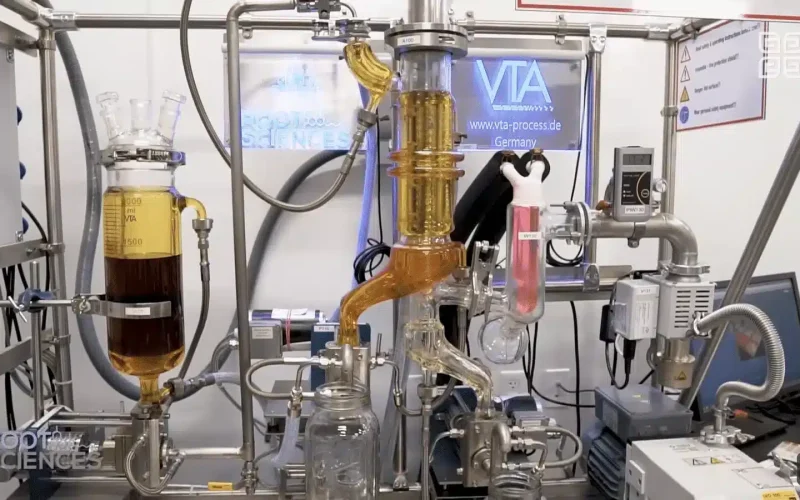
Choosing a cannabis distillation system means matching equipment to your actual feed volume, product goals, and facility constraints, not picking the biggest unit on a spec sheet. Root Sciences builds two distinct distillation lines, UIC and VTA, each with its own strengths depending on whether you are running short-path batches or continuous wiped-film production.
This guide walks through the decisions that actually determine fit: throughput, construction, supporting equipment, and what has to happen before and after the still itself.
Key Takeaways
- Daily crude feed volume, not headline batch size, should drive your throughput decision, since feed rate directly affects cannabinoid recovery.
- Short path and wiped film solve different problems: short path suits batch flexibility, wiped film suits continuous higher-volume runs.
- Glass evaporators give operators direct visual confirmation of distillation in progress; stainless steel trades that visibility for durability and lower breakage risk.
- A still is only as good as the vacuum system, cold trap, and pumps supporting it, so those specs need to match the still’s rated performance.
- Winterization and decarboxylation upstream, and isolation or crystallization downstream, shape what the still needs to deliver, so buy the line, not just the unit.
Buying Decision | Options | What Should Drive the Choice |
Throughput | Batch capacity per cycle, cycles per day | Your daily crude feed volume and how many shifts you plan to run, not just headline batch size |
Technology | Wiped film vs. short path | Whether you are running continuous production or lower-volume, higher-touch batches |
Construction | Glass vs. stainless steel | Product visibility needs during operation versus throughput, durability, and crew safety exposure |
Product line | UIC vs. VTA | Feed characteristics, target purity, and whether you need dual-stage passes in one unit |
Supporting equipment | Vacuum system, cold trap, pumps | Matching the still’s rated vacuum and flow specs, not buying a still in isolation |
Controls and compliance | Manual vs. automated, data logging | Whether your facility needs GMP-ready documentation and repeatable process control |
Service and training | Installation, commissioning, spare parts | How much in-house process engineering experience your team already has |
Start With Daily Crude Volume and Feed Rate
The single most common mistake in equipment selection is sizing a still to a batch-capacity number instead of a daily feed rate. A still’s rated batch size tells you what one run can hold, not how much crude you can realistically process across a shift once loading, heating, and cooldown are factored in. Feed rate, the volume that moves through the evaporator per hour, is what actually determines whether a unit fits your operation.
Feed rate also matters for product quality, not just throughput. A 2023 peer-reviewed study published in Separation and Purification Technology examined how feed flow rate affects cannabinoid recovery in short-path distillation, finding that pushing feed rate too high for a given evaporator surface area reduces separation efficiency and cannabinoid yield. Running a still faster than its wall surface and vacuum system can support does not just risk equipment strain, it can leave potency on the table.
- Calculate your daily crude input in kilograms, not your desired output, and work backward from there.
- Account for load, heat-up, and cooldown time between batches when comparing a batch-oriented short-path unit to a continuous wiped-film system.
- Build in headroom for seasonal demand swings rather than sizing exactly to current average volume.
Short Path or Wiped Film: Where Each Fits
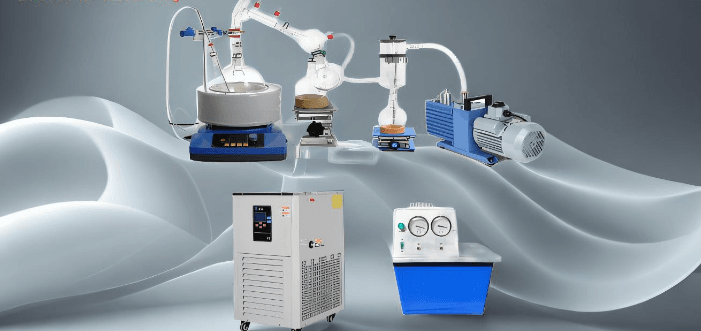
Short-path distillation runs crude through a single evaporator in discrete batches, with the operator controlling temperature and vacuum stage by stage. Wiped-film distillation feeds crude continuously across a heated cylinder while an internal wiper spreads it into a thin film, letting cannabinoids evaporate and condense in one continuous pass. The two approaches solve different operational problems.
Wiped-film systems, including Root Sciences’ VTA VKS line, are built around the principle described in equipment patents for thin-film short-path distillation, where minimizing the residence time and thickness of the product film at the heated surface reduces thermal degradation while maintaining continuous throughput, a design approach documented in U.S. Patent 10,888,595. Short-path systems trade that continuous throughput for more granular batch-by-batch control, which some operators prefer when refining process parameters or running smaller, more variable crude lots.
- Choose a short-path if you are still refining your distillation parameters or run varied, smaller crude batches.
- Choose wiped film if you have a consistent, high-volume feed and want continuous rather than batch processing.
- Many operations run both: short path for R&D or specialty runs, wiped film for standard production volume.
Glass or Stainless Steel Construction
Distillation equipment construction material affects both what you can see during a run and what you need to plan for around crew safety and equipment longevity.
Glass Evaporators
- Let operators visually confirm the distillate stream, color changes, and boiling behavior in real time.
- Are typically favored for short-path systems where visual feedback supports fine-tuning temperature and vacuum stage by stage.
- Require more careful handling and a defined inspection routine, since borosilicate glass under vacuum carries a failure risk that stainless steel does not.
Stainless Steel Evaporators
- Trade direct visual monitoring for durability, easier cleaning, and lower long-term breakage risk.
- Are standard on continuous wiped-film systems, where process consistency is controlled through temperature and vacuum readouts rather than visual inspection.
- Tend to have a longer service life in high-throughput, multi-shift operations.
The Safety Routine Glass Requires
Any glass vessel operated under vacuum needs a documented pre-use inspection for cracks, chips, or star fractures, since a flaw that looks cosmetic can propagate under vacuum stress. The University of Illinois’ vacuum apparatus safety guidance recommends shielding for glass vacuum apparatus and routine inspection before each use as standard practice, a routine worth building into your SOPs regardless of which vendor’s glassware you run.
UIC or VTA: Choosing Between the Two Lines
Root Sciences builds two distillation product lines, and the choice between them comes down to how your operation is structured rather than one line being categorically better.
The UIC Line
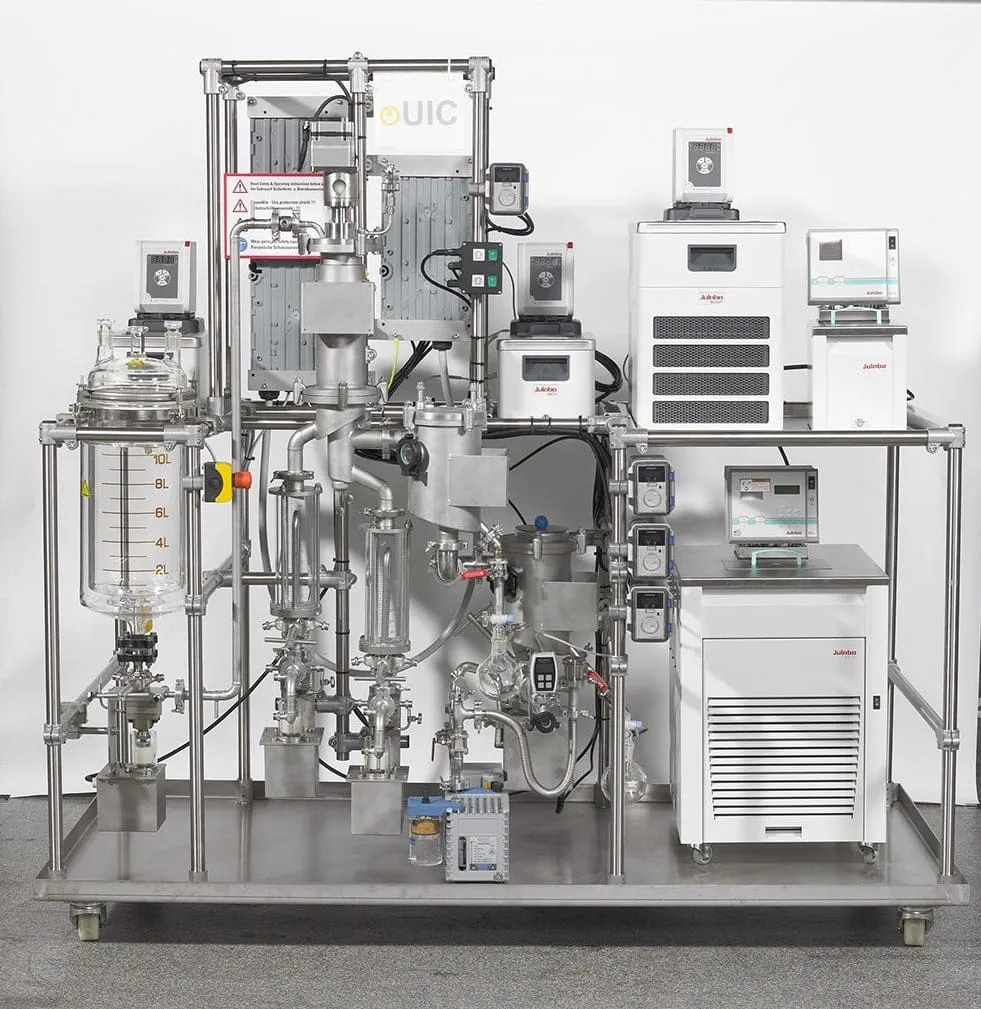
The UIC line, including the KDL5, KD6, and the KD10, is built around short-path distillation and tends to fit operations that are scaling up from smaller batch sizes or that want a compact footprint with strong batch-by-batch control, with the KD10 covering the higher end of that range.
The VTA Line

The VTA line spans both short-path (VKL models) and wiped-film (VKS models) configurations, giving operations a path to scale from smaller short-path units into continuous wiped-film production without switching equipment families entirely.
Model | Line | What Sets It Apart |
KDL5 | UIC | Entry point into the UIC line, sized for smaller operations validating a distillation process before scaling |
KD6 | UIC | Higher-throughput UIC unit built for operations that have outgrown a KDL5 but do not yet need VTA-scale output |
KD10 | UIC | Largest short-path unit in the UIC line, built for operations that need UIC’s batch-control design at a higher daily volume than the KD6 supports |
VKL 70-S | VTA | Smaller VTA short-path unit suited to labs prioritizing flexibility over maximum daily volume |
VKL 75 | VTA | Mid-range VTA short-path configuration positioned between the 70-S and the wiped-film VKS models |
VKL 85 | VTA | Larger VTA short-path unit for operations pushing more crude through short-path distillation specifically |
VKS 90-S | VTA | Entry wiped-film VTA unit for operations moving from short-path to continuous wiped-film processing |
VKS 95 | VTA | Mid-tier wiped-film VTA system built for sustained, higher-volume continuous runs |
VKS 125 | VTA | Largest VTA wiped-film unit in the line, built for industrial-scale continuous distillation |
The Supporting Equipment the Still Depends On
A distillation unit’s published specifications assume it is paired with a vacuum system, cold trap, and pumps rated to match. Undersizing any of these creates a bottleneck that limits the still’s real-world performance regardless of what the evaporator itself is capable of.
Vacuum System
- Needs to reach and hold the pressure range the still requires; process patents for wiped-film short-path distillation describe operating pressures in the range of 0.3 to 0.8 mbar for effective cannabinoid separation, per U.S. Patent 10,413,843.
- Should be sized with margin, since vacuum pumps lose efficiency over time and a system running at its absolute limit has no buffer for wear.
Cold Trap
- Protects the vacuum pump by condensing volatiles before they reach it, typically operating in the range of negative 22 to negative 30 degrees Celsius per the same patent’s disclosed process parameters.
- Needs regular defrosting and cleaning built into your maintenance schedule, since a saturated trap stops protecting the pump.
Heating, Cooling, and Feed Pumps
- Feed tank temperatures around 105 to 115 degrees Celsius and evaporator wall temperatures around 155 to 162 degrees Celsius are representative of the ranges described in patented wiped-film short-path processes, with condensing coil temperatures around 58 degrees Celsius.
- Feed pump consistency matters as much as heater accuracy, since an uneven feed rate creates the film-thickness variability that reduces separation efficiency.
Solvent Removal Before the Still
Crude entering the still needs residual solvent already removed. Pairing your distillation purchase with a decarboxylation and solvent recovery equipment keeps that step in-line rather than treating it as an afterthought once the still is already installed.
Automation, Controls, and GMP Readiness
Manual systems rely on the operator to read gauges and adjust temperature and vacuum by hand, which works for smaller operations but does not produce the automatic data logging that GMP-oriented facilities increasingly need. Automated systems record temperature, pressure, and flow data continuously, generating the audit trail that quality teams and regulators expect.
- If you are supplying pharmaceutical, EU-GMP, or other regulated channels, prioritize a system with automated data logging over one that is marginally cheaper without it.
- Even for non-regulated markets, automated logging shortens troubleshooting time when a batch comes out off-spec, since you can review the actual run data instead of relying on operator memory.
- Ask whether the control system’s historical data exports in a format your quality team can actually use, not just whether it logs data at all.
What Has to Happen Before and After the Still
A distillation system does not operate in isolation. What happens before it, and what happens to the distillate after it comes off the still, both shape whether the unit you buy actually gets you the product you need.
Before the Still
Crude that has not been properly winterized can leave lipids and waxes in the feed, which affects both distillation efficiency and finished product clarity. Running winterization equipment upstream reduces the load on the still and helps protect consistent output quality.
After the Still
Distillate coming off the still is not the final product for every operation. If your target is THCA crystallization or further isolate purification, plan for isolation and crystallization equipment as part of the same buying decision rather than a separate purchase down the line, since matching distillate characteristics to crystallization requirements affects yield.
Facility, Utilities, and Safety Planning
Distillation equipment has real utility and space requirements that need to be confirmed before installation day, not discovered after the unit arrives.
- Confirm electrical service, including voltage and amperage, matches the still’s heating and pump requirements, especially for larger wiped-film systems.
- Verify your vacuum pump exhaust and any chiller loop have adequate ventilation and drainage per your facility’s mechanical plans.
- Plan floor space not just for the still itself but for the cold trap, vacuum pump, and chiller, which are often sized larger than operators expect.
- Coordinate with your facility’s fire and safety documentation early, since distillation equipment placement typically falls under the same review as extraction equipment.
Service, Training, and Spare Parts: What to Confirm Before You Buy
The equipment purchase is the beginning of the relationship with a vendor, not the end of it. A handful of questions before you sign off can save weeks of downtime later.
- Ask what installation and commissioning support is included versus billed separately.
- Confirm operator training is part of the package, and whether it covers troubleshooting, not just startup and shutdown procedures.
- Ask which spare parts the vendor recommends keeping on hand, and realistic lead times for parts that are not in stock.
- Clarify what technical support looks like after the first 90 days, since early support windows can mask longer-term response times.
Conclusion
The right distillation system is the one that matches your actual daily feed volume, fits into a process that already includes proper winterization and solvent recovery upstream, and connects cleanly to isolation or crystallization downstream if that is where your product line is headed. Getting the supporting equipment, vacuum, cold trap, and pumps right matters as much as the still itself, and confirming service and training up front avoids costly surprises after installation.
Frequently Asked Questions
Do I need a dual-stage system, or is a single-stage still enough?
It depends on your target purity and what happens to the distillate afterward. A single pass is often sufficient for standard distillate, but operations targeting very high purity for isolate or crystallization frequently run a second pass, either through a second stage built into the unit or a second run through the same still, to strip remaining lower-boiling-point compounds.
What potency should I expect on the spec sheet, and does it match real-world results?
Manufacturer spec sheets reflect performance under controlled conditions with well-prepared feedstock. Real-world potency depends heavily on crude quality going in, how well winterization and decarboxylation were performed upstream, and whether feed rate was kept within the equipment’s rated range. Treat spec sheet numbers as a ceiling, not a guarantee.
If I upgrade to a larger unit, is it worth keeping the smaller one?
Many operations keep a smaller short-path unit even after adding wiped-film capacity, using it for R&D batches, specialty runs, or smaller crude lots that do not justify running the larger continuous system. Whether that makes sense depends on your facility space and whether you have batch work that does not fit continuous processing.
What is a URS, and do I need one before buying equipment?
A URS, or user requirements specification, is a document outlining exactly what you need equipment to do, including throughput, product specifications, facility constraints, and compliance requirements, before you start evaluating vendors. It is standard practice in regulated pharmaceutical and GMP environments and is increasingly used by cannabis operations pursuing similar quality standards, since it keeps vendor conversations focused on your actual requirements rather than their standard configurations.
Does crude viscosity affect which distillation equipment I should buy?
Yes. Highly viscous crude can strain feed pumps and create uneven film distribution in wiped-film systems, reducing separation efficiency. If your crude runs thick, ask vendors specifically how their feed system and heating stages handle viscosity, and whether feed tank pre-heating is built in or needs to be added separately.