Root Sciences

Wiped Film Distillation: A Guide to How It Works and Why Cannabis Processors Use It

What is wiped film distillation?

Wiped film distillation purifies crude cannabis oil by spreading it into a thin, continuously moving film across a heated surface under vacuum, which vaporizes cannabinoids at much lower temperatures than atmospheric distillation would require and separates them from waxes, chlorophyll, and other residue in a matter of seconds. 

Cannabis processors use it because that short heat exposure preserves cannabinoid and terpene integrity while still running continuously at commercial throughput. This guide covers the mechanism step by step, why it’s become the processor default, and what to watch for when running or evaluating the equipment.

  • Wiped film distillation works by spreading crude oil into a thin, continuously wiped film on a heated surface under deep vacuum, which vaporizes cannabinoids in seconds rather than minutes.
  • Vacuum is what makes the process viable at all: it drops THC’s effective boiling point from an atmospheric ~245°C to a fraction of that, avoiding the thermal degradation that would otherwise destroy the molecule.
  • Processors favor wiped film specifically for its combination of thermal preservation and continuous operation, a combination batch methods and simple short path systems don’t offer together.
  • Output quality depends heavily on four equipment specs: vacuum depth, wiper design/speed, temperature control precision, and feed rate matched to the system’s actual capacity.
  • Most quality problems trace back to operator error, poorly prepared feedstock, insufficient vacuum, overfeeding, or neglected condenser cleaning, rather than fundamental equipment limitations.

How Wiped Film Distillation Works?

The process moves crude oil through five stages in sequence, each one addressing a specific problem that atmospheric or simple batch distillation runs into with heat-sensitive cannabinoids.

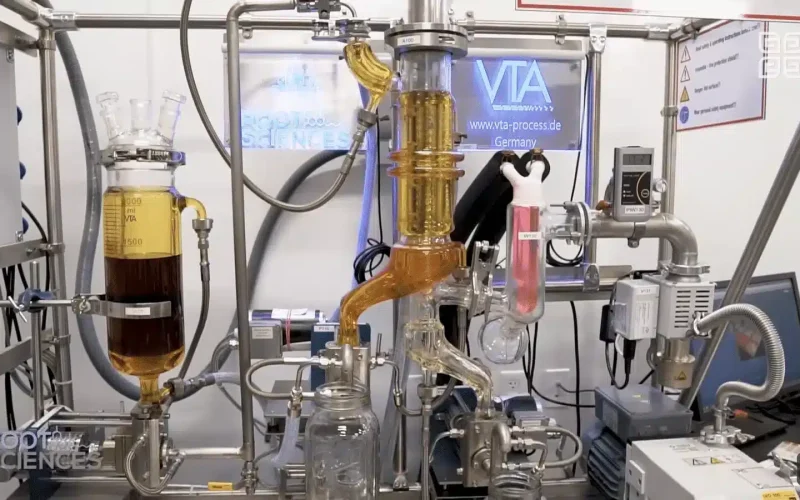
VKS 95, Cannabis Distillation Equipment

Thin Film Formation

Crude oil is fed continuously onto the top of a heated, cylindrical evaporation surface, where it’s spread into a thin film, typically in the range of 0.1 to 0.5 millimeters. That thinness is the entire point: a thin film heats far more evenly and rapidly than a pooled liquid, since heat doesn’t have to conduct through a deep, insulating layer of oil to reach the molecules that need to vaporize.

The Wiping Mechanism

A rotating wiper or roller system continuously spreads and moves the film down the heated cylinder wall. This does two things at once: it keeps the film thin and evenly distributed rather than letting it pool or run unevenly, and it constantly refreshes the surface layer exposed to heat, which is what allows the process to run continuously rather than in discrete batches.

Vacuum and Reduced-Pressure Boiling

At atmospheric pressure, THC’s boiling point sits high enough (independent lab analysis using thermogravimetric and calorimetric methods has placed it around 245°C) that reaching it would degrade the molecule before it fully vaporizes. 

Under the deep vacuum used in wiped film systems, typically in the range of 0.001 to 1 Torr, that boiling point drops dramatically, letting cannabinoids vaporize at a fraction of the temperature they’d otherwise require. This is the mechanism that makes the whole process viable: without vacuum, wiped film distillation of cannabinoids wouldn’t be possible without destroying the product.

Short Path to the Condenser

Wiped-film systems built specifically for cannabinoid processing typically pair the wiped film evaporator with a short path to an internal condenser, positioned close to the evaporation surface. Vapor travels only a short distance before condensing, which minimizes the chance of it re-condensing on the wrong surface or recombining with residue, and further shortens total exposure time to heat.

Separating Distillate from Residue

Lighter, lower-boiling-point fractions (cannabinoids, and terpenes if not already removed) vaporize and condense as distillate, while heavier residue, chlorophyll, large lipids, waxes, and other non-volatile material, continues down the cylinder wall and exits separately for disposal or further processing. This split happens continuously as the film moves, rather than requiring the system to stop and separate fractions manually.

Why Cannabis Processors Use Wiped Film Distillation?

The short residence time is the core advantage, and it matters more than it might seem. Peer-reviewed research on cannabinoid thermal stability has found that degradation happens on a timescale of seconds once cannabinoids are exposed to elevated temperatures, meaning the difference between a process that exposes oil to heat for a few seconds versus several minutes can meaningfully change the finished product’s potency and cannabinoid profile. Beyond thermal preservation, three other factors drive adoption at commercial scale:

  • Continuous operation: unlike batch methods that require loading, running, and unloading in discrete cycles, wiped film systems feed and discharge continuously, which meaningfully increases daily throughput for the same footprint of equipment
  • Consistency: because the process parameters, film thickness, temperature, vacuum level, stay constant during a run, output quality tends to be more repeatable batch to batch than manual or semi-batch methods
  • Viscosity handling: cannabis crude oil is thick and can be difficult to process evenly; the mechanical wiping action handles high-viscosity, high-solids material that would be difficult to distill efficiently in a simple static system

This is also why wiped film systems scale from craft to industrial output without changing the underlying mechanism, only the size. Root Sciences’ VK 200-40, for example, applies the same thin-film, deep-vacuum principle at industrial throughput that a smaller benchtop unit uses at craft scale.

Wiped Film vs. Other Distillation Methods

Wiped film isn’t the only vacuum distillation approach used in cannabis processing, and it’s worth knowing where it fits relative to the alternatives. The short path vs. wiped film distillation comparison goes deeper into the trade-offs between the two if you’re deciding between them specifically; the table below gives the broader picture across methods.

Method

How It Separates

Best Fit

Wiped film distillation

Continuous thin film on a heated, wiped rotating surface under vacuum

Commercial/industrial throughput with consistent, repeatable output

Simple short path (batch)

Static or lightly agitated pool distilled in a single batch, short evaporator-to-condenser distance

Small-batch or lab-scale runs; simpler equipment, lower throughput

Fractional distillation

Multiple condensation/re-evaporation stages to separate very close boiling points

High-precision isolation of specific cannabinoids, slower overall throughput

Wiped-film short path (combined)

Wiped film evaporation paired with a short vapor path to the condenser

Facilities wanting the throughput of wiped film with tighter separation control

Key Equipment Specs That Affect Output Quality

Not all wiped film systems perform equivalently, and a handful of specs determine most of the difference. Vacuum depth is the biggest lever: a system that can reliably hold a deeper vacuum lets you distill at a lower temperature, directly reducing degradation risk. 

Wiper design and rotation speed affect how evenly the film forms and how consistently it’s refreshed, which shows up as run-to-run variability if the mechanism is inconsistent. Temperature control precision matters because cannabinoids and undesired compounds often have boiling points close enough together that a few degrees of drift changes the separation quality. 

Feed rate has to be matched to the evaporator’s surface area and wiper capacity; feeding faster than the system can maintain proper film thickness pushes material through under-processed. Cannabis distillation equipment built specifically for cannabinoid processing, rather than adapted from general industrial use, is typically engineered around these four variables specifically.

Common Operating Mistakes

Most quality issues with wiped film distillate trace back to a handful of recurring operator errors rather than equipment limitations:

  • Feeding crude that hasn’t been properly decarboxylated or winterized: residual waxes or unconverted THCA foul the film and reduce separation quality
  • Running too shallow a vacuum: forces higher operating temperatures to compensate, increasing thermal degradation risk
  • Overfeeding relative to wiper capacity: produces an uneven or overly thick film, undermining the short-residence-time advantage the method depends on
  • Neglecting condenser cleaning between runs: residue buildup on the condenser surface degrades separation efficiency over successive batches

Conclusion

Wiped film distillation solves a specific problem: cannabinoids need heat to vaporize and separate from crude oil, but too much heat exposure destroys them. Spreading crude into a thin, continuously wiped film under deep vacuum lets processors hit the vaporization point with only seconds of heat exposure, which is what makes it possible to run this process continuously at commercial scale without sacrificing product quality. 

That combination, thermal preservation plus throughput, is why it’s become the standard rather than the exception for processors distilling at any real volume.

FAQs

1. Can wiped film distillation fully remove residual solvents from crude oil, or is that a separate step?

Wiped film distillation can remove some residual solvent as part of the same vacuum process, since most solvents have boiling points well below cannabinoids and vaporize off early in the run. However, most processors still run a dedicated solvent recovery or degassing step beforehand, since relying on distillation alone to hit residual solvent testing limits adds risk and inefficiency to the distillation run itself.

2. Does wiped film distillation remove terpenes along with cannabinoids, or do they need to be preserved separately?

Terpenes have lower boiling points than cannabinoids and will vaporize earlier in a typical run, so a standard single-pass wiped film distillation generally strips most terpenes into the crude cannabinoid distillate fraction or a separate lower-temperature cut. Processors wanting to preserve a strain-specific terpene profile usually capture terpenes in a separate low-temperature step before or during distillation, then reintroduce them into the finished distillate afterward.

3. How does feed material quality affect wiped film distillation results?

Crude that’s poorly winterized or still contains significant plant lipids and waxes fouls the evaporation surface faster and reduces separation efficiency, since those compounds don’t vaporize but still affect film consistency as they move down the cylinder. Better-prepared feedstock generally means fewer passes are needed to reach target purity, which is a meaningful throughput and cost factor at commercial scale.

4. Is wiped film distillate automatically higher potency than distillate from other methods?

Not automatically. Potency depends more on run parameters (vacuum depth, temperature, number of passes) and starting material quality than on the distillation method itself. Wiped film’s advantage is consistency and reduced degradation risk at scale, which tends to produce more reliably high potency across a production run rather than a guaranteed higher ceiling on any single batch.

5. How many passes through a wiped film system does crude oil typically need to reach finished distillate purity?

This varies by starting material and target purity, but two passes is common in commercial operation: a first pass to strip lighter volatiles and remove the bulk of residue, and a second pass to refine cannabinoid purity further. Some operations run a third pass for very high purity targets, though each additional pass adds processing time and slightly increases cumulative thermal exposure.

Related Articles

Curing bubble hash means aging fully dried hash in a sealed, airtight container under controlled temperature and humidity,...

Marijuana. Cannabis. Weed. Bud. Whatever you want to call it, legal cannabis is the fastest growing industry in...

Extremely proud of our presence this year at mjbizcon2019. Check out our recap video of the show at...

Scroll to Top

Planning an Extraction or Processing Lab?

Talk to our engineers — get a custom equipment recommendation and lab plan, free of charge.