
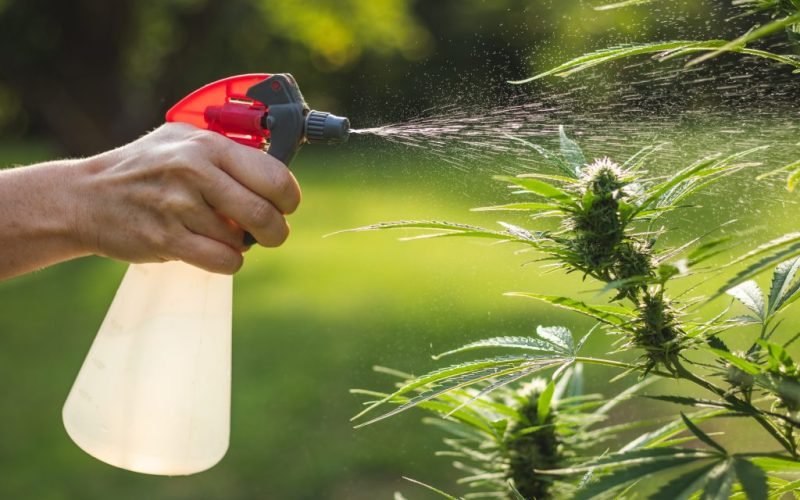
Pesticide remediation is the process of reducing pesticide residues in a cannabis extract to an acceptable level, and for processors it works pesticide by pesticide and not as a single fix. The contamination it addresses is well documented: a peer-reviewed study of cannabis tested in 2016 and 2017 identified 50 different pesticides, and 9 of them are classified by the World Health Organization as highly or extremely hazardous.
This blog explains why residues carry into extracts, what remediation methods can and cannot separate, when remediation is not the answer, and how to verify that it worked.
Sections
ToggleKey Takeaways
- Extraction can concentrate pesticide residues into the finished extract, so an extract can fail testing even when the plant material looked acceptable.
- Purification steps such as winterization and distillation should not be assumed to remove pesticides, and regulators ask for scientific support that a process addresses the specific pesticide.
- Remediation works pesticide by pesticide. In a 2023 benchtop study, one chromatography method separated 7 of 11 pesticides and 25 of 26 cannabinoids, while others overlapped with cannabinoids and needed more steps.
- Some batches should not be remediated, including those with no validated method for the failing pesticide, so destruction can be the correct outcome.
- A remediated batch is only proven by retesting, and the plan, materials, and results should be documented from the start.
The table compares the main approaches and what the evidence reviewed for this blog shows about each.
Approach | How it works | What the evidence shows |
Preparative chromatography | Separates pesticides from cannabinoids as they travel through a column at different speeds | A 2023 study separated 7 of 11 pesticides and 25 of 26 cannabinoids, with some pesticides needing more steps |
Adsorbent media | Passes the extract over solid media that binds contaminants | Depends on the media and the pesticide, and no peer-reviewed removal data was found in the sources reviewed |
Winterization and distillation | Purification steps designed to remove waxes, lipids, and other compounds | Persistence of at least one pesticide has been reported, so they should not be assumed to remediate |
Why Pesticides Carry Over Into Extracts?
Pesticides are applied to the plant, and any residue that dissolves in the extraction solvent travels with the cannabinoids. Once the solvent is removed, the extract is a much smaller mass than the plant it came from, so the same residues sit at a higher concentration. A pesticide level that looks small in flower can therefore become a failing result in a concentrate.
The reporting from Terpenes and Testing summarizes the point as extraction concentrating pesticides, not removing them. The Oregon data in the study above adds context on how common residues were. It found high levels of residual pesticides in both recreational and medicinal samples, including pesticides not legally allowed on cannabis, and medicinal products had mean residual levels 3 to 12 times higher than recreational ones.
For a processor, the lesson is that a pesticide result on incoming material does not guarantee a pass on the extract, and a margin below the limit on flower may not survive concentration.
Does Distillation or Winterization Remove Pesticides?
It is tempting to assume that purification steps such as winterization and wiped film distillation clear contaminants along with waxes and lipids. That assumption is risky. Terpenes and Testing reports that myclobutanil, a fungicide of particular concern, may persist through winterization or distillation, and that it can form hazardous compounds when heated. The reporting is trade press and not a controlled study, so the safest reading is that these steps are unproven for pesticides unless a processor has data.
Regulators take the same view. California’s remediation plan form asks the processor to show scientific support or validation studies that the process can address the specific adulterant, and to say which step in the plan addresses it. A general purification step does not meet that test by default.
In practice, if a batch fails for a pesticide, the purification already performed should be treated as having failed to solve the problem, and any further processing should be justified with test data.
Pesticide Remediation Methods for Extracts
Remediation methods work by exploiting a difference between the pesticide and the cannabinoid, such as how each moves through a column or binds to a surface. Two approaches come up most often in the research and trade literature.
The first is preparative chromatography. A 2023 study in the Journal of Cannabis Research tested a chromatography method across six cannabis matrices, including raw flower, crude extracts, distillate, and distillation byproducts. It separated 7 of 11 pesticides and 25 of 26 cannabinoids. The authors described fractionation of the eluent as a highly attractive industrial solution, while noting that some pesticides need extra steps. This was a benchtop study, so it shows what is possible in principle and not what a production line will achieve.
The second is adsorbent-based remediation, where the extract passes over solid media that binds contaminants. The sources reviewed for this blog gave no peer-reviewed removal data for adsorbents, so a processor should ask for validation data on the specific pesticide and extract type before relying on one.
Whichever method is chosen, the result should be confirmed by retesting the remediated material and not assumed from the method.
Why One Method Does Not Clear Every Pesticide?
The same study shows how uneven the results can be. Each pesticide came off the column at a different time, and the time relative to the cannabinoids decided whether separation was easy or hard.
Result in the study | Pesticides | What it means |
Eluted within 3.6 minutes, ahead of the cannabinoids | Clothianidin, imidacloprid, carbaryl, diuron, spinosyn A, myclobutanil | Separated cleanly from the cannabinoids |
Eluted close to a cannabinoid | Boscalid (3.55 min) near 7-OH-CBD (3.44 min) | Close enough that separation needs care |
Overlapped with cannabinoids | Pyrethrins, permethrin, piperonyl butoxide | Needed further purification steps |
Three factors explain why a method that works on one failure can fail on the next.
- Pesticide chemistry. Each compound moves and binds differently, so some separate cleanly and others overlap with cannabinoids.
- Matrix. The study used six matrices, and flower extract, distillate, and byproducts behave differently.
- Scale. A method validated at benchtop scale needs further validation before production use.
This is why a remediation plan should start from the pesticide profile on the failed test and pick a method to match it, not the other way around.
When Pesticide Remediation Is Not the Answer
Remediation is not always possible, and sometimes it is not the right choice even when it is allowed. The research and regulatory guidance point to several situations where destruction or a different route is the better outcome.
- No validated method exists for the failing pesticide. Pyrethrins, permethrin, and piperonyl butoxide overlapped with cannabinoids in the 2023 study and needed extra purification.
- The plan cannot show scientific support. Regulators such as California’s expect validation evidence for the specific adulterant.
- The batch fails again after remediation. A second failure is a sign that the method is not suited to that pesticide or matrix.
- The rules for that product or state do not allow remediation. Some jurisdictions require failed batches to be destroyed.
Remediation also adds processing, solvents, retesting, and documentation, which a processor weighs against the value of the batch. That calculation is specific to each operation, so this blog does not set a threshold, and no source reviewed supports a universal one.
Verifying Remediation: Retesting and Documentation
A remediated batch is not proven until it is tested again, and the records are part of the process. California’s plan form shows what a regulator may expect to see: each remediation step and its intent, the materials, solvents, reagents, and equipment used, and a hazard analysis covering biological, chemical, and physical hazards. It also asks for supporting documents and, for adulterated product, a root cause analysis.
A processor can build the same discipline into every remediation, whatever the rules in its state.
- The failed result, with the pesticide, the level, and the limit it was measured against.
- The method chosen and the reason it suits that pesticide.
- Materials, solvents, and equipment, with their purpose and food-grade documentation where relevant.
- The retest result, and potency results before and after.
- The root cause, traced to the supplier lot, cultivation practice, or process step.
Keeping these records current from the start is far easier than rebuilding them after a failure.
Preventing Pesticide Failures Upstream
The cheapest remediation is the one a processor never needs. Testing incoming material before extraction avoids processing contaminated biomass in the first place. The guide to in-house cannabis testing covers how processing labs build this into their workflow.
Upstream control also includes asking suppliers for pesticide results by lot, keeping lot records through extraction, and recording the margin between each result and the limit. A narrow margin on input is a signal that concentration could push the extract over.
Questions to Ask Before Choosing a Remediation Approach
The table lists questions that help a processor decide whether and how to remediate, along with why each matters.
Question to ask | Why it matters |
Which pesticides failed, and by how much? | Methods work pesticide by pesticide, and the margin affects feasibility |
Is there validation data for this pesticide and matrix? | Regulators expect scientific support, and some pesticides overlap with cannabinoids |
Has the method been shown beyond benchtop scale? | Benchtop results do not guarantee production performance |
What will retesting cover? | A remediated batch is proven only by a new test |
What will happen to potency and the rest of the profile? | The 2023 study focused on separation, so results should be confirmed with potency testing |
Where did the contamination come from? | Fixing the source prevents the same failure |
The common thread is evidence. A remediation plan that names the pesticide, the method, the validation data, and the retest result is easier to defend to a regulator and to a buyer.
Making the Remediation Decision
Pesticide remediation sits where chemistry and quality control meet. The research shows that methods can separate many pesticides from cannabinoids but not all of them, and that results depend on the pesticide, the extract, and the scale.
Processors that test incoming material, treat purification steps as unproven for pesticides, and document every step are in a better position when a batch fails. Where the chemistry or the rules say remediation will not work, destroying the batch is a legitimate outcome and not a failure of process.
Frequently Asked Questions
Does remediation change the cannabinoid content of an extract?
The 2023 study focused on separating pesticides from cannabinoids and reported that 25 of 26 cannabinoids separated cleanly, but it did not report yield or potency changes after processing. That means the effect on potency is not established by the research reviewed here. Potency should be tested before and after remediation and recorded with the batch. A certificate of analysis for each stage is the clearest way to show what changed.
Why can a remediation that works on one extract fail on another?
The 2023 study tested six matrices, including raw flower, crude extracts, distillate, and distillation byproducts, because each behaves differently in a separation. A method validated on one matrix may not carry over to another with a different composition. The pesticide itself also matters, since some separated cleanly and others overlapped with cannabinoids. Validation should therefore name both the pesticide and the extract type.
What does a validation record for a remediation need to show?
California’s plan form is a useful model. It asks for each step and its intent, which step addresses the adulterant, scientific support or validation studies for that specific pesticide, and a list of materials, solvents, reagents, and equipment. It also asks for a hazard analysis covering biological, chemical, and physical hazards. A record that answers those points is easier to defend to any regulator or buyer.
What does remediating below the action level mean in practice?
Regulators set action levels, and they vary by pesticide and by jurisdiction, so the target is a specific number from the applicable table and not a general standard. Limits listed on third-party pages can be inconsistent, which is why the regulator’s own table is the reference to use. A processor should record which version of the table applied on the test date. The remediated batch is judged against that number on retesting.
Is a pesticide failure a one-time problem or a root-cause issue?
California expects the original manufacturer of an adulterated product to run a root cause analysis and add preventive measures to its product quality plan. That treats a failure as a signal about the supply chain or process, not only a batch to fix. Tracing the failure back to the supplier lot, the cultivation practice, or an internal step helps prevent the same failure next time. It also gives a regulator evidence that the problem is being addressed.