
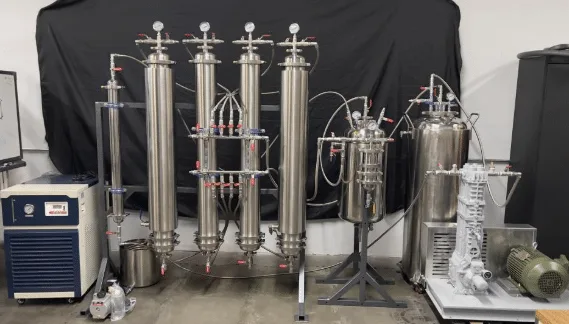
Closed-loop BHO extraction equipment prevents solvent loss through specific design features, including full-bore active recovery lines, jacketed columns, inline dewaxing coils, sintering filters, and engineered recovery tanks, that physically contain and recapture butane at every stage of the process instead of releasing it as vapor.
This article breaks down exactly which design elements do this, how each one works, and what to check for when evaluating closed-loop BHO equipment.
Sections
ToggleKey Takeaways
- Solvent loss in closed-loop BHO extraction occurs at predictable points, including incomplete recovery, vapor escape at fittings/transfers, and residual solvent left in material, and equipment design addresses each one directly.
- Active recovery kits with full-bore lines reduce recovery time and the volume of vapor left uncaptured compared to passive recovery systems.
- Inline dewaxing and jacketed columns reduce the need for reprocessing, which is one of the biggest indirect contributors to solvent loss.
- Certification standards like C1D1 and ASME exist for the same underlying reason as loss-prevention design: containing butane vapor. NFPA 420, expected in 2027, will formalize this further at the facility level.
- Residual solvent regulations vary significantly by state and have shifted over time, making equipment-level recovery efficiency a more reliable standard to design around than any single state’s current limit.
Closed-Loop BHO Design Elements at a Glance
Design Element | What It Does | Solvent-Loss Impact |
Full-bore active recovery lines | Widens the recovery path and actively pulls vapor back instead of relying on passive condensation | Cuts recovery time and reduces vapor left uncaptured |
Jacketed & sleeved columns | Regulates material temperature during extraction | Improves single-pass efficiency, reducing reprocessing that reopens the system |
Inline dewaxing/injection coils | Chills and separates waxes during, not after, extraction | Removes a separate open-air post-processing step |
Sintering filters | Traps fine plant material before it reaches the collection vessel | Prevents clogging that forces manual intervention (and venting) |
Sight glasses | Lets operators visually track solvent flow in real time | Catches leaks or incomplete transfer before they become losses |
Color remediation columns (CRC) & recovery tank engineering | Handles final-stage purification and condensation | Recaptures the last fraction of solvent that basic systems vent or discard |
How Closed-Loop Equipment Design Prevents Solvent Loss in BHO Extraction?

Solvent loss in butane hash oil (BHO) extraction happens at a few fairly predictable points. Well-designed closed-loop hardware is built specifically to close off each of these points rather than relying on the operator to manage them procedurally:
- Incomplete recovery: solvent left uncaptured at the end of a run
- Vapor escape: loss through loose fittings or manual transfers between components
- Residual solvent in material: butane left behind in wax or filtered material that then has to be purged separately
The result is a system where butane moves from tank to material column to recovery tank in a sealed path, with every transition (injection, extraction, separation, recovery) engineered to keep the solvent inside the loop. This is different from a system that is technically “closed” but still loses meaningful solvent to inefficient recovery hardware or extra open-air steps. The specific components below are what separate the two.
Full-Bore Recovery Lines & Active Recovery Kits
Passive recovery, where the system simply relies on pressure differential and ambient condensation to pull butane back into the recovery tank, is slower and tends to leave more solvent in the column and collection vessel at the end of a run.
Active recovery kits use a compressor to actively pull vapor through the line, and pairing that with full-bore (typically ½” or larger) recovery lines removes the bottleneck that causes vapor to back up and vent during recovery. Wider lines plus active pull materially shortens recovery time, which in practice means less butane sitting exposed in the system waiting to be recaptured.
Jacketed & Sleeved Columns
Temperature-controlled jacketing around the material column lets operators run colder extractions (useful for fresh-frozen or terpene-sensitive material) without needing a separate chilling step.
This matters for solvent loss because a poorly temperature-controlled column often produces a lower-quality first pass, pushing operators toward reprocessing the same material, and every extra pass means the system is opened, reloaded, and re-run, multiplying the number of points where solvent can escape. A jacketed or sleeved column that gets a clean result on the first pass reduces that exposure.
Inline Dewaxing & Injection Coils
Dewaxing, or removing plant lipids and waxes to improve clarity, has traditionally been a separate post-processing step done after the main extraction is complete and the material has already left the closed system. Inline dewaxing via chilled injection coils performs this step inside the column, during extraction.
Removing a step that used to happen outside the closed loop is a direct reduction in the number of times solvent-laden material is handled in an open environment.
Sintering Filters & Sight Glasses
A 50-micron (or finer) sintering filter keeps fine plant particulate out of the collection vessel, which prevents the clogging that otherwise forces an operator to manually clear the column, a manual intervention that risks a partial system opening and vapor release.
Sight glasses serve a related but distinct function: they let the operator watch solvent flow and material separation happen in real time, so a slow transfer, an air pocket, or a partial blockage gets caught and corrected mid-run instead of discovered afterward, when the volume already lost isn’t recoverable.
Color Remediation Columns (CRC) & Recovery Tank Engineering
By the time material reaches final-stage purification, most solvent should already be back in the recovery tank, but the recovery tank itself is where the last, hardest-to-capture fraction gets handled. A well-engineered recovery tank uses a combination of a compressor, condenser coil, and vacuum pump to condense butane vapor back to liquid efficiently rather than venting the tail end of a run.
Color remediation columns operate downstream of this, refining the extract’s clarity without reintroducing new solvent exposure. Systems that treat the recovery tank as an afterthought, with undersized condensing capacity or no vacuum assist, are typically where the final percentage points of recoverable solvent get lost.
Certification Standards That Reflect Good Design
Equipment design that minimizes solvent loss overlaps heavily with what’s required for hydrocarbon extraction equipment to be certified for commercial use in the first place. Butane’s low flash point means any vapor escaping the loop is both a loss and a hazard, and the two problems share the same root cause and the same design fix: containment. The main standards to know:
- Class 1 Division 1 (C1D1): certifies that electrical components are safe to operate in an area where flammable vapor may be present
- ASME pressure vessel standards: govern the design and testing of the tanks and columns that hold pressurized solvent
- NFPA 420 (in development): the first standalone fire protection standard for cannabis facilities, expected to formalize containment and vapor-handling requirements at the facility level
This is also an area actively evolving in 2026. The National Fire Protection Association has been developing NFPA 420, a first-of-its-kind, stand-alone fire protection standard specifically for cannabis growing, processing, and extraction facilities, targeting a 2027 first edition, building on the earlier work of NFPA 1, Fire Code. For extraction facilities, this means the compliance bar for equipment containment and vapor handling is being formalized rather than pieced together from adjacent codes, which is worth tracking when budgeting for new hardware.
There’s also a regulatory angle specific to how much solvent loss actually shows up in the finished product. A Leafly investigation found that Colorado’s regulatory threshold for residual butane in cannabis concentrates rose more than sixfold, from 800 parts per million to 5,000 parts per million, after the state aligned its limits with a pharmaceutical-industry solvent standard, a change industry commentary at the time noted didn’t actually reflect what well-run, professional closed-loop equipment was already achieving.
Utah’s cannabis testing rules, by contrast, still list specific action-level thresholds for individual residual solvents, underscoring that these limits vary meaningfully by state, another reason equipment that recovers solvent efficiently at the design level, rather than relying on regulatory headroom, is the safer long-term bet for producers selling across multiple markets.
What to Look for When Evaluating Closed-Loop BHO Equipment
When comparing systems, the design elements above translate into a practical checklist:
- Active (not passive) recovery with full-bore lines
- Jacketed or sleeved column options if you’re running fresh-frozen material
- Inline dewaxing if extract clarity matters for your product line
- A sintering filter rated fine enough for your material
- Sight glasses on the column and recovery path
- A recovery tank sized with adequate condensing and vacuum capacity for your actual throughput, not just your batch size on paper
It’s also worth asking any manufacturer directly what independent recovery-rate data they can share, rather than taking a marketing percentage at face value. Root Sciences works through this evaluation directly with teams setting up or scaling an extraction lab, matching equipment specs to actual production goals.
Conclusion
Solvent loss in closed-loop BHO extraction isn’t primarily an operator discipline problem. It’s a hardware design problem, and it’s solved the same way: by engineering out the points where butane can escape the loop. Full-bore active recovery, jacketed columns, inline dewaxing, precision filtration, and a properly sized recovery tank each close off a specific loss point.
For a broader look at how closed-loop systems work across both BHO and ethanol, see our closed-loop extraction overview, and for BHO-specific process fundamentals, our BHO extraction guide covers the basics this piece builds on.
FAQs
1. Does a higher recovery percentage always mean less residual solvent in the final extract?
Not necessarily. Recovery percentage measures how much butane the system pulls back into the recovery tank during processing, while residual solvent testing measures what’s left in the finished concentrate after purging. A system can have excellent recovery and still require a proper vacuum purge step to bring residual levels down to target, since the two numbers address different stages of the process.
2. Can retrofitting an older closed-loop system with an active recovery kit meaningfully reduce solvent loss, or is it better to replace the unit?
Retrofitting can help, particularly if the existing system has passive recovery and undersized lines, but it depends on whether the column, valves, and recovery tank are rated to work with the added recovery capacity. It’s worth having the full system reviewed rather than assuming a single component swap solves loss across the board.
3. How does running fresh-frozen material affect solvent loss compared to cured material?
Fresh-frozen material introduces more moisture and plant lipids into the column, which increases the load on filtration and dewaxing components. If those components aren’t sized for it, you’ll see more reprocessing, and more reprocessing means more open-loop handling steps and more opportunity for loss.
4. Is there a way to independently verify a manufacturer’s stated solvent recovery rate before buying equipment?
Ask for third-party validation or documented test runs rather than relying on a quoted percentage alone, and where possible, ask other operators running the same model at similar throughput what they’re seeing in practice. Recovery rates are also throughput- and maintenance-dependent, so a rate achieved in a controlled demo may not hold at your production volume.
5. Do state-level residual solvent limits affect how extraction equipment should be designed, or only how the finished product is tested?
They’re related but separate. Equipment design determines how much solvent is captured during processing; state limits determine how much residual solvent is allowed in the final product regardless of how it got there. Because those limits vary by state and have shifted over time, producers selling into multiple markets generally get more consistent results by designing for maximum recovery at the equipment level rather than relying on the most permissive applicable limit.