
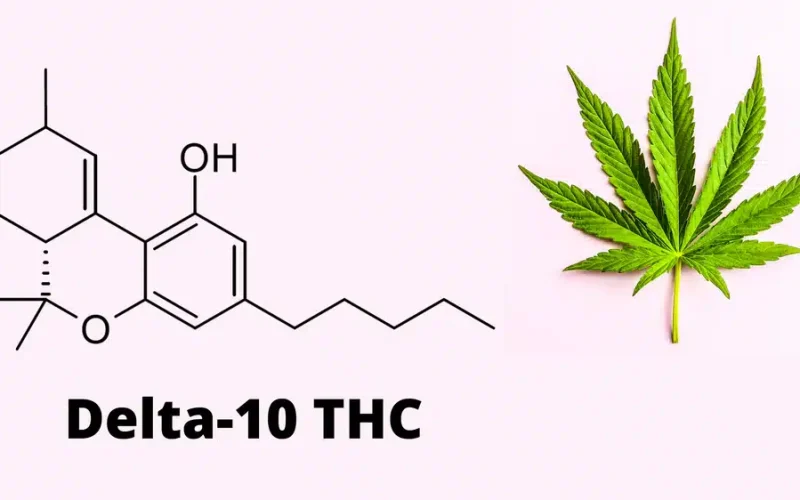
Delta-10 THC is a cannabinoid that is typically found in cannabis in very small amounts and is most often available as a hemp-derived product made through cannabinoid conversion. People commonly describe Delta-10’s effects as milder than Delta-9 THC and often more uplifting or “daytime-friendly” compared to other THC variants. That said, Delta-10 is still psychoactive, product quality varies a lot, and the legal landscape can be confusing.
This guide breaks down what Delta-10 THC is, what it feels like, how long it takes to kick in, potential benefits and side effects, drug testing concerns, legality, and how to choose products you can actually trust.
Important: This article is for education only. It is not medical advice. Always check local laws and talk to a qualified healthcare professional if you have health conditions or take medications.
Sections
ToggleWhat is Delta-10-THC?
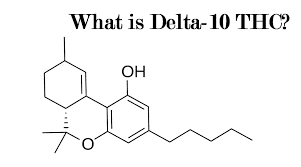
Delta-10 THC (Delta-10-tetrahydrocannabinol) is a THC isomer. This means it has the same basic formula as Delta-9 THC but a slightly different arrangement of atoms. That small structural difference can change how it interacts with receptors in the body and how people experience its effects.
Delta-10 occurs naturally in trace amounts, which is why most commercial Delta-10 products are made by converting hemp-derived cannabinoids (commonly CBD) into Delta-10 and then refining or purifying the resulting extract. Because the product is created through conversion and processing, testing and manufacturing standards matter a lot.
If you are newer to THC variants, it helps to understand how Delta-10 fits into the broader THC family. For a foundation on the most well-known form, see our Delta-9 THC comprehensive guide.
How Does Delta-10-THC Affect the Body?
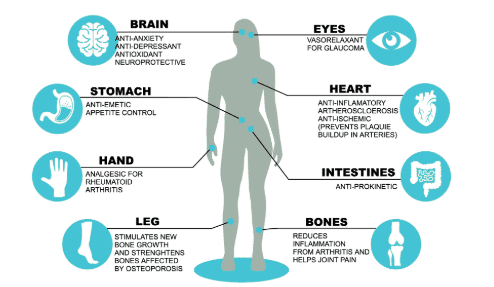
Delta 10 interacts with the body’s endocannabinoid system similar to Delta 8 and Delta 9 THC, but with slightly different binding affinity. It primarily binds with CB1 receptors in the brain and central nervous system. Due to its interaction with CB1 receptors, this cannabinoid has little psychoactive effects and only potential therapeutic benefits.
Potential Benefits:
- Improved mental clarity and focus
- Mild euphoria similar to THC in cannabis but without overwhelming sedation
- Potential mood enhancement and stress relief
- Possible pain-relieving properties
Can Delta-10-THC Get You High?
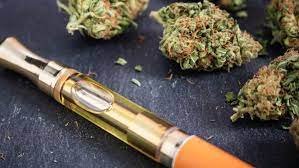
Yes, delta 10 THC can produce a psychoactive effect or “high” similar to delta 8 and delta 9 THC, but not to the same extent. The effects are milder and create a more energetic experience compared to traditional THC. Delta 9 is highly psychoactive in its natural form, delta 8 and delta 10 THC are found in trace amounts. These compounds are synthetically enhanced and typically use solvents. Delta 10 falls on the lower end of the potency spectrum compared to the other two variants. This form of THC is potentially appealing to those seeking subtle effects or who are sensitive to THC.
Delta-10 THC Effects: What Does It Feel Like?
People commonly search phrases like “what does Delta-10 feel like,” “does Delta-10 get you high,” or “does Delta-10 make you high” because effects vary by person. That said, common reported effects include:
- Mild euphoria
- Uplifted mood
- Increased sociability
- Light body relaxation (less “couch-lock” for many users)
- A more energized or clear-headed feel compared to heavier THC experiences
Some people also report unwanted effects, especially at higher doses, like anxiety, racing thoughts, or dizziness.
Potential Benefits of Delta-10 THC (What People Use It For)
Research on Delta-10 specifically is still developing, so it is best to be careful with claims. Most “benefits” discussed online come from consumer reports and from what we know about cannabinoids more broadly.
Common reasons people try Delta-10 THC include:
1) Mood lift and stress relief (reported)
Some users report Delta-10 feels like a lighter mood boost that is less sedating than other THC products.
2) Daytime-friendly use (reported)
Because Delta-10 is often described as less heavy, some users prefer it for daytime situations where they still want to stay functional.
3) Mild euphoria without heavy sedation (reported)
For people who find Delta-9 too strong, Delta-10 can feel like a lower intensity option.
If you are sensitive to THC, the safest approach is always to start low, go slow, and choose products with strong lab testing.
Delta-10 Dosage: How Much Should You Take?
One of the most common queries is “how much Delta-10 should I take?” The honest answer is that it depends on the product format, your tolerance, and your sensitivity.
Here is a conservative starting framework many consumers follow (not medical advice):
Suggested starting points (beginner-friendly)
- Edibles (gummies): Start with 2.5 to 5 mg, then wait at least 2 hours before taking more
- Tinctures: Start with 2.5 to 5 mg, then wait 60 to 90 minutes before increasing
- Vapes: Start with 1 small puff, then wait 10 to 15 minutes before taking another
General dosing tips
- Do not stack doses too fast, especially edibles.
- If you are unsure, choose a product with clear mg-per-serving labeling and a COA.
- Avoid high-dose edibles early on. Delta-10 gummies can feel stronger than expected once metabolized.
How Long Does Delta-10 Take to Kick In? (Onset and Duration)
Queries like “how long does Delta-10 take to kick in” are common because onset varies by method.
Delta-10 onset and duration (typical ranges)
Method | Onset | Peak | Duration |
Vape or inhalation | 1 to 10 minutes | 15 to 30 minutes | 1 to 3 hours |
Tincture (sublingual) | 15 to 45 minutes | 45 to 90 minutes | 2 to 4 hours |
Edibles (gummies, etc.) | 30 to 120 minutes | 2 to 4 hours | 4 to 8+ hours |
Edibles are the biggest source of “oops, too much” experiences because people do not wait long enough.
Delta-10 THC Side Effects, Risks, and Safety
People search “is Delta-10 safe” and “Delta-10 side effects” because quality varies widely.
Possible short-term side effects
- Dry mouth
- Red eyes
- Increased heart rate
- Dizziness
- Anxiety or restlessness (especially at higher doses)
- Impaired coordination or reaction time
Potential longer-term risks (especially with heavy use)
- Tolerance development
- Dependence in some users
- Possible cognitive or mood effects with prolonged heavy use
The biggest safety variable: product purity
Because many Delta-10 products are made through conversion, the most important safety steps are:
- Buy from brands that provide current third-party lab tests (COAs)
- Avoid products with unclear sourcing or missing test results
- Confirm the COA includes contaminant screening, not just potency
How to Know if Delta-10 Products are Clean and Accurately Labeled (COA Checklist)
If you want to stand out vs competitors, this is where you win with practical guidance.
Before buying any Delta-10 product, look for a third-party COA that includes:
Potency and cannabinoid profile
- Delta-10 content (mg/g or %)
- Delta-9 THC content (and whether it meets legal thresholds where applicable)
- Presence of other cannabinoids (Delta-8, HHC, etc.)
Contaminant testing (non-negotiable)
- Residual solvents
- Heavy metals
- Pesticides
- Microbial contamination
- Mycotoxins (where applicable)
If a brand only shares potency but not contaminants, that is a red flag.
For additional cannabinoid comparison context, these related guides can help:
Delta-10 vs Other Cannabinoids (Delta-8, Delta-9, THCA, HHC)
Delta-10 vs Delta-9
- Delta-9 is typically stronger and more intoxicating
- Delta-10 is often reported as milder and more uplifting
Learn more basics here: what is Delta-9 THC
Delta-10 vs Delta-8
- Delta-8 is often described as calmer and more body-relaxing
- Delta-10 is often described as lighter and more “daytime”
For a deeper foundation: Delta-8 vs Delta-9 THC
Delta-10 vs THCA
THCA is a different kind of THC-adjacent topic that can overlap with legal conversations. Here is the comparison: THCA vs Delta-9
Delta-10 vs HHC
HHC is often discussed alongside Delta cannabinoids and may feel different depending on formulation and dose. See: HHC vs Delta-10
What is Delta-6a10a THC and How Does it Compare to Delta-10?
You will sometimes see Delta-6a10a THC mentioned in product listings and forums. It is often discussed as a THC-related compound that may show up in certain hemp-derived formulations. Because labeling and naming conventions vary across brands and labs, it is especially important to:
- Confirm the exact compound on the COA
- Understand mg per serving
- Ensure full contaminant screening is included
If a product uses confusing naming but does not provide a detailed COA, treat that as a red flag.
Find the right extraction equipment for your needs today!
Conclusion
Delta 10 is an exciting development for cannabinoid manufacturers and consumers. This variation of THC not only offers a unique profile of effects but is also safer compared to Delta-8 and Delta-9 THC due to its mildest psychoactive nature.
Whether you are seeking enhanced focus, mild euphoria, or potential therapeutic benefits, delta 10 provides them all without the intense psychoactive effects associated with traditional THC. As it is still under research and evolution, be aware of the potential side effects or risks, especially long-term side effects. You can prioritize safety by purchasing delta 10 products from reputable sources, starting with low doses, and being aware of the legal status in your area.
With safer consumption, delta 10 offers exciting possibilities, from boosting productivity to offering a clear-headed alternative to other forms of THC. You can use Delta 10 THC for both recreational and therapeutic purposes, with a bit of caution.
FAQs
Yes, Delta-10 THC can be psychoactive and produce a high, typically reported as milder than Delta-9.
Many users report Delta-8 feels more relaxing and body-heavy, while Delta-10 feels lighter and more uplifting. Strength depends on dose and product quality.
Delta-10 can occur naturally in trace amounts, but most commercial products are made by converting hemp-derived cannabinoids. Always check COAs.
Most people report Delta-10 is less intense than Delta-9, but experiences vary.
Vapes can kick in within minutes; edibles can take 30 to 120 minutes. Always wait before increasing your dose.
Often 1 to 3 hours for vapes, and 4 to 8+ hours for edibles, depending on dose and tolerance.
It may. Many tests look for THC metabolites rather than identifying specific THC variants.