
A cannabinoid nanoemulsion that looks perfectly clear on day one and shows creaming, ringing, or potency drift by week four isn’t a processing failure so much as a stabilizer mismatch. High-pressure homogenization can hit a target droplet size reliably, but droplet size alone doesn’t guarantee shelf stability.
What actually determines whether a batch holds up over its intended shelf life is whether the stabilizer system addresses the specific ways nanoemulsions break down, not just how small the droplets were on the day the batch was made.
Key Takeaways
- Nanoemulsions fail through three distinct pathways, Ostwald ripening, coalescence, and flocculation, and a stabilizer effective against one isn’t automatically effective against the others.
- An all-in-one stabilizer system typically combines a primary emulsifier with a co-stabilizer or ripening retardant, addressing more than one degradation pathway rather than relying on interfacial tension reduction alone.
- Homogenization pressure and droplet size are directly linked, but published research shows the relationship has diminishing returns past a certain point, not a straight line.
- Stabilizer chemistry and HPH process parameters need to be matched together, since a stabilizer optimized for a different energy-input method won’t necessarily perform the same way through a valve homogenizer.
- Droplet size distribution at time zero is a starting point for stability testing, not a substitute for it; accelerated stability testing is what actually confirms shelf performance.
Why Nanoemulsions Fail: Three Distinct Degradation Pathways
Treating nanoemulsion instability as a single problem leads to picking a single-mechanism fix, which is a common reason a formulation that tests well initially still fails on the shelf. Research on nonionic-surfactant-stabilized nanoemulsions, published in Physical Chemistry Chemical Physics, found that Ostwald ripening is the main coarsening process only in nanoemulsions with low oil-phase fractions, roughly up to 5 percent.
At the higher oil-phase fractions typical of commercial beverage and edible formulations, flocculation and coalescence take over as the dominant failure modes instead, with coalescence becoming the primary driver of long-term degradation.
Failure Mode | What’s Happening | When It Dominates |
Ostwald ripening | Cannabinoid diffuses from smaller droplets to larger ones through the water phase, since smaller droplets have higher effective solubility | Dominant mainly at low oil-phase fractions; less of a driver once oil content rises past roughly 5 percent |
Coalescence | Two droplets collide and merge into one, permanently increasing average droplet size | Becomes the primary long-term failure mode at the oil-phase fractions typical of commercial beverage formulations |
Flocculation | Droplets clump together without merging, often visible early as haze or a loose sediment layer | Can precede coalescence, since clustered droplets have far more contact time to eventually merge |
- Formulating against Ostwald ripening alone, when the product’s actual oil fraction puts coalescence in the driver’s seat, leaves the real failure mode unaddressed.
- A stability plan should identify which mechanism is most likely at the product’s specific oil-phase fraction before selecting a stabilizer strategy.
What ‘All-in-One’ Stabilizer Systems Actually Combine
A single surfactant reduces interfacial tension between the oil and water phases, which is necessary for emulsification but insufficient on its own for long-term stability against all three failure modes. All-in-one stabilizer blends typically layer two or more functions into one system: a primary emulsifier to establish the interfacial film, plus a co-stabilizer that adds either steric bulk or electrostatic charge to keep droplets from approaching closely enough to coalesce or flocculate.
A recent review on emulsion stability mechanisms, published in Food Chemistry Advances, found that stabilizer type directly determines interfacial film thickness, and thicker films correlate with better long-term stability. Surfactant-only films measured roughly 0.5 to 1 nanometer thick, proteins 1 to 5 nanometers, and hydrocolloids or solid particles 5 nanometers up to several micrometers. A stabilizer system that layers a surfactant with a hydrocolloid or polysaccharide co-stabilizer builds a meaningfully thicker interfacial barrier than either ingredient would produce alone.
- Steric stabilization works by physically blocking droplets from approaching each other closely enough to merge, using bulk rather than charge.
- Electrostatic stabilization relies on surface charge, measured as zeta potential, where higher-magnitude charge produces stronger droplet-to-droplet repulsion.
- Combining both mechanisms in one stabilizer system is generally more robust across a wider range of storage conditions than relying on either alone.
How High-Pressure Homogenization Fits the Stabilizer Choice?
Stabilizer chemistry and the homogenization process aren’t independent decisions. What happens physically inside the homogenizing valve determines the droplet size the stabilizer then has to protect.
What Actually Happens in the Valve?
Droplet breakup in a high-pressure homogenizer happens through a combination of forces acting in a fraction of a second as product passes through a narrow valve gap, as described in manufacturer process documentation from BOS Homogenisers: rapid acceleration and pressure drop across the gap, intense shear as adjacent liquid layers move at different velocities, turbulence where the accelerated jet strikes the valve’s impact ring, and cavitation, vapor bubbles that form and then collapse as pressure recovers downstream of the valve, releasing localized shockwaves that further fragment droplets.
Pressure and Droplet Size, With Diminishing Returns
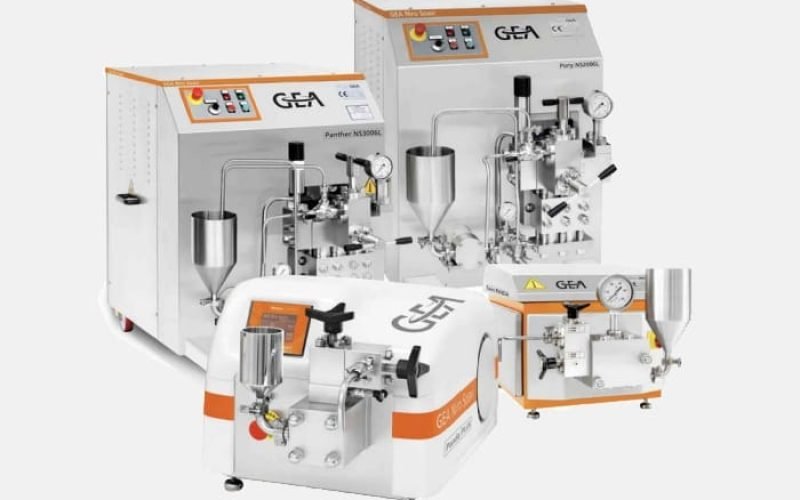
The same Food Chemistry Advances review found homogenization pressures studied across a range of roughly 0.1 to 120 megapascals, with higher pressures in the 40 to 120 MPa range producing smaller droplet sizes and greater emulsion stability. In practice, this relationship flattens well before the top of that range: past a certain pressure and pass count for a given formulation, additional energy input adds heat load and equipment wear without meaningfully shrinking droplets further. High-pressure homogenizers built for nanoemulsification, such as the Panther, let operators run controlled multi-pass processing to find that point for a specific formulation rather than guessing at a single pressure setting.
Matching Stabilizer Chemistry to Your HPH Process
A cannabis extract nanoemulsion study published in Ultrasonics Sonochemistry achieved median droplet sizes below 100 nanometers using a Tween 80 and Span 80 surfactant blend with an optimized hydrophilic-lipophilic balance, while a natural surfactant tested in the same study failed to produce a comparable result.
That study used ultrasonic processing rather than a valve homogenizer, but the underlying principle transfers directly: surfactant HLB has to be tuned to the specific oil phase being emulsified, and swapping in a different stabilizer chemistry without re-optimizing HLB for that formulation is a common reason a process that worked with one crude batch underperforms with another.
- Run a pre-mix and pre-homogenization step, typically with a rotor-stator high-shear mixer, before the HPH pass; feeding an unmixed emulsion directly into the homogenizer wastes processing capacity on coarse droplet reduction the pre-mix step handles more efficiently.
- Track product temperature through the HPH pass, since the same pressure drop and shear that break down droplets also generate heat, and excess heat can degrade both cannabinoids and terpenes before the batch reaches packaging.
- Operations scaling past bench trials toward continuous production runs typically move to a higher-throughput platform such as the Pony, where consistent stabilizer dosing into a continuous feed matters as much as the homogenization step itself.
- Re-validate HLB and stabilizer ratio whenever the crude source, cannabinoid concentration, or target oil-phase fraction changes, rather than assuming a formulation that worked once will transfer directly to a new input.
Verifying Stability Before Scaling Production
Droplet size measured immediately after homogenization confirms the process worked, not that the formulation will hold up over its intended shelf life. A meaningful stability plan checks droplet size distribution, zeta potential, and visual appearance at intervals over accelerated storage conditions, typically elevated temperature and freeze-thaw cycling, before a formulation moves from bench batch to full production run.
- A narrowing or unchanged droplet size distribution over the test period indicates the stabilizer system is holding; a distribution that shifts upward over time signals ripening or coalescence in progress before it becomes visible.
- Zeta potential trending toward zero over storage time indicates the electrostatic component of the stabilizer system is breaking down, even if the emulsion still looks clear.
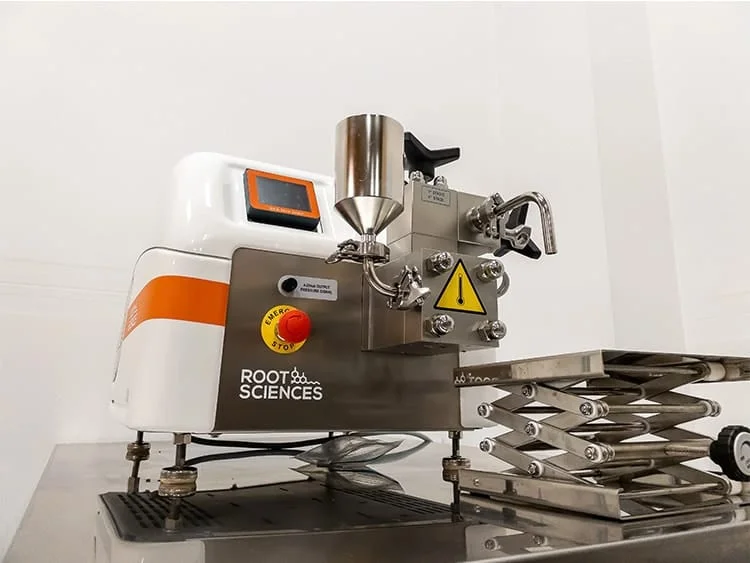
Bench-scale trials on a lab-format unit like the XStream are useful for narrowing stabilizer chemistry and pressure settings before committing formulation time to a full production batch, but stability results from a bench trial still need confirming at the actual production scale, since scale-up can change heat exposure and mixing dynamics enough to shift outcomes.
Conclusion
Getting a clear nanoemulsion out of a high-pressure homogenizer is the easier half of the problem. Keeping it stable through its full shelf life depends on matching the stabilizer system to the specific failure mode the formulation’s oil-phase fraction is actually exposed to, tuning HLB to the input material rather than a generic recipe, and confirming performance with real accelerated stability data before committing to a production run.
Equipment and formulation decisions made independently of each other are the most common reason a promising bench batch doesn’t hold up at commercial scale.
Frequently Asked Questions
What’s the practical difference between a nanoemulsion and a microemulsion?
Nanoemulsions are kinetically stable, meaning they don’t form spontaneously and require energy input, such as high-pressure homogenization, to create, and they remain stable for an extended but finite period. Microemulsions are thermodynamically stable and form spontaneously given the right ratio of ingredients, remaining stable indefinitely, but typically require significantly higher surfactant concentrations to achieve that spontaneous stability, which affects taste and formulation cost in a beverage application.
Does a stabilizer blend need to be matched to a specific HPH model, or does it transfer across equipment?
Stabilizer chemistry itself isn’t equipment-specific, but the pressure and pass-count settings needed to achieve a target droplet size with that stabilizer can vary between homogenizer models based on valve design and achievable pressure range. A formulation validated on one unit should be re-checked, not assumed identical, when moving to a different homogenizer.
How long should accelerated stability testing run before scaling to full production?
There’s no single universal duration, since it depends on the product’s intended shelf life and storage conditions, but a common approach runs elevated-temperature storage alongside real-time room-temperature storage for at least several weeks, checking droplet size and appearance at multiple intervals, before committing to a full production batch based on the results.
Does a smaller starting droplet size always mean better long-term stability?
Not by itself. Smaller droplets do improve resistance to creaming and can slow Ostwald ripening in some conditions, but if the stabilizer system doesn’t address coalescence and flocculation, a formulation with excellent initial droplet size can still destabilize over time. Droplet size and stabilizer chemistry both need to be right together.
What’s a realistic target droplet size for a cannabinoid beverage application?
Many commercial cannabinoid beverage nanoemulsions target droplet sizes under 100 nanometers, both for visual clarity in the finished beverage and for the bioavailability benefits associated with smaller droplet size. The achievable size in practice depends on the specific oil phase, stabilizer system, and homogenizer capability being used, so this is a target to validate against your specific formulation rather than a guaranteed outcome of any single process step.