
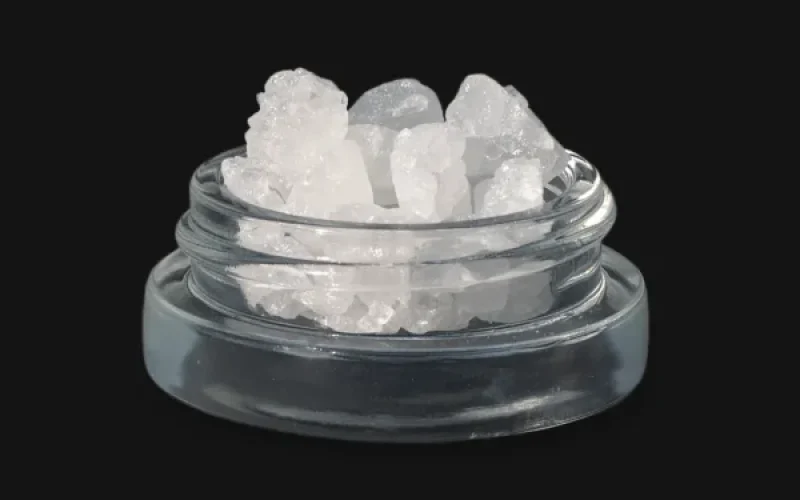
THCA diamonds are crystalline concentrates made of near-pure tetrahydrocannabinolic acid (THCA), the raw, non-intoxicating precursor to THC. Because state hemp testing guidance calculates total THC as delta-9 THC plus THCA multiplied by 0.877, a diamond testing at 99% THCA works out to roughly 86.8% total THC once heated. That gap between the THCA number and the total THC number is the most misread figure on a Certificate of Analysis, and it is where most buyer questions start.
Sections
ToggleKey Takeaways
- THCA diamonds are near-pure crystallized THCA, sold dry or in terpene sauce, and their quality depends on every step of the line from extraction and winterization to crystallization and solvent recovery.
- Total THC is calculated as delta-9 THC plus 0.877 times THCA, so a 99% THCA diamond works out to about 86.8% total THC, and a pure THCA product caps near 87.7%.
- A COA should state the analytical method, because HPLC and GC-FID report THCA differently, and color alone is not proof of purity since high-purity crystals can tint purple through oxidation.
- THCA converts to THC only when heated, which is why diamonds are dabbed, vaporized, or added to the flower, and why they should be stored cool and sealed, with 4°C recommended in the storage research cited.
- The federal hemp restriction has been pushed to Dec. 11, 2026 and state rules vary, so formats and target states should be confirmed before every launch.
What are THCA Diamonds?
A THCA diamond is what is left when a cannabinoid-rich solution is pushed past saturation and the THCA nucleates into a solid lattice, leaving most terpenes and minor compounds in the liquid around it. Processors get clean faceted crystals instead of cloudy grain by managing solvent selection, reactor setup, and nucleation control during crystallization, and by following a repeatable process for making THCA diamonds from crude from start to finish. The end product is a high-purity solid that is then sold dry, in sauce, or ground into other formats.
Three things define a diamond commercially.
- First is purity, meaning how much of the solid is THCA rather than other cannabinoids, terpenes, or residual solvent.
- Second is form, meaning whether the buyer receives faceted crystals, a slurry, or a powder.
- Third is documentation, because a crystal without a matching COA cannot be sold into most regulated or compliance-minded channels.
Reading Purity and Potency Numbers
Two figures appear on a diamond COA, and they should not be compared directly. The first is THCA as measured in the raw material. The second is total THC, the theoretical amount of THC available after decarboxylation. The conversion factor of 0.877 accounts for the carbon dioxide THCA loses when it converts, so the ceiling for total THC from a purely THCA product is about 87.7%.
Applying that formula to typical THCA results gives the following total THC values.
THCA on COA | Delta-9 THC on COA | Calculated total THC |
99% | 0% | 86.8% |
95% | 0% | 83.3% |
90% | 0.5% | 79.4% |
85% | 0.5% | 75.0% |
The method matters as much as the math. According to Connecticut Department of Agriculture guidance, HPLC reports THCA and delta-9 THC separately, so the conversion factor is applied afterward, while GC-FID heats the sample during analysis and converts THCA to THC on its own. Two labs can report different-looking numbers for the same product if they use different methods, so check which one a COA used before comparing batches.
How THCA Diamonds Are Used?
THCA does not convert to THC at room temperature. It needs heat. Drying a sample converts THCA to delta-9 THC, which is the same chemistry that applies when a concentrate is vaporized or smoked. For that reason, diamonds are typically consumed by dabbing, vaporizing, or adding them to flower in bowls or pre-rolls, with heat doing the conversion at the point of use.
Common Formats Processors Sell Into
Diamonds rarely reach the market in only one form. Processors typically sell them into four formats, and each one serves a different buyer.
- Dry diamonds in jars, sold by weight to retailers and brands.
- Liquid diamonds, where crystals are blended back into terpene sauce for flavor.
- Infused pre-rolls, where diamonds or ground isolate are added to flower.
- Vape and dab formulations that use diamonds as a high-potency base.
Each format changes the packaging, labeling, and testing requirements, so it helps to decide the end format before the batch is finished. A diamond intended for blending needs a different COA than one sold as a finished jar, because the final product, not the starting crystal, is what a retailer or regulator will ask about.
The Main Crystalline and Near-Crystalline Formats Comparison
Product | Composition | Typical look | Terpenes | Common use in the supply chain |
THCA diamonds | Crystallized THCA, near-pure | Clear to white crystals | Minimal when sold dry | Jarred crystals, ingredient for blends |
Liquid diamonds (diamonds in sauce) | Diamonds suspended in terpene-rich liquid | Crystals in a viscous liquid | High | Dab-ready jars, infused products |
THCA sauce | Cannabinoid-rich liquid, often with some crystal | Golden, fluid to grainy | High | Flavor-forward concentrate, base for blends |
THCA isolate | THCA only, ground or powdered | White powder | Removed | Formulation input, infused pre-rolls |
THCA Diamonds vs. Sauce, Isolate, Live Resin, and Other Concentrates
Diamonds are one of several concentrate types, and buyers often compare them against products that look similar on a menu but behave very differently in production and testing. The main differences come down to what each product keeps and what it removes.
- Sauce: keeps the terpene profile and some cannabinoid diversity, but is lower and less uniform in THCA than crystals.
- Isolate: close in purity, but terpenes are removed and the product is usually a powder rather than a faceted crystal.
- Live resin: made from fresh-frozen plants and valued for aroma, not for crystalline purity.
- Distillate: heated and decarboxylated, so it is already THC rather than THCA.
The result is a trade-off. Diamonds maximize purity, sauce maximizes flavor, and many finished products combine the two. For processors, the choice also changes the equipment path: crystallization suits THCA-forward output, while distillation is the route for finished THC distillate.
Color and Clarity as a Quality Signal
Clean THCA crystals are typically colorless or white, so clarity is a reasonable first visual check. It is not proof of purity, though. The same patent notes that THCA crystals of roughly 99% purity can turn purple under certain environmental conditions through oxidation, which means a crystal can look off and still test well, or look clean and test lower than expected. Treat color as a prompt to test, not a result.
In practice, a visual check works best as a screening step. Faceted, transparent crystals suggest a clean crystallization, while a cloudy or uneven mass can point to trapped mother liquor, which is the terpene-rich liquid left between crystals. Neither observation replaces a lab result.
Testing and Quality Specs
A diamond Certificate of Analysis should show THCA and delta-9 THC separately, the calculated total THC, and the analytical method used. Contaminant panels such as residual solvents, pesticides, and heavy metals sit alongside it, and required panels vary by state. Residual solvent results matter most for crystals, since the process relies on solvent and a clean-looking crystal can still hold trapped solvent.
COA field | Why it Matters |
Analytical method (HPLC or GC-FID) | Determines whether THCA is reported separately or converted during analysis |
THCA and delta-9 THC | Needed to calculate total THC with the 0.877 factor |
Residual solvents | Crystallization uses solvent, so trapped solvent is a key risk |
State-required contaminant panels | Panels vary by state and product type |
Batch ID and sample date | Links the COA to the exact lot being sold |
Legal Status
The federal picture is unsettled. A late-2025 law restricting intoxicating hemp-derived products was set to take effect Nov. 12, 2026, and Congress has since pushed that date to Dec. 11. The same reporting notes that the package also bans synthetic hemp derivatives, and that the delay is a one-time extension rather than a permanent fix, so Congress would have to act again to change the outcome.
For THCA specifically, the key point is how THC is measured. Hemp testing guidance such as Connecticut’s calculates total theoretical THC from both delta-9 THC and THCA, so a product is not treated as compliant simply because its THC reads low before heating. A diamond with 99 percent THCA and almost no delta-9 THC can still carry a total THC value far above hemp limits, which is why the COA method and formula matter as much as the label.
State rules add a second layer. Each state decides whether hemp-derived THCA products can be sold, in which formats, and with which testing and packaging requirements. Before committing to a product line, a processor should confirm the following for every state it plans to sell into.
- Whether the state measures compliance on total THC or on delta-9 THC alone.
- Which product formats are permitted, such as flower, concentrates, vapes, or infused pre-rolls.
- Which contaminant panels, labeling, and packaging rules apply.
- Whether sales are limited to licensed channels or open to general retail.
Because the federal date and state rules can change quickly, treat any legal summary, including this one, as a starting point and check current guidance from the state regulator and legal counsel before a launch.
Storage and Shelf Life of THCA Diamonds
Heat is the main enemy because it drives decarboxylation. In a one-year Frontiers in Plant Science study, 25°C produced the largest cannabinoid changes, with THCA in stored flower falling about 33 percent, and the authors recommended storage at 4°C. The study tested flower and extracts in solvent rather than crystalline diamonds, so the exact rates will differ, but the direction applies: keep diamonds cool, sealed, and out of heat.
The same study shows how much the surrounding material matters. Extracts held in ethanol or DMSO lost about 85 percent of their THCA at 25°C over a year, compared with about 22 percent at 4°C, while extracts in olive oil lost about 24 percent at 25°C. Flower also lost more than half of its terpenoids within four months. That last point is relevant for liquid diamonds and sauce, where aroma is part of the product, because terpene loss can reduce quality well before potency visibly changes.
A few handling habits follow from this. They cost little and protect both potency and aroma.
- Store diamonds in sealed containers kept cool and away from direct heat or sunlight.
- Divide larger batches into smaller units so a full jar is not repeatedly warmed and opened.
- Label each unit with the batch ID and test date so it can always be matched to its COA.
- Retest or re-verify older inventory before sale, since potency can drift over time.
Repeatedly warming and opening a jar adds heat exposure each time, and condensation can add moisture when a cold container is opened in a warm room. Letting a refrigerated jar reach room temperature before opening is a simple way to avoid that.
Equipment Behind Consistent THCA Diamonds
Consistent crystals come from consistent inputs, and no single machine delivers them. Diamond quality is set by every step from extraction through testing, so processors build a line in which each stage hands clean material to the next. Weak steps upstream, such as poor crude quality or leftover solvent, show up later as cloudy crystals, low purity, or failed residual solvent tests.
The core stages, and the equipment behind each, look like this. It starts with extraction: THCA-rich crude usually comes from hydrocarbon extraction equipment, which preserves the acidic cannabinoids that decarboxylation would otherwise convert. From there, the crude needs cleanup before it will crystallize well. Winterization equipment removes fats, waxes, and lipids that interfere with nucleation, which is why it is treated as a quality step rather than an optional one.
Next comes the crystallization step itself. Processors who run it regularly rely on dedicated isolate crystallization equipment for controlled temperature ramps, agitation, and filtration instead of improvising with general lab glassware. Finally, solvent has to come out of both the crystals and the mother liquor. Solvent recovery and purge equipment handles that stage, and it also determines whether residual solvent results pass.
A summary of how each stage contributes to the final diamond follows.
Stage | Equipment role | What it protects |
Extraction | Produces THCA-rich crude while keeping acidic cannabinoids intact | Starting potency and terpene content |
Winterization | Removes fats, waxes, and lipids | Crystal clarity and nucleation |
Crystallization | Controls temperature, agitation, and filtration | Purity and crystal form |
Solvent recovery and purge | Pulls solvent from crystals and mother liquor | Residual solvent compliance |
Potency testing | Verifies THCA content before lab submission | Batch decisions and testing costs |
Quality control closes the loop. Verifying THCA content in-house with a LightLab 3 cannabis analyzer lets teams check potency before sending a batch to the lab. In-house screening does not replace a compliant third-party COA, but it shortens the feedback loop. Catching a low-purity run before it is jarred and shipped saves both product and testing fees.
Conclusion
THCA diamonds are defined by purity, and purity is proven by testing, not by appearance. The number on the label only means something once you know the method behind it, the formula used to convert THCA to total THC, and the batch it belongs to.
For processors, the same discipline applies across the whole line. Match the format to the market, store product cool and sealed, and keep compliance questions answered before inventory is built. Understanding the gap between THCA and total THC, and keeping up with shifting rules, is what separates a repeatable product line from a one-off batch.
Frequently Asked Questions
Why can the same THCA diamond show different potency numbers at two labs?
Labs do not all measure THCA the same way. According to Connecticut Department of Agriculture guidance, HPLC reports THCA and delta-9 THC as separate values, and the 0.877 factor is applied afterward to calculate total THC. GC-FID heats the sample during analysis, so THCA converts to THC inside the instrument. A buyer comparing two COAs should confirm the method on each before concluding that one batch is stronger. Sample preparation, homogeneity, and rounding can add smaller differences on top.
Can a Certificate of Analysis show total THC above 87.7% for a THCA diamond?
Yes, but only if the product also contains delta-9 THC that was already decarboxylated. The 87.7 percent ceiling applies to a product that is purely THCA. Once any delta-9 THC is present, it is added at full weight, so a sample at 99 percent THCA plus 1 percent delta-9 THC calculates to about 87.8 percent total THC. A figure far above that for a crystalline product usually signals a different product type or a reporting error, and it is worth asking the lab about.
What should a processor check on a diamond COA besides the potency number?
Start with the analytical method, since it controls how THCA is reported. Then confirm that residual solvent results are present, because crystallization depends on solvent and a clean-looking crystal can still trap it. Check the contaminant panels your state requires, the sample date, the batch or lot number, and whether the tested material matches the finished format. A liquid diamond blend, for example, should not be sold against the COA of the dry crystals it started from.
How stable is THCA over time, and does that change how diamonds are stored?
Heat is the main driver. In a one-year Frontiers in Plant Science study, THCA in stored flower dropped about 33 percent at 25°C, and the authors recommended 4°C for stored flower and extracts. In the same study, extracts held in ethanol or DMSO lost about 85 percent of their THCA at 25°C, compared with about 22 percent at 4°C. Crystalline diamonds were not tested, so rates will differ, but the practical takeaway is consistent: cooler storage slows conversion, and a COA ages as a batch ages.
How should processors plan around the federal hemp restriction date?
Treat it as a moving target. The federal restriction on intoxicating hemp-derived products was pushed from Nov. 12 to Dec. 11, 2026, and Congress would need to act again to change that. State laws run on separate timelines, so a format that is legal to sell in one state may not be in another. Practically, that means deciding the end format and target states before scaling a batch, keeping COAs and records ready for audits, and avoiding inventory commitments tied to a single state or product type.