
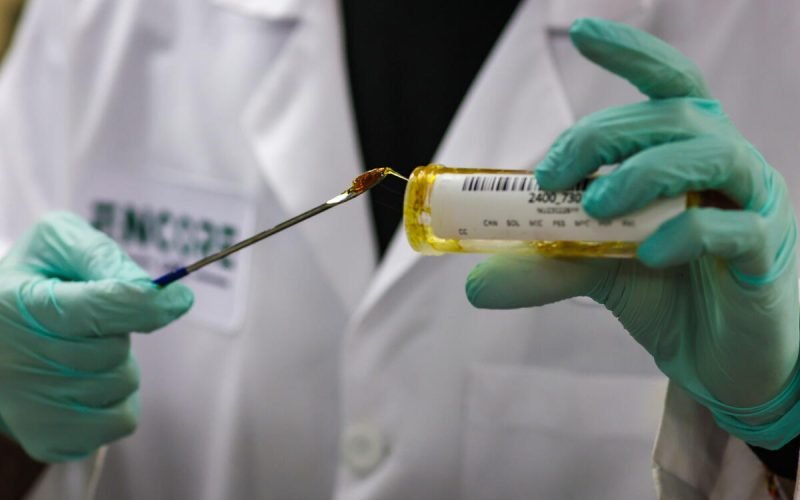
Cannabis extracts fail pesticide testing mainly because residues in the input material become concentrated during extraction and are not reliably removed by purification, and what follows is usually a short, time-bound path of reanalysis, confirmation, and often destruction. Test results themselves are not perfectly consistent. In a 2019 study of five California labs, the labs recorded only 13 of 60 possible pesticide detections in spiked distillate samples.
This blog explains where failures start, why purification does not fix them, what happens in the days after a failed result, and how processors can reduce the chance of a repeat.
Sections
ToggleKey Takeaways
- Most failures trace back to the input material, since residues on plant material concentrate during extraction and show up in the extract.
- Winterization and distillation should not be assumed to clear pesticides, and at least one regulator states that decontamination is not permitted for pesticide failures.
- After a failed result the common path is a hold, a short reanalysis window, confirmation at a second lab, and then destruction or limited remediation, with windows measured in days.
- Lab results can differ. In the 2019 five-lab study, labs missed most of the pesticides spiked into distillate, so method and sample preparation matter.
- Blending a failed batch into other extractions is treated by at least one regulator as diluting detection, and it is not a fix.
The table lists the main causes of failure, how each happens, and what a processor can do about it.
Cause of failure | How it happens | What a processor can do |
Contaminated input material | Residues on purchased or third-party plant material carry into the extract | Test purchased material and audit suppliers |
Concentration in extraction | Residue stays with the cannabinoids while the extract becomes a smaller mass | Keep a margin below the limit on input results |
Reliance on purification | Winterization or distillation is assumed to clear the residue | Treat purification as unproven for pesticides and test the result |
Test or sampling variation | Labs prepare and analyze samples differently | Ask about method and test the final form |
Blending a failed batch | Failed product is mixed into other extractions to dilute it | Follow the hold and retest path instead |
Where Pesticide Failures Start: The Input Material
A pesticide failure in an extract is often an input problem discovered late. A Colorado Marijuana Enforcement Division memo, reported by Westword, described extractors with reduced testing allowances that failed to properly vet or test their source material, including plant material from third-party cultivations with pesticide problems. The division urged licensees to test purchased marijuana, audit their partners, and tour each other’s facilities.
The practical reading is that incoming material is where a processor has the most control. Once residues are in the biomass, extraction carries them forward, and every later step is an attempt to manage a problem that began upstream.
How Cannabis Extraction Turns a Marginal Input Into a Failing Extract?
A pesticide level that clears a flower test by a small margin can still produce a failing extract. Reporting from Terpenes and Testing summarizes the point as extraction concentrating pesticides, not removing them. Residue that dissolves in the solvent travels with the cannabinoids, and once the solvent is removed the extract is a much smaller mass than the plant it came from.
The same reporting advises buyers to look for a batch-specific certificate of analysis from an accredited lab that includes a pesticide panel, not potency results alone. For a processor, the equivalent habit is to read the margin between each input result and the limit, since a narrow margin is a warning.
Why Purification Does Not Fix It?
Processors sometimes expect wiped film distillation or winterization to clean up a borderline batch. The reporting suggests otherwise. Terpenes and Testing says myclobutanil may persist through winterization or distillation, and that it can form hazardous compounds when heated. It is a trade press and not a controlled study, so the safe reading is that purification is unproven for pesticides unless a processor has data.
Regulators can be explicit about it. Colorado’s compliance tip on decontamination states that for failed pesticide or elemental impurities tests, decontamination is not permitted. For those failures the business can ask the testing facility to retest the original test batch.
Even a large reduction can leave a problem. The same trade reporting notes that a reduction of over 99 percent can still leave a pesticide above a jurisdiction’s limit, which is why the result, not the process, is what counts.
What Happens Immediately After a Failed Result
The first days after a failed result follow a pattern. A request for reanalysis is made within a short window, and a pass is confirmed at a second lab before the product can move on. Mississippi’s testing bulletin, effective July 1, 2025, gives concrete numbers. Other states differ in the details, and the bulletin applies to that state’s medical program, so it is a worked example and not a national rule.
Step | What happens | Example window in the bulletin |
Failing result | The licensee receives a failing certificate of analysis | Starts the clock on reanalysis |
Reanalysis request | Made in writing to the lab and the regulator, and paid by the requester | Within 3 days of the failing certificate of analysis |
Reanalysis | The original lab uses reserve product first, on a new aliquot, and may limit the run to the failed category | If it fails, pesticide failures are destroyed |
Confirmatory test | If reanalysis passes, a second lab runs a full compliance test | Request within 14 days, sampling within 30 days |
Outcome | A pass resets the product’s status after regulator approval, and a fail means destruction | Depends on regulator approval |
Colorado’s position is simpler. The memo reported by Westword says the state’s rules allow no further processing, remediation, or new pesticide test batches for failed product, and that the only options are retesting the original batch or destroying the production batch.
Why Results Can Differ Between Labs?
A failed result is not always the whole story, and a passing result is not always safe. In the 2019 study, five central California labs each received four distillate samples, two spiked with six pesticides and two pesticide-free. All pesticide-free samples were reported clean, so there were no false positives.
But the labs recorded only 13 of the 60 possible detections, a false negative rate of 78 percent, and paclobutrazol, which California does not allow at any detectable level, was missed by every lab. Myclobutanil was found in only 5 of 10 spiked samples, and two labs missed it entirely.
The authors proposed that differences in sample preparation, including solvents, agitation, and dissolution, can produce different extraction efficiencies, and that results clustered by lab, which points to systematic error and not random error. They also noted that California did not require a standard testing protocol and that no cannabis reference materials existed. A processor should know how the lab prepares samples and what it can detect, instead of treating a single result as final.
Why Blending a Failed Batch Is Not a Fix?
The Colorado memo described a pattern of licensees mixing concentrate that failed pesticide testing with other extractions to create new production batches. The division described this as diluting detection before required testing. It also described using research and development testing as a workaround for required compliance testing, and said it would recommend administrative action for violations of the failed-testing rules.
The logic is straightforward. Blending does not remove the pesticide. It spreads it across a larger volume and makes a failure harder to trace, which creates a larger problem if the blended product is later found to be contaminated. The same memo reported 13 health and safety notices over about three months, and that four of the last five recalls involved products that passed initial testing but failed later lab analysis.
Retest, Remediate, or Destroy: How to Decide?
The right path depends on why the batch failed and what the rules allow. The table lists common situations and the usual direction, with the caveat that jurisdictions differ.
Situation | Usual direction | Why |
Lab error is suspected, such as a method or sample preparation problem | Reanalysis, then confirmation at a second lab | Results can vary between labs, as the five-lab study showed |
Failure is confirmed where further processing is barred | Destroy the batch | Colorado allows only retest of the original batch or destruction, and Mississippi destroys pesticide failures |
Failure is confirmed where remediation is permitted | Build and validate a remediation plan, then retest | Regulators expect evidence that the method addresses the specific pesticide |
The cause is a supplier lot | Quarantine the lot and trace it | The same input will fail again if reused |
Whatever the path, the batch should stay on hold until the result is settled, and every step should be recorded. Selling, transferring, or blending a batch while it is under review turns a testing problem into a compliance problem.
Preventing the Next Failure
The most reliable fix is upstream. Testing incoming material before extraction, as described in the guide to in-house cannabis testing, gives a processor an early read and a record to trace if a failure follows. Reading those results correctly matters too, and the guide to lab testing of high-quality distillates explains what a good panel looks like.
These habits reduce the odds of a failure and make one easier to explain.
- Ask suppliers for pesticide results by lot and keep lot records through extraction.
- Record the margin between each input result and the limit.
- Test the final form, since Mississippi’s bulletin requires samples from the full batch after it is processed into its final form.
- Know the reanalysis deadlines and the lab contacts before a failure happens.
A failure that is traced to a lot and recorded can lead to a supplier change. A failure with no records leaves a processor guessing.
What a Failed Result Is Telling You?
A pesticide failure is usually information about the supply chain before it is information about the extract. The residue came in with the input, extraction concentrated it, and purification did not remove it, so the useful response is to trace the source and not to look for a way around the result.
The path after a failure is short and time-bound, and the details vary by jurisdiction. Processors that test incoming material, know their reanalysis deadlines, avoid blending, and keep clear records handle a failure far better than those who improvise.
Frequently Asked Questions
How long does a processor have to request reanalysis?
In Mississippi’s 2025 bulletin, the request must be made in writing within three days of the failing certificate of analysis, and the requester pays. Other jurisdictions set their own windows, and they are generally short. The practical step is to have the lab contact and a written request ready before a failure happens. Because the original lab uses reserve product first, it is also worth confirming how long it keeps reserve samples.
What should a processor ask a lab before a retest?
Start with how the lab prepares samples, since the five-lab study proposed that solvents, agitation, and dissolution can change results. Ask which pesticides are on the panel and at what reporting limits, and whether the lab can run the retest on a new aliquot. The Mississippi bulletin also notes that a reanalysis may be limited to the failed analyte category, so ask whether that applies. The answers help judge whether a retest is likely to differ from the original.
Does a failed result mean the supplier is at fault?
Not always. A borderline input result can fail after extraction because residue concentrates, so the problem may be the margin and not a clearly contaminated lot. Comparing the input result with the extract result for the same lot helps separate the two. The Colorado memo also placed responsibility on the processor to vet and test source material, so tracing the lot is useful either way.
What can trigger a recall after a product has shipped?
A later failed analysis on product that already passed an initial test can trigger one. The Colorado memo reported that four of the last five recalls involved products that passed initial testing but failed later lab analysis. That shows a pass is not always final, and it is why lot records and the ability to trace sold product matter. A processor that can identify exactly which units came from a lot can respond faster.
What should a pesticide panel on a certificate of analysis show?
It should be batch-specific, issued by an accredited lab, and list the pesticides tested with their results and limits. Panels differ by state, and the 2019 five-lab study checked samples against California’s list of 66 regulated pesticides, so a processor should check that the panel matches the rules where the product is sold. A potency-only result is not a pesticide result. The method and reporting limits are worth confirming with the lab.