
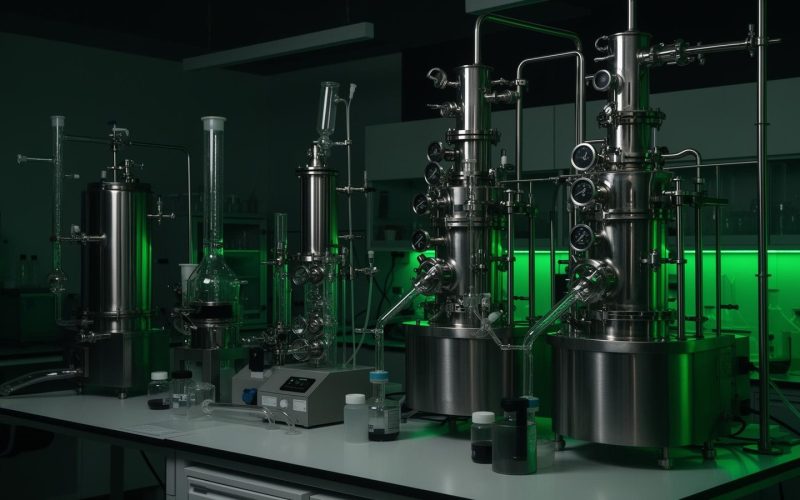
Scale a cannabis extraction lab when production consistently runs at capacity against validated, not projected, demand, and do it by identifying the actual bottleneck first, sizing new equipment and facility utilities to a real growth target, and rebuilding documentation and staffing for continuous rather than batch-driven operation.
This guide covers the signs it’s time to upgrade, how to plan the transition without overbuilding, and the parts of the process most operators underestimate.
Sections
ToggleKey Takeaways
- Scaling should be driven by production data against validated demand, not growth optimism; a maturing, price-compressed cannabis market makes overbuilding capacity a real financial risk in 2026, not just a theoretical one.
- The real production constraint is often not extraction itself but a downstream stage, post-processing, solvent recovery, or packaging, that gets overlooked until after new extraction capacity is already purchased.
- Industrial-scale operation requires a structurally different staffing and documentation model than craft scale, not just bigger versions of the same equipment and processes.
- Facility utilities (electrical, HVAC, water) are frequently the actual limiting factor in a scale-up, and are more expensive to retrofit after the fact than to plan for upfront.
- Phased scaling generally reduces financial risk compared to an all-at-once upgrade, since it surfaces bottlenecks and demand mismatches before the full capital commitment is made.
Craft vs. Industrial Scale at a Glance
Factor | Craft Scale | Industrial Scale |
Typical throughput | Under 100 lbs biomass/day | 500+ lbs biomass/day, often over 1,000 |
Operation style | Manual or semi-automated, batch-driven | Automated, continuous or high-frequency batch |
Staffing model | Small team, cross-trained across stages | Dedicated roles per production stage, shift coverage |
Documentation | Basic SOPs, informal quality checks | GMP-style batch records, validated processes |
Facility/utility needs | Sized for current equipment only | Oversized electrical, HVAC, and water for headroom |
Primary risk | Missing market demand due to capacity limits | Overbuilding capacity ahead of validated demand |
Five decisions determine whether a scale-up strengthens the business or creates a new set of problems. Getting the order right, and being honest about which stage is actually the constraint, matters more than the size of the check being written.
Signs Your Lab Has Genuinely Outgrown Craft-Scale Equipment
The clearest signal is production consistently running at or near maximum capacity against orders you can already confirm, not orders you expect to land. Watch for this pattern across several consecutive production cycles, not a single unusually busy month:
- Extended shifts have become the norm: overtime or double shifts are no longer occasional, they’re how the schedule works every week
- A growing backlog of confirmed orders: not projected sales, but orders you’ve already accepted and can’t fulfill on the original timeline
- Equipment running near-continuously: little to no maintenance buffer between runs, which raises breakdown risk right when you can least afford downtime
- Turning away business you’d otherwise take: declining or delaying new accounts specifically because current capacity can’t absorb them
One strong month of demand is not the same signal as six months of consistent capacity strain, and treating the two as equivalent is a common way operators scale before the data actually supports it.
Identify the Real Bottleneck Before Buying Anything
Adding extraction capacity when the actual constraint sits downstream doesn’t increase finished output, it just moves the backlog further down the line. Map throughput at every stage before committing to new equipment:
- Extraction: how much biomass actually clears this stage per day at current staffing and equipment
- Winterization or dewaxing: how long crude sits waiting for this step, and whether it’s queuing up behind extraction output
- Filtration: how often filter media changes slow down throughput, and whether that’s a capacity issue or a maintenance issue
- Distillation: whether finished crude is backing up waiting for distillation capacity to free up
- Packaging and fulfillment: whether finished product is actually shipping as fast as it’s being produced
It’s common for extraction to look like the bottleneck simply because it’s the most visible and heavily used piece of equipment, when solvent recovery or post-processing capacity is actually what’s capping total output.
Choose Equipment Sized for Where You're Going, Not Just Where You Are
Sizing new equipment to solve only today’s bottleneck often means a second expensive upgrade within a couple of years. Root Sciences’ hydrocarbon extraction systems, for example, range from a 5.HX processing roughly 80 lbs per 8-hour shift in a 17-square-foot footprint up to a 40.HX built for industrial-scale continuous operation, illustrating how differently sized equipment within the same product line can match a specific growth target rather than forcing a jump straight to the largest available option.
The right size depends on a realistic 2-3 year demand projection, not the current backlog alone
Rebuild Utilities and Facility Classification Around the New Scale
Electrical capacity, HVAC, and water and wastewater handling are frequently the actual limiting factor in a scale-up, not the extraction equipment itself. Industrial-scale equipment typically draws meaningfully more power and, for ethanol operations specifically, more water than a craft setup, and retrofitting utilities after new equipment has already arrived is more expensive and disruptive than planning for it upfront.
Facility classification (C1D1 for hydrocarbon, C1D2 for ethanol) also needs to be re-evaluated at scale under OSHA’s flammable and hazardous location standards, since a room built to code for craft-scale equipment doesn’t automatically remain compliant when equipment density or solvent volume increases.
Automate the Stages That Actually Justify It
Automation reduces labor intensity and improves batch-to-batch consistency, which matters more at industrial volume than at craft scale, but it isn’t universally worth the added cost at every stage.
This is particularly relevant for operations moving to ethanol extraction equipment at industrial scale, where automated recovery and winterization can meaningfully reduce the labor burden that comes with higher solvent volume. MJBizDaily reporting on automation trends across the cannabis supply chain notes that the stages seeing the fastest automation adoption are the ones with the most repetitive, high-volume manual work, sorting, packaging, and material handling, rather than every process step uniformly.
Prioritize automating the stages where manual labor is both high-volume and highly repetitive, and be more cautious about automating stages where input material variability still requires human judgment to avoid under- or over-processing.
What Changes Structurally Between Craft and Industrial Operations?
Scaling isn’t just bigger versions of the same equipment and team; the operational model itself needs to change:
- Staffing shifts from generalists to specialists: craft operations often run on a small, cross-trained team; industrial scale generally requires dedicated roles and shift coverage per production stage
- Documentation shifts from informal to validated: industrial-scale operations increasingly need GMP-style batch records and documented, repeatable processes rather than informal quality checks
- Quality control shifts from spot-checks to continuous monitoring: higher volume raises the cost of a single undetected quality issue, which pushes toward more frequent or continuous in-process testing
- Maintenance shifts from reactive to scheduled: equipment running near-continuously at industrial volume can’t absorb the same unplanned downtime a craft operation tolerates
Phased vs. All-at-Once Scaling: Which Fits Your Situation
Both approaches can work, but they fit different situations and carry different risk profiles. Weighing the two directly before committing to either avoids defaulting into whichever one happens to be the more familiar or more heavily marketed option:
- Phased scaling, upgrading one bottleneck stage at a time and validating results before the next investment: generally carries less financial risk, since it surfaces problems, an underestimated utility requirement, a downstream bottleneck that wasn’t visible until upstream capacity increased, before the full capital commitment is made. The tradeoff is a longer runway to full target capacity and a temporary mismatch between stages during the transition.
- All-at-once scaling, building the full target capacity in a single project: makes more sense when demand is already firmly validated through confirmed contracts or purchase orders rather than projections, and when the facility and capital are both ready to support the full build without a staged approach.
Phased scaling is the more conservative default when demand validation or capital readiness isn’t fully in place yet, which describes most scale-up decisions being made in the current market.
Post-Processing and Downstream Capacity: The Bottleneck Everyone Underestimates
Across scale-up projects, the most consistently underestimated constraint isn’t extraction capacity, it’s everything after it. Winterization, filtration, and distillation each have their own throughput ceiling, and increasing extraction output without matching those stages just relocates the bottleneck rather than resolving it.
This is where a solventless production line built for staged growth, moving from a smaller system into a larger one as volume justifies it, illustrates the principle even outside solvent-based methods: matching each stage’s capacity to the others, rather than maximizing one stage in isolation, is what actually increases finished output.
What a Craft-to-Industrial Scale-Up Typically Costs?
Total scale-up cost varies enormously by starting point and target scale, but a few cost categories consistently show up regardless of the specific numbers involved:
- New or upgraded extraction and post-processing equipment: typically the largest single line item, and the one most operators budget for first
- Facility utility upgrades: electrical service, HVAC, and water/wastewater work that’s frequently underestimated relative to equipment cost
- Facility classification work: re-certifying or expanding C1D1 or C1D2 rated space to match the new equipment footprint and solvent volume
- Staffing and training: hiring and training for the specialist roles industrial operation requires, plus the ramp-up period before a new team reaches full productivity
- Documentation and compliance systems: building out GMP-style batch records and quality systems, which is as much a labor cost as a software or paperwork cost
Traditional bank financing is generally unavailable to cannabis businesses given continued federal restrictions, which pushes most scale-up capital toward private and cannabis-specialized lenders. Cannabis equipment financing and leasing structured specifically around this reality is generally a more realistic starting point for budgeting a scale-up than assuming conventional financing terms will apply.
Scaling in a Maturing Market: Why Demand Validation Matters More Than Optimism
The market context for scaling decisions has shifted in a way worth accounting for directly. MJBizDaily reporting found that legal U.S. cannabis retail revenue fell to $29.1 billion in 2025, the first year-over-year decline since adult-use sales began, driven by oversupply and wholesale price compression that has pushed prices in some markets below the cost of production.
That doesn’t mean scaling is the wrong move for a facility with genuinely validated demand, but it changes the risk calculus: capacity built ahead of confirmed demand is more exposed in a market where oversupply is already suppressing prices than it would have been during a period of straightforward growth. Confirming demand with actual contracts or purchase commitments, rather than extrapolating from a strong sales quarter, matters more now than it did a few years ago.
Conclusion
The operators who scale well treat it as a sequence of validated decisions rather than a single capital event: confirm the demand is real, find the actual bottleneck, size equipment and utilities for where the business is going rather than just where it is today, and rebuild staffing and documentation for how an industrial operation actually runs.
Skipping any one of those steps is usually still recoverable. Skipping several of them at once, in a market where oversupply is already compressing margins, is a considerably more expensive mistake to walk back.
FAQs
1. Is there a specific throughput number that marks the transition from craft to industrial scale?
Not a universal one; the transition is better defined by operational characteristics than a single throughput figure. That said, operations processing under roughly 100 lbs of biomass per day generally still operate with craft-scale staffing and documentation practices, while facilities running 500 lbs per day or more typically need the staffing, documentation, and utility infrastructure of an industrial operation regardless of the exact number.
2. Can existing craft-scale equipment be repurposed or resold when scaling up, or does it typically go to waste?
Craft-scale extraction and post-processing equipment generally holds resale value in the active secondary market for cannabis equipment, particularly if well-maintained with documented service history. Some operators also repurpose smaller units for R&D, small-batch or limited-release product lines, or backup capacity during maintenance on the primary industrial line, rather than selling it off entirely.
3. How long does a typical craft-to-industrial scale-up take from decision to full operation?
This varies significantly based on facility changes required, but a scale-up involving new facility classification work or a significant utility upgrade commonly takes six months to a year or more from decision to full operational capacity, factoring in equipment lead times, permitting, and inspection. Phased approaches often reach partial capacity increases faster while the full build-out continues.
4. Does scaling up extraction capacity typically require new state licensing or license amendments?
Often yes. Many states require licensees to report significant facility, equipment, or process changes, and a meaningful capacity increase can trigger a license amendment or additional inspection rather than being automatically covered under an existing license. Confirming this with the specific state regulator before finalizing equipment orders avoids a compliance gap discovered after the investment is already made.
5. Is it possible to scale up gradually using modular equipment rather than replacing systems outright?
Yes, and several equipment lines are specifically designed around this approach, adding capacity incrementally rather than requiring a full system replacement. This generally reduces both the capital risk and the operational disruption compared to swapping out an entire production line at once, though it depends on whether the original equipment was selected with that expansion path in mind from the start.