
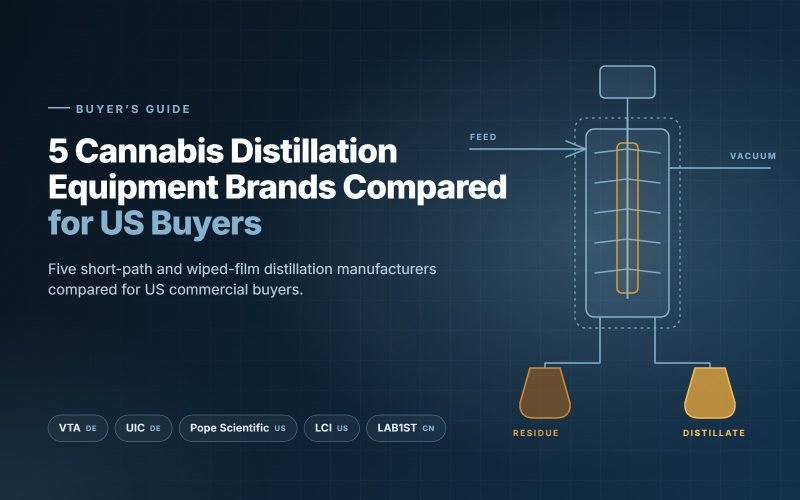
Choosing cannabis distillation equipment means evaluating more than a manufacturer’s advertised feed rate. Commercial processors must also consider the equipment configuration, cannabinoid recovery, facility requirements, installation, maintenance and support. This guide compares five original equipment manufacturers with relevant short-path or wiped-film distillation technology available to US buyers. The focus is on equipment selection, not a ranking based on unverified performance claims.
Commercial distillation equipment manufacturers at a glance
| Manufacturer | Origin | Relevant equipment | Primary consideration |
|---|---|---|---|
| VTA | Germany | VKS 95, VKS 125, VK 200 | Commercial-to-industrial cannabinoid processing |
| UIC | Germany | KD6, KD10; pilot and industrial systems | Compact systems and process scale-up |
| Pope Scientific | USA | ProPass 600, 9-inch and 12-inch Canna Still | US manufacturing and documented model specifications |
| LCI Corporation | USA | Short-path evaporators and custom systems | Application-specific industrial engineering |
| LAB1ST | China | GMD, SMD and industrial wiped-film systems | Glass and stainless steel configuration options |
Comparison note: Published throughput figures may use L/hour or kg/hour and refer to feed rates rather than finished distillate. They are not directly comparable without material density, feedstock composition, process conditions and pass-count assumptions.
1. VTA — commercial and industrial molecular distillation
VTA Verfahrenstechnische Anlagen GmbH & Co. KG manufactures thin-film and short-path distillation systems in Germany. Its systems use high-vacuum operation and short residence times to process heat-sensitive materials. VTA also provides laboratory and pilot testing for process design and industrial scale-up.
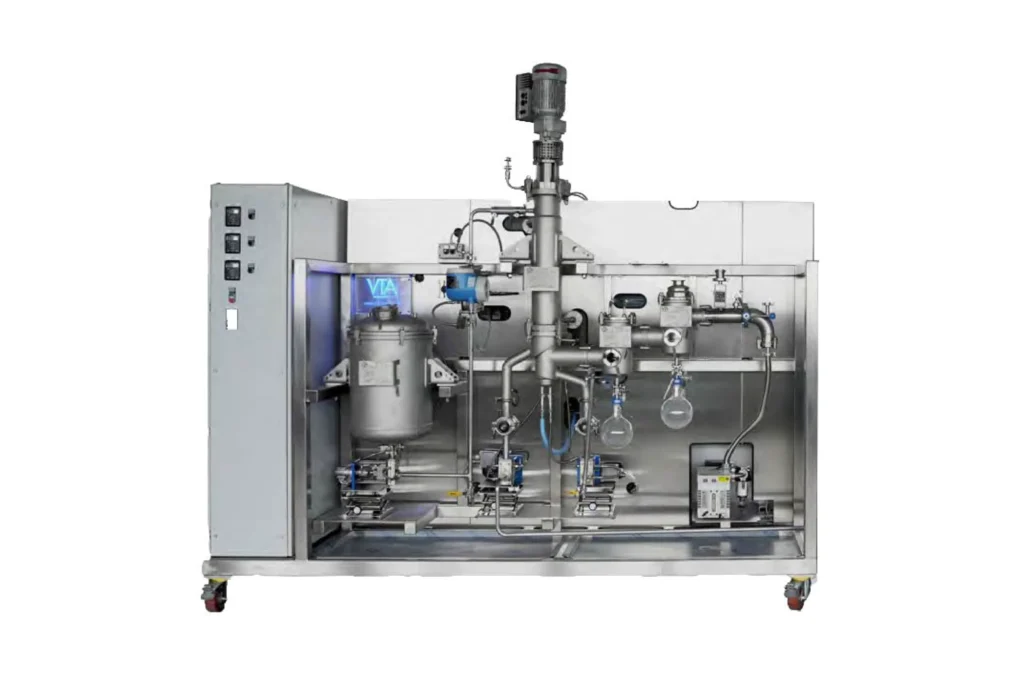
Figures as published by the manufacturer or supplier; not independently tested.
Relevant equipment
Root Sciences lists the VKS 95, VKS 125 and industrial VK 200 among VTA systems for cannabis and hemp processing. Its current equipment page lists the VKS 125 at 15 L/hour and the VK 200 at 40 L/hour typical throughput. These are supplier-reported figures, not independently tested cannabinoid-distillate output rates.
Why buyers consider it
The range spans commercial systems and larger production equipment. Higher-capacity installations may be relevant when processing schedules and facility infrastructure justify industrial-scale equipment.
Operating capacity with representative feedstock; degassing configuration; number of passes; auxiliary equipment; installation requirements and expected recovery.
2. UIC — short-path systems from pilot to industrial scale
UIC GmbH manufactures short-path and thin-film distillation systems in Germany. Its product range includes laboratory, pilot and engineered industrial plants. UIC describes an internal condenser and wiped-film operation that enable high-vacuum distillation of heat-sensitive compounds.
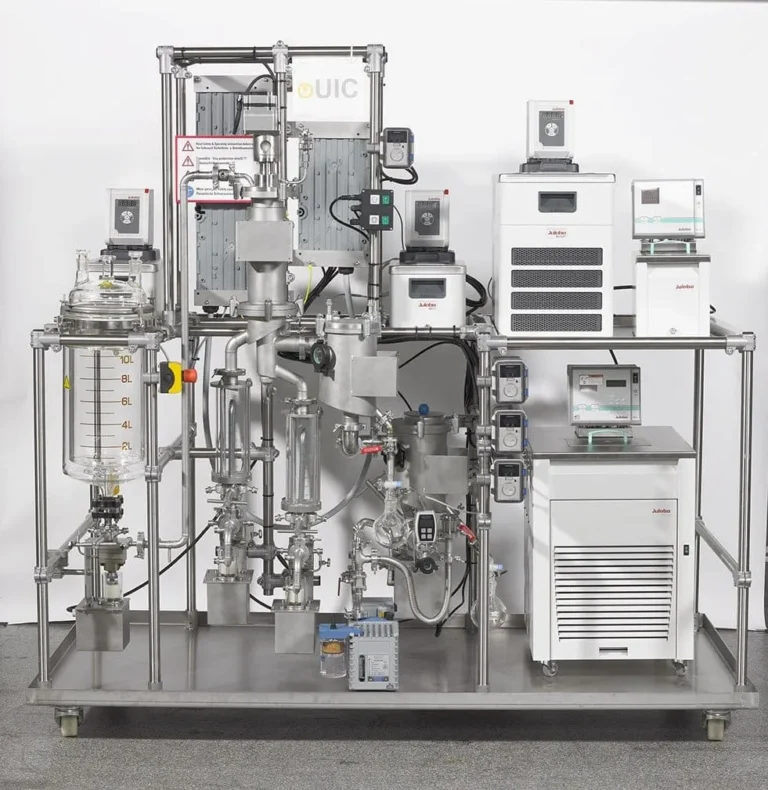
Figures as published by the manufacturer or supplier; not independently tested.
Relevant equipment
For the cannabis market, Root Sciences lists the KD6 and KD10. Its Equipment & Services Catalog (distillation section, printed page 14) reports the KD6 typical throughput at 6 L/hour and a 0.06 m² evaporator surface area. That catalog figure is used here provisionally; the currently published KD6 web page reports 3.5 L/hour. The KD10 is listed in the catalog at 10 L/hour throughput capability, but Root Sciences’ UIC page describes it as an upcoming offering.
Why buyers consider it
UIC has compact short-path systems as well as pilot and customized industrial designs, potentially useful for processors validating a process before scale-up.
Current model availability, actual production rate, feedstock preparation, whether a degassing stage is included, and who handles US installation and spare parts.
3. Pope Scientific — US-manufactured wiped-film equipment
Wisconsin-based Pope Scientific manufactures wiped-film molecular distillation systems for botanical extracts and other industrial materials. It publishes a detailed comparison of its cannabis-oriented stills, including feed rates, evaporator areas, power requirements, dimensions and warranty terms.
Figures as published by the manufacturer or supplier; not independently tested.
Relevant equipment
Pope lists the ProPass 600 at 3–10 kg/hour, the 9-inch Canna Still at 20–30 kg/hour and the 12-inch Canna Still at 40–60 kg/hour feed rate. Its larger turnkey offerings can incorporate multistage processing and automation.
Why buyers consider it
The range provides several defined sizes, US-based manufacturing and relatively detailed published product specifications for preliminary comparison.
Throughput after all required passes, product recovery with the intended feedstock, the exact scope of a turnkey quotation and operator requirements.
4. LCI Corporation — engineered industrial short-path evaporation
LCI Corporation manufactures short-path evaporators and other thermal-processing equipment in the United States. Its short-path units use a wiped-film rotor and internal condenser to handle high-boiling and heat-sensitive materials. LCI describes vacuum capability down to approximately 0.001 mbar for this technology.
Figures as published by the manufacturer or supplier; not independently tested.
Relevant equipment
LCI markets short-path evaporators and custom-engineered systems rather than a clearly standardized cannabis-specific model lineup. Its systems can incorporate pumps, condensers, instrumentation and controls in an engineered installation.
Why buyers consider it
Industrial processors with nonstandard feedstocks or integration requirements may benefit from process testing and tailored system engineering.
Cannabinoid-processing experience, required application testing, system throughput, US service scope and whether the quoted package is suitable for the facility as configured.
5. LAB1ST — glass and stainless steel molecular distillation systems
LAB1ST markets glass and stainless steel wiped-film molecular distillation systems, including cannabis/CBD-oriented configurations. Its portfolio extends from smaller GMD systems to stainless steel SMD equipment and larger industrial designs.
Figures as published by the manufacturer or supplier; not independently tested.
Relevant equipment
Its stainless steel SMD page describes 0.1–0.5 m² evaporator configurations, automated feed/discharge options and model-dependent capacity figures; its industrial page lists customizable evaporator area from 1 to 20 m². Those manufacturer figures should be evaluated by specific model and duty.
Why buyers consider it
The catalog includes different material and staging options, including dual-stage configurations and custom industrial systems.
US supply and commissioning arrangements, service and spare parts, electrical compliance, which components are included, and comparable feedstock performance. Published claims of higher speed or extended service life should be treated as supplier claims rather than independent comparisons.
How to choose a manufacturer for your processing facility
Match capacity to finished-product requirements
Start with the amount and grade of distillate needed per shift, then work backward to expected feed volume and pass count. Request the assumptions behind published feed-rate figures. For instance, 40 L/hour of feed is not necessarily 40 L/hour of finished cannabinoid distillate. Compare machines using equivalent feedstock composition, pass count and operating hours.
Compare recovery separately from potency
Potency describes the cannabinoid concentration of the product; recovery describes how much cannabinoid is retained from the incoming material. High potency does not, on its own, demonstrate high recovery. Ask suppliers for test runs or mass-balance data using representative feedstock, including cannabinoid content in feed, distillate and residue.
Account for upstream preparation and integration
Determine whether the system requires winterized, decarboxylated, devolatilized or otherwise prepared oil. Confirm requirements for degassing, pumps, vacuum, heating, cooling and product discharge. Two quotations can differ materially if one omits essential supporting equipment.
Review labor, service and facility readiness
Assess automation, cleaning intervals, maintenance access, spare-part lead times and operator training. Verify utility loads, electrical supply, footprint, ventilation and relevant local safety requirements. Confirm which organization—not simply which brand—will perform commissioning and service in the United States.
What does commercial cannabis distillation equipment cost?
Industrial equipment is often priced by quotation, and publicly available prices rarely represent comparable turnkey scopes. An evaluation should include the evaporator, vacuum equipment, heating and cooling, controls, freight, commissioning, training, utilities, labor, cleaning, replacement parts and downtime. Ask suppliers to price the same operational scope, then compare expected cost per unit of saleable distillate using explicit assumptions. Do not assume the lowest initial quotation delivers the lowest total ownership cost.
Seven questions to ask before purchasing
- What sustained feed rate and saleable distillate output can you demonstrate with feedstock similar to ours?
- How many processing passes are needed to reach our purity target, and what is the expected cannabinoid recovery?
- Which preparation stages are required before material enters the distillation system?
- What ancillary equipment, utilities, controls and safety documentation are included in the quotation?
- What cleaning, maintenance and operator labor are required during a normal production week?
- Who provides US installation, commissioning, training, warranty service and spare parts?
- Can we review a representative trial, documented installation or customer reference for a similar application?
Selecting the right manufacturer
No single distillation manufacturer is the best choice for every commercial facility. For a credible shortlist, compare the documented systems that can meet the process requirement, then validate real throughput, recovery, required infrastructure and life-cycle costs through technical discussions and representative trials. Manufacturer datasheets are a starting point, not a substitute for process-specific qualification.
Root Sciences supplies VTA and UIC distillation systems to cannabis and hemp processors. To discuss equipment sizing and system configuration, explore its commercial distillation equipment range below.
Explore commercial cannabis distillation equipment at Root Sciences
Selection methodology and disclosure
Manufacturers were included based on evidence that they produce relevant wiped-film, short-path or molecular distillation equipment and serve or market to US commercial buyers. This is a documented equipment overview, not hands-on comparative testing or a complete survey of every manufacturer. Published specifications are attributed to manufacturers or suppliers; performance depends on feedstock and operating conditions. Root Sciences distributes equipment manufactured by VTA and UIC. Their presence in this guide does not imply independent superiority over other manufacturers.