
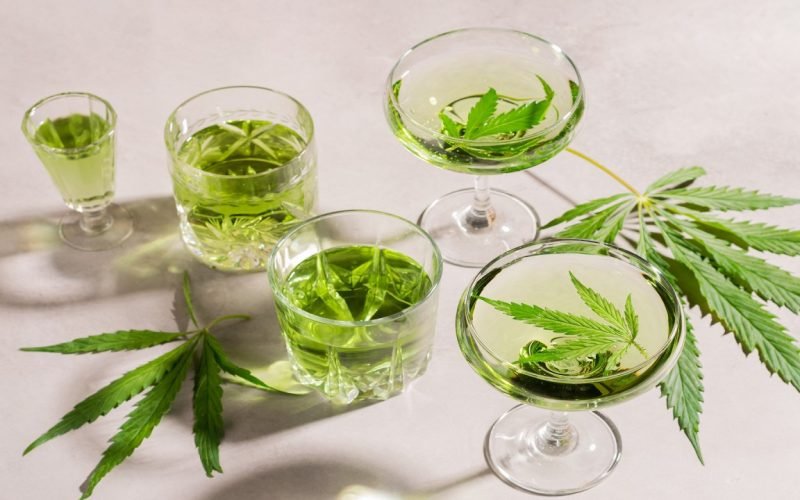
Particle size decides whether a cannabis beverage stays evenly mixed, looks clear or cloudy, and holds together on the shelf, because the oil droplets inside it behave very differently at different sizes. In a 2021 stability study, a coarse emulsion with droplets of about 450 nanometers shrank to about 120 nanometers after 10 passes through a homogenizer at 30,000 psi, and the diluted result was almost transparent. This blog explains what droplet size controls, what moves it during processing, how it is measured, and why it keeps changing after a drink is filled.
This blog covers how particle size affects separation, clarity, and shelf life in cannabis drinks, and what processors can measure and control.
Sections
ToggleKey Takeaways
- Droplet size controls how fast oil separates from a drink and how clear the drink looks, so it is a quality measure and not only a technical detail.
- Processing sets droplet size but with diminishing returns: in one study, size fell from about 450 nm to 185 nm after one homogenization cycle and then leveled off after 8 to 9 cycles.
- Size is not fixed after filling. Low pH, high sugar, calcium, and storage time all changed droplet size or stability in the research reviewed here.
- A single average is not enough. Dynamic light scattering, polydispersity, zeta potential, and a microscopy cross-check each describe a different part of the picture.
- Smaller is not automatically better. Uniform droplets that stay stable in the actual drink matter more than the smallest possible number.
The table shows droplet sizes reported in the research and what happened at each.
Condition | Droplet size reported | What happened |
Coarse emulsion before homogenization | About 450 nm | Starting point before processing |
After 10 homogenization cycles | About 120 nm | Diluted 355 mL serving almost transparent |
After 500 mM sucrose | About 130 nm rising to about 170 nm | Droplets grew in the sweetened drink |
Below pH 2 | About 30 nm larger | Droplets creamed or flocculated |
Cloud emulsions at 20 to 40 percent oil | About 0.2 to 0.8 micrometers | Opaque, as designed for cloud drinks |
Why Larger Droplets Separate Faster?
Oil is lighter than water, so droplets in a drink drift upward and collect at the top, a process called creaming. Larger droplets rise faster and merge more easily, which is why droplet size and size distribution are central to how long a beverage emulsion holds together. A review of beverage emulsion stability describes cloud emulsions as thermodynamically unstable and prone to breaking down during storage, and covers how droplet size and distribution feed into that.
The 2021 study showed the same pattern in a cannabinoid drink. Below pH 2 the droplets grew by about 30 nanometers and creamed or flocculated, and after six weeks of storage a thin whitish ring appeared at the top. Research on non-ionic surfactant nanoemulsions by Koroleva and colleagues adds that there are several ways size can drift: Ostwald ripening, where larger droplets grow at the expense of smaller ones, plus flocculation and coalescence. Ostwald ripening was the main cause of coarsening only at oil fractions up to 0.05, while flocculation and coalescence dominated at 0.15 to 0.45, and the pattern differed between surfactant systems.
The practical point is that a wide size range is a warning sign, because the biggest droplets set how quickly separation starts, and the right fix depends on which pathway is active at that oil concentration.
Particle Size and Beverage Clarity
Droplets scatter light, and larger droplets scatter more of it. That is why the same dose of cannabinoid can look cloudy in one drink and nearly clear in another. In the 2021 study, the optimized emulsion with droplets of about 120 nanometers was almost transparent when diluted into a 355 mL serving, including with carbonated water. The authors did not report a numeric transmittance, so the description is visual.
The opposite design goal exists in beverages too. In a study of cloud emulsions made with gum arabic, modified starch, and ghatti gum, raising the oil phase from 20 to 40 percent increased mean droplet size for every emulsifier tested, for example from 0.48 to 0.84 micrometers with gum arabic. Opacity also rose with oil content, which the authors described as making the drinks look more like natural juice. These were flavor and cloud emulsions, not cannabis drinks, but they show that clarity is a design target set by droplet size and oil load, not an accident.
A processor making a clear drink and one making a cloudy drink therefore need different size targets, and both need to know the number they are aiming for.
What Moves Particle Size During Processing?
Droplet size is set by the formulation and the process together. The 2021 study tested each variable separately, which shows how much each one matters.
- Homogenization cycles: At 30,000 psi, size fell from about 450 nm in the coarse emulsion to 185 nm after one cycle and 165 nm after two. It stabilized after 8 to 9 cycles, and 10 cycles were used.
- Emulsifier concentration: Raising it from 0.5 to 1.5 percent by weight reduced droplet diameter by about 125 nm. Going from 5 to 10 percent changed it by only about 12 nm, and at 15 percent size no longer depended on concentration.
- Oil load: As shown above, more oil gave larger droplets in every cloud emulsion tested.
- Dilution: Diluting the emulsion to a 355 mL serving slightly reduced droplet size in the 2021 study.
Hitting a size target repeatedly takes controlled equipment, and the options are laid out on the nanoemulsification equipment page. Choosing between machine types is a separate decision, and the guide to cannabis homogenizers explains how the main types differ.
How Particle Size Is Measured?
A single size number hides a lot, so several measurements are used together. The table lists the ones used in the 2021 study and what each tells a processor.
Measurement | What it reports | Why it matters |
Dynamic light scattering | Average droplet diameter (Z-average) | Fast routine check of size on each batch |
Polydispersity index (PDI) | How wide the size range is | A wide range signals larger droplets that start separation |
Zeta potential | Surface charge of the droplets | Fell with storage and fell to zero as calcium chloride drove separation |
Electron microscopy | Direct count of droplets | Cross-check: 115 nm with a standard deviation of 39 nm against about 120 nm by light scattering |
The study measured size with dynamic light scattering after diluting samples 50 to 100 fold, and checked the optimized emulsion with microscopy on more than 250 droplets. The two methods agreed closely, which is the reason for using both. The dilution step also means a result measured in a concentrate may not describe the finished drink, so it is worth asking where the measurement was taken.
How Particle Size Changes Over Shelf Life?
A drink that starts at the right size can drift. In the 2021 study, the emulsion resisted flash heating at 80 degrees Celsius for one minute, freezing and thawing, dilution, and carbonation with only slight size changes. Other conditions moved it more.
- pH: Droplets grew by about 30 nm below pH 2, with extensive flocs at pH 1.6. There was no size change up to pH 9.
- Sugar: Sucrose up to 250 mM had no effect, but at 500 mM size rose from about 130 nm to about 170 nm.
- Calcium chloride: Droplets grew somewhat at 50 mM or less, slow separation began at 100 mM, and it was rapid above that as zeta potential fell to zero.
- Time: After six weeks of storage a thin ring formed at the top and zeta potential fell, although the emulsion stayed stable to agglomeration and phase separation.
The study also tracked potency. CBD content fell by about 17 percent over the six weeks, even though the emulsion held together physically. A stable size does not prove stable potency, so both need testing across the shelf life, not only at filling.
Does Smaller Always Mean Better?
Not necessarily. The research shows diminishing returns: size leveled off after 8 to 9 cycles, and above 15 percent emulsifier size no longer responded to more of it. Extra cycles and extra emulsifier add processing time and ingredient cost without moving the number. None of the studies reviewed here tested whether going below about 120 nanometers improves a drink, so there is no evidence from this research that it does.
What the research does support is consistency. A uniform emulsion that holds its size in the actual drink matters more than the smallest possible average, and the mechanics behind it are explained in the guide to nanoemulsification in cannabis. For a processor, the useful target is a size range tied to the product: clear or cloud, the pH and sugar level of the drink, and the shelf life it must reach.
Setting a Particle Size Target for Your Product
The research points to a short working approach: choose clear or cloud first, set a droplet size and spread that fit that choice, test it in the finished drink rather than the concentrate, and re-measure over the shelf life. A size number only has meaning when it comes with the conditions it was measured under.
Beverage makers who treat particle size as a specification, with a target, a measurement method, and a shelf-life check, are better placed to avoid the separation, haze, and potency drift that the studies describe.
Frequently Asked Questions
What droplet size counts as a nanoemulsion in a beverage?
The studies reviewed here do not use a single cut-off. The cannabinoid emulsion that stayed almost transparent measured about 120 nanometers, while the cloud emulsions in the beverage study measured roughly 0.2 to 0.8 micrometers and were opaque. The term is therefore used loosely, and the measured size and the resulting drink matter more than the label. A supplier should state the number and how it was measured.
Can two drinks with the same average size behave differently?
Yes, because an average does not show how wide the size range is. In the cloud emulsion study, gum arabic emulsions had over 90 percent of droplets under 1 micrometer at 20 percent oil, but only 48 percent at 30 percent oil and 26 percent at 40 percent. Emulsifier type also changed stability, with ghatti gum emulsions unchanged across oil levels. This is why polydispersity and distribution data should accompany the average.
How often should particle size be measured in production?
The studies reviewed here do not set a testing frequency. The 2021 study measured samples every 7 days for up to six weeks, which shows how tracking over time works in practice. A reasonable approach is to measure during development, on every production batch, and at intervals across shelf life, with each result recorded alongside the storage conditions. The right schedule depends on the product and its risk.
Why does a clear drink still lose potency?
Droplet size describes physical structure, and potency is a separate chemical measure. In the 2021 study, the emulsion stayed stable to phase separation for six weeks while CBD content fell by about 17 percent. The text reviewed here does not establish the cause of that loss. Potency should be tested at several points across shelf life, not assumed from a good size result.
What does a high polydispersity index tell you?
A high index means a wide range of droplet sizes. Larger droplets in that mix tend to set how quickly creaming begins, and a broad range can also feed Ostwald ripening as larger droplets grow at the expense of smaller ones. The 2021 study reported PDI as part of its method but gave no numeric value for the optimized sample. A supplier should provide PDI alongside the average, so a narrow average is not mistaken for a narrow distribution.