
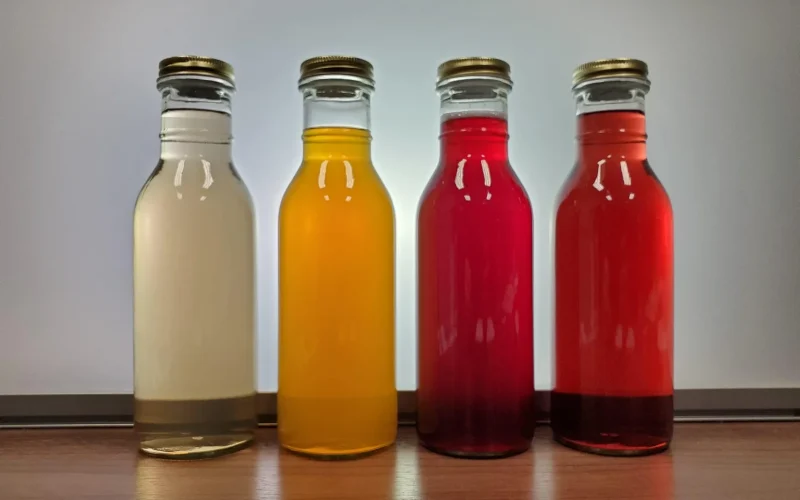
Cannabis beverages separate because cannabinoids are not water-soluble, so the oil droplets that carry them slowly drift, merge, or cling to surfaces instead of staying evenly mixed. The loss is not always visible. A 2021 survey of 40 CBD beverages found label accuracy ranging from 0 to 132 percent, with an average of 26.2 percent below the label claim.
This guide explains why drinks separate, how potency disappears even when a drink looks fine, and how processors can prevent and test for it.
Key Takeaways
This guide covers why cannabis beverages separate and the steps that reduce it.
- Emulsions are never permanently stable. Droplets destabilize through creaming, flocculation, coalescence, and Ostwald ripening.
- A drink can lose potency without showing separation. Reports describe cannabinoids moving into can liners and plastic bottles.
- Smaller droplets slow creaming, but they do not stop other changes. Droplets can still grow after filling.
- Prevention works at four points: formulation, processing, packaging, and storage.
- Testing at set time points, including early ones, shows what is actually happening in the package.
The table matches what a processor might see with the likely cause and the first thing to check.
| What you see | Likely cause | First check |
|---|---|---|
| Cream ring or oily layer at the top | Droplets have grown and risen | Particle size of a retained sample |
| Sediment or haze that was not there at filling | Droplets have flocculated or coalesced | Particle size and a look under the microscope |
| Drink looks fine but tests low | Cannabinoids moved into the container | Potency of the drink against the same batch in glass |
| Results differ between cans or bottles | Uneven emulsion or container effects | Potency by unit, tested at the same time |
Why Cannabis Beverages Separate?
Cannabinoids dissolve in oil, not in water. To put them in a drink, processors disperse the oil as tiny droplets, an emulsion. The droplets stay suspended only as long as the emulsion holds, and the SupplySide Supplement Journal article notes that these droplets can fail to stay suspended over time.
A published review of nanoemulsions explains why. In Soft Matter, Gupta and colleagues describe emulsions as thermodynamically unstable, meaning they drift toward separation even when well made. Four mechanisms are involved.
- Creaming or sedimentation. Droplets rise or settle because of buoyancy.
- Flocculation. Droplets stick together and move as a cluster.
- Coalescence. Droplets merge into one larger droplet.
- Ostwald ripening. Material moves from small droplets to larger ones, so small droplets shrink and large ones grow.
In a drink, these overlap. A droplet that grows through ripening or coalescence is then more likely to cream, which is how a drink that looks uniform at filling ends up with a visible layer.
Why Can a Drink Lose Potency Without Looking Separated?
Separation is the visible problem, but it is not the only way a drink loses cannabinoids. Both reports reviewed for this guide point to the container.
According to the SupplySide article, the thin polymer lining inside aluminum cans is hydrophobic, so it attracts cannabinoid droplets and pulls them out of the liquid. The same piece says plastic bottles showed similar problems, and that three of the 40 beverages tested contained no CBD, all in plastic bottles. A KSTP News report from 2024 describes the same effect in THC drinks. A Minnesota brand reported that one batch lost about 30 percent of its potency, and its CEO said most of the loss happened in the first week before leveling off.
Experts quoted by Food Quality & Safety connect the two problems. One says that because cannabinoids and can liners are both hydrophobic, a less stable emulsion makes leaching into the liner more likely. The reports come from trade publications and company accounts, not controlled studies, so the figures show that the problem exists and not how large it will be in a given product.
What Makes an Emulsion Fail?
Several factors push an emulsion toward separation, and most can be influenced by the processor.
Droplet size
Size controls which mechanism dominates. The Soft Matter review reports that creaming is weak in nanoemulsions. For a 1 micrometer droplet the relevant ratio is about 1, and for a 100 nanometer droplet it is about 0.0001, so creaming becomes insignificant until droplets grow to a few micrometers. A drink that starts with small droplets resists creaming for longer, and one that starts with large droplets separates sooner.
Ostwald ripening
The same review identifies Ostwald ripening as the dominant destabilization mechanism in nanoemulsions. Its rate scales with the inverse square of droplet size, depends on how soluble the dispersed phase is in the continuous phase, and rises with temperature. That is why small droplets alone do not guarantee a long shelf life.
Heat and pressure during processing
Experts quoted in Food Quality & Safety say high-heat, high-pressure thermal processing can worsen cannabinoids clinging to hydrophobic plastic. Processors who heat or pasteurize filled products should test potency before and after that step.
How to Prevent Cannabis Beverages From Separating?
Prevention works at four points: how the emulsion is made, what keeps its droplets from growing, what happens to it after filling, and what it is stored in. A drink that is strong on one and weak on another can still separate or lose potency. The guide to nanoemulsification explains how nanoemulsions are made, and the steps below build on it.
Start with small, uniform droplets
Smaller droplets stay suspended longer, and a narrow size range matters as much as a small average, because a few large droplets can seed the layer that later shows up at the top of the drink. High-shear and high-pressure equipment is how processors get there, and the guide to cannabis homogenizers covers the types.
Match the emulsifier and oil phase to the drink
The emulsifier has to hold the droplets apart at the size you are targeting, and what works at one droplet size may not hold at another. Validate the emulsifier in your own formula and not on a published example, since the same emulsifier can behave differently across oils, drink chemistries, and processing steps.
Keep heat after emulsification to a minimum
Experts quoted in Food Quality & Safety say high-heat, high-pressure thermal processing can worsen cannabinoids clinging to hydrophobic plastic. If a heat step is unavoidable, test droplet size and potency before and after it.
Choose packaging with potency in mind
The SupplySide article reports that the polymer lining of aluminum cans attracts cannabinoid droplets, and that plastic bottles showed similar problems. A KSTP News report describes a brewery that bottled its THC drinks in glass to avoid the liner. A glass-held sample from the same batch is also a clean way to tell container loss from emulsion failure.
Store cool where you can
Heat accelerates the changes that make emulsions age, so cooler storage is the safer default for finished products.
Processors who make emulsions in-house usually do this work on dedicated nanoemulsification equipment, where droplet size can be tuned and repeated from batch to batch.
Want tighter control over droplet size in your beverage emulsions? Explore Root Sciences nanoemulsification equipment.
How to Test for Separation and Potency Loss?
Testing is what separates a guess from a finding. Following the KSTP report, one brand now tests at least three times, including one month after canning. Because the reported loss happens early, the first sample should come within days of filling. The guide to cannabis potency testing covers how potency testing works.
A practical plan for each product covers the following.
- Visual check of retained units at set intervals for a cream ring, sediment, or haze.
- Particle size at filling and at later time points, to see whether droplets are growing.
- Potency at filling, within the first week, and after a month or more.
- A paired sample from the same batch held in glass, so a gap in potency points to the container.
The glass comparison is a method suggested here and not one taken from the reports. It isolates the container effect from the emulsion itself, which is the question most processors need to answer.
What to Do Next
Separation is the symptom that is easy to see, and potency loss is the one that matters more to a label. Both come from the same starting point, an emulsion that is stable only for a while.
A processor can narrow the problem in three steps:
- Make the droplets small and uniform
- Protect them from heat and hydrophobic surfaces
- Test early and often.
The results show whether the product is losing cannabinoids to the layer, the liner, or neither.
Planning to make cannabis beverage emulsions in-house? Talk to the Root Sciences team about the right equipment for your line.
Frequently Asked Questions
Does a clear nanoemulsion mean the drink is stable?
Clarity shows that the droplets are small at the time of filling, not that they will stay small. The Soft Matter review reports that Ostwald ripening grows droplets over time, with a rate that depends on how soluble the oil is in the drink and on temperature. A clear drink can therefore turn hazy and later show a layer as droplets grow to a few micrometers. Particle size measured at later time points is a better indicator than appearance at filling.
Is adding extra cannabinoid to offset losses a sound approach?
One could add extra THC to compensate and then test at several points. The approach only works when the loss is steady and measured, because the 2021 survey found label accuracy ranging from 0 to 132 percent. An overage that is not tracked can leave some units above and others below the label. Record the overage, the testing schedule, and the results for each batch.
Should heat treatment happen before or after the emulsion is made?
High-heat, high-pressure thermal processing can worsen cannabinoids clinging to plastic. Separately, the Soft Matter review notes that ripening rates rise with temperature. Both point to keeping heat steps after emulsification to the minimum the product needs. Test potency and particle size before and after any heat step to see what it changes.
How can I tell if the container or the emulsion is causing the loss?
Hold a sample from the same batch in glass and another in the final package, then test both at the same time points. If the glass sample keeps its potency and the packaged one does not, the container is the likely cause. If both lose potency or show a layer, the emulsion is unstable. This is a practical check and not a method from the published reports, so confirm it with your lab.