
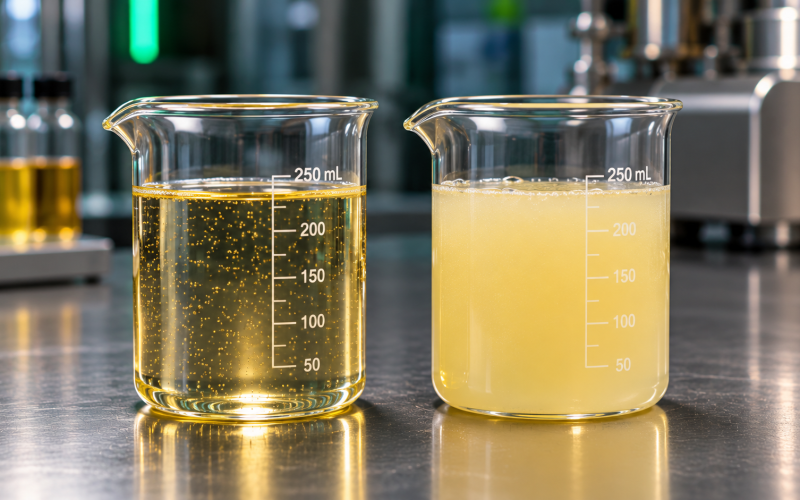
A cannabinoid nanoemulsion looks clear or cloudy depending on how small the oil droplets are, and clear is a spectrum, not a switch. In a 2021 Journal of Cannabis Research study of a CBD nanoemulsion, the coarse starting mixture was milky with droplets around 450 nm. After high-pressure homogenization the droplets measured about 120 nm, and the drink made from it was described as almost transparent, not fully clear.
This guide explains what separates clear from cloudy formulations in cannabis products, when each fits, and what each choice costs in processing, stability, and potency.
Key Takeaways
This guide covers how to choose between a clear and a cloudy cannabinoid formulation.
- Clarity depends on droplet size, and size depends on the process. More homogenizer passes give smaller droplets.
- Clear is a spectrum. A 120 nm CBD emulsion diluted into a drink was almost transparent, not perfectly clear.
- Judge clarity in the finished drink at serving dilution, not in the concentrate.
- Neither style is immune to potency loss. A CBD nanoemulsion lost about 17% of its CBD over six weeks in one study.
- Acidic flavors add a separate risk, since nano-emulsified CBD in some acidic drinks converted to THC over months.
The table compares the two styles using the cannabis data covered in this guide.
| Factor | Clear formulation | Cloudy formulation |
|---|---|---|
| Droplet size in one CBD study | About 120 nm, almost transparent once diluted into a drink | About 450 nm, milky |
| How it is reached | Many passes through a high-pressure homogenizer | Fewer passes, since a coarser result is acceptable |
| Best fit | Clear waters and flavored waters | Cloud-style and opaque drinks |
| Shared risks | Potency loss, container effects, separation over time | Potency loss, container effects, separation over time |
| Extra check | Clarity at serving dilution, plus acidity of the drink | Droplet size staying within the planned range |
What Makes a Cannabinoid Nanoemulsion Clear or Cloudy?
The clearest cannabis-specific picture comes from that same 2021 CBD study. The researchers blended CBD-enriched distillate with soybean oil, dispersed it in water with about 1.5% quillaja saponin as the emulsifier, and passed it through a high-pressure homogenizer at 30,000 psi for 10 cycles. The coarse pre-emulsion measured around 450 nm. One cycle brought it to about 185 nm, two cycles to about 165 nm, and sizes largely leveled off after eight or nine cycles at roughly 120 nm.
That progression is the practical meaning of clear versus cloudy. The oil is the same in every case. What changes is how far the droplets are broken down, and the milky look fades as they shrink.
Two details matter for formulators. First, even at 120 nm the diluted drink was only almost transparent, so a processor who wants a fully clear drink should expect to measure and tune, not assume. Second, the paper describes the diluted product, made by adding 1 mL of concentrate to 355 mL of water, and does not describe how the concentrate itself looks.
Root Sciences describes its cannabis nanoemulsification equipment as producing nanoemulsions in the 20 to 600 nanometer range, including clear, high-load, and flavorless versions, which fits the same idea that droplet size sets the look.
When a Clear Formulation Is the Right Choice
A clear formulation fits drinks where appearance is part of the product, such as flavored and fortified waters. In those drinks, a milky tint would change how the product looks on the shelf.
The study’s dilution result is the key planning point. The concentrate and the finished drink are different products visually, so test clarity at the serving dilution you will actually sell, in the same water, with the same additives.
A clear choice also commits the processor to a capable process. The study needed ten passes at 30,000 psi to reach its smallest droplets, and a result that is not reliably repeatable batch to batch defeats the purpose of choosing clear.
When a Cloudy Formulation Makes Sense
A cloudy formulation suits drinks that are opaque or cloud-style anyway. In those drinks, a slightly milky tint is not noticed, so the droplets do not need to be pushed as far.
The study’s pass-by-pass numbers suggest where the benefit comes from. Most of the size reduction happened in the first one or two cycles, with a long tail of smaller gains after that. A product that can accept 165 to 185 nm droplets may therefore need far less processing than one chasing the last few tens of nanometers. That is an inference from one formulation, so confirm it for your own oil, emulsifier, and equipment.
The caution is that cloudy does not mean uncontrolled. A chemistry consultant writing in MJBizDaily warns that nanoemulsions are thermodynamically unstable and that surfactants can interact with cannabinoids, so manufacturers need real knowledge of nanoemulsion fabrication regardless of how the product looks.
Clear vs. Cloudy Nanoemulsions: Trade-Offs Beyond Appearance
Clarity is the visible difference. The risks that matter most to a cannabis product apply to both styles.
Potency over time
In the CBD study, CBD fell by about 17 percent over six weeks, and the emulsion also developed a slight cream ring while staying free of agglomeration and phase separation. The paper’s description of storage conditions is inconsistent, so the loss cannot be pinned to temperature or container. The point for formulators is that a drink can look acceptable and still be losing potency.
Acidic flavors
A 2025 study in Cannabis and Cannabinoid Research fortified six acidic grocery products with a nano-emulsified CBD isolate and stored them for up to 15 months. THC formed in some of them. A lemonade reached 3.09 mg of THC per serving after 15 months and a sports drink 1.18 mg, while a cola reached 0.10 mg after 4 months. Both of the highest-THC drinks contained citric acid, and the authors advise caution with acidic products labeled THC-free.
This matters for clear products because many clear drink concepts, such as lemonade-style flavors, are acidic. Whatever the style, an acidic flavor should be tested for THC formation as well as potency.
Container losses
The SupplySide Supplement Journal reports that the polymer lining of aluminum cans attracts cannabinoid droplets, and that plastic bottles showed similar problems. A KSTP News report describes a Minnesota brand whose batch lost about 30 percent of its potency, and a brewery that moved to glass bottles. These reports are trade reporting and company accounts, not controlled studies, and they apply to clear and cloudy drinks alike.
Comparing equipment for clear or cloudy formulations? Explore Root Sciences nanoemulsification equipment.
How the Production Method Shapes the Choice
Droplet size is set at the homogenizer, and droplet size sets how clear the drink looks. The same oil and emulsifier can give a milky product or a nearly clear one depending on how hard and how long the emulsion is processed.
What controls droplet size?
Every pass through a high-pressure homogenizer breaks droplets down further. In a CBD nanoemulsion processed at 30,000 psi, size fell as follows:
| Stage | Droplet size |
|---|---|
| Coarse pre-emulsion | About 450 nm, milky |
| After 1 pass | About 185 nm |
| After 2 passes | About 165 nm |
| After 8 to 9 passes | About 120 nm, then largely level |
Most of the reduction happens in the first one or two passes, and later passes add smaller gains. That sets the processing needs for each style:
- Cloudy products can stop after a few passes.
- Clear products keep processing until size stops falling, which takes more passes and more time.
- Both styles need the same droplet size from batch to batch, which is why settings must be recorded and repeated. The guide to cannabis homogenizers explains the main equipment types.
Matching equipment to your stage
Root Sciences offers its nanoemulsification equipment in three tiers. The figures are RS’s published specifications.
| Tier | Models | Flow rate | Production per 8 h shift | Typical use |
|---|---|---|---|---|
| Lab | PandaPLUS, XStream | 10.8 to 24 L/h | Up to 1.4 to 2.4 kg | Developing and proving a formula |
| Commercial | Pony, Panther | 35 to 120 L/h | Up to 8 to 12 kg | Regular production runs |
| Industrial | Ariete 3030 | 330 to 500 L/h | Up to 50 kg | High-throughput manufacturing |
From lab to production
- Prove the formula at lab scale. Measure droplet size after each pass to find where the gains flatten.
- Check clarity in the finished drink. Test at serving dilution, in the same water used in production.
- Re-measure at the next scale. Confirm that droplet size and potency hold on larger equipment.
- Lock the settings. Record pressure, passes, and batch size so every run can be repeated.
The 450, 185, 165, and 120 nm figures still come from that single CBD formulation, so I’ve kept the link on the first mention. Without a source link those numbers would be unsupported. If you’d prefer no numbers at all, I can reduce the table to “larger droplets at the start, smaller after each pass
Choosing an Emulsifier for Each Style
The emulsifier coats each oil droplet and keeps it from merging with its neighbors, so it has to be matched to the droplet size you are targeting. One documented CBD nanoemulsion reached about 120 nm using roughly 1.5 percent quillaja saponin and a 10 percent lipid phase, and it held at low emulsifier concentrations. That combination is a reference point, not a rule.
Three checks apply to any emulsifier, in either style:
- Amount. The level needed depends on the oil, the load, and the droplet size. Test a range and not a single value.
- Compatibility with cannabinoids. Surfactants can interact with cannabinoids, so potency has to be tested in the finished emulsion.
- Compatibility with the drink. Acids, sugars, and minerals in the final beverage can push an emulsion toward separation, so the emulsifier should be tested in the real formula.
How to Measure Clarity and Stability
Clarity is judged by eye, but the decision should rest on measurements taken at the start and over time.
| Measurement | What it shows | When |
|---|---|---|
| Droplet size (dynamic light scattering) | Average size and spread, which set how clear the drink looks | At filling, then at set intervals |
| Droplet size (electron microscopy) | A direct check on the light scattering number | During development |
| Zeta potential | The electrical charge on droplets, which helps keep them apart | At filling and in storage |
| Appearance at serving dilution | How the finished drink looks in the final package | At filling and in storage |
| Potency | Whether the label claim holds | At filling, early, and after weeks |
| THC formation (acidic flavors) | Whether CBD is converting in the drink | Over months of storage |
Using two sizing methods is worthwhile because they can differ. In the CBD formulation above, light scattering gave about 120 nm and electron microscopy about 115 nm, since light scattering weights larger droplets more heavily. That formulation’s zeta potential was about minus 30 mV.
Stress tests
Beyond routine checks, stress tests show how an emulsion behaves under conditions it will meet in production and distribution:
- Storage for several weeks.
- Heat, such as a brief hot hold.
- Freeze-thaw.
- Dilution into the serving volume.
- Acidity, sugar, and minerals, matched to the drink’s recipe.
Potency testing belongs at every stage. For acidic flavors, add THC formation checks, since nano-emulsified CBD converted to THC in some acidic drinks over months of storage.
If both styles are under consideration, run the same plan on a clear and a cloudy version of the same product, so the decision comes from your own data.
The facts are the same as before: the droplet sizes, the emulsifier level, the zeta potential, and the stress tests all come from that one CBD formulation. They’re linked on first mention and stated as plain facts. I also removed my earlier line that clear products “may need different emulsifier levels”, because I had no source for it.
Making the Call
The choice between clear and cloudy follows the product. A clear drink needs smaller droplets, more processing, and clarity checked at serving dilution. A cloudy drink allows larger droplets and less processing, but still needs controlled droplet size.
Neither style protects potency on its own. The better formulation is the one that holds its droplet size, its potency, and its appearance in the final package, and the testing plan shows which one that is.
Ready to choose a formulation path for your beverage line? Talk to the Root Sciences team about equipment for your stage.
Frequently Asked Questions
Can a concentrate look cloudy but make a clear drink?
It can. In the CBD study, the diluted drink was almost transparent, while the paper did not describe the concentrate. A concentrate that is thicker or more opaque can look very different once a small amount is added to a large volume of water. Evaluate clarity in the finished drink at the real dilution, in the same water you will use in production.
How many homogenizer passes does a cannabis nanoemulsion need?
It depends on the formula and the equipment. In the CBD study, droplets dropped from about 450 nm to about 185 nm after one cycle, and sizes largely leveled off after eight or nine cycles at 30,000 psi. A different oil, emulsifier, or machine will behave differently. Run size measurements after each pass during development to find where the gains flatten.
Will a nanoemulsion lose potency even if it looks fine?
Yes, it can. The CBD study reported about a 17 percent drop in CBD over six weeks even though the emulsion stayed free of agglomeration and phase separation. Reports from the industry describe cannabinoids moving into can liners and plastic. Appearance alone does not show this, so potency testing over time is the check.
Should I make clear and cloudy versions side by side before launching?
It is a sound step when both are realistic options. The published cannabis data shows the trade-offs but not how your formula will behave. Make both versions from the same oil, fill them in the final packaging, and track droplet size, appearance, and potency over the intended shelf life. Record the results so the decision rests on your own data.