
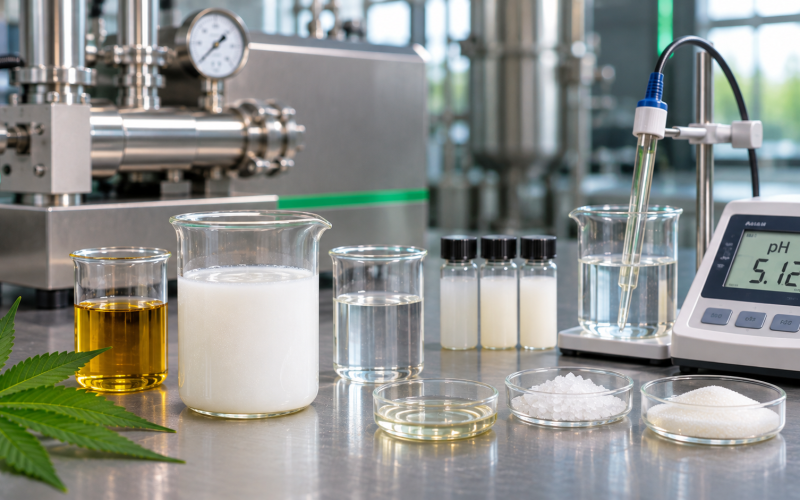
A cannabis nanoemulsion holds together only inside a set of limits. In a stress test of a CBD nanoemulsion, droplet size held steady up to pH 9, but it grew about 30 nm below pH 2 and flocs appeared at pH 1.6. Salt, sugar, emulsifier level, and homogenizer passes each have limits of their own.
This guide walks through how pH, ingredients, and processing conditions affect stability, and where each one starts to fail.
Key Takeaways
- This guide covers what holds a cannabis nanoemulsion together and what breaks it.
- Droplets stay apart because of their surface charge, so anything that removes the charge makes the emulsion unstable.
- One tested CBD nanoemulsion was stable across roughly pH 3 to 8 and failed at very low pH.
- Calcium salt is far more disruptive than sugar, since it compresses the charge layer around each droplet.
- A cannabinoid-heavy oil phase produced larger droplets and agglomeration in storage.
- Droplet size stopped falling after about 8 to 9 homogenizer passes, so more passes added no benefit.
The table lists each factor, the value tested, and what happened. All values come from one quillaja saponin and soybean oil formulation, so other emulsifiers will have different limits.
| Factor | Value tested | What happened |
|---|---|---|
| pH | Below 2 | Droplets grew about 30 nm, with creaming and flocs at pH 1.6 |
| pH | About 3 to 9 | No size change, and the emulsion was stable from about pH 3 to 8 |
| Sucrose | Up to about 250 mM | No change in droplet size |
| Sucrose | 500 mM | Droplets grew from about 130 nm to about 170 nm |
| Calcium chloride | 50 mM or less | Droplets stayed sub-micron |
| Calcium chloride | About 100 mM and above | Slow, then rapid, phase separation |
| Homogenizer passes | 1 to 9 at 30,000 psi | Size fell from about 450 nm to 185 nm, then leveled off by passes 8 to 9 |
What Holds a Cannabis Nanoemulsion Together
A nanoemulsion is a dispersion of tiny oil droplets, loaded with cannabinoids, in water. The droplets are kept apart by an emulsifier film and by an electrical charge on their surface. That charge is measured as zeta potential, and a strongly negative value means the droplets repel each other.
The role of that charge is easy to see in an instrument test. Microtrac measured a CBD nanoemulsion made by microfluidization at a zeta potential of -16.2 mV and a pH of 5.12. Adding a cationic polyelectrolyte brought the zeta potential to zero, and the particle size rose at that point as the droplets agglomerated. Once the charge is gone, nothing keeps the droplets apart.
Every factor below acts on the same two things: the charge on the droplets and the size they start at.
How pH Affects Cannabis Nanoemulsion Stability?
pH changes the charge on the droplet surface. In the Banerjee stress test, zeta potential became more negative as pH rose, and droplet size did not change anywhere between the acidic range and pH 9. The authors describe the emulsion as stable across roughly pH 3 to 8.
Below pH 2, the result changed. Droplets grew by about 30 nm, and creaming and flocs appeared at pH 1.6. CBD content stayed steady across the pH values tested, even after a month at 4°C, so the pH effect in this test was physical, not chemical.
The chemistry can still matter in acidic products. RTI researchers fortified six products at pH 4 or below with nano-emulsified CBD and stored them at room temperature for up to 15 months. THC formed in some of them, with one lemonade reaching 3.09 mg of Δ9-THC per serving and a sports drink reaching 1.18 mg. Cola and condiments produced far less, and the RTI results show that the type of acid matters. A stable emulsion can still change chemically in a low-pH drink.
How Ingredients Affect Cannabis Nanoemulsion Stability
Ingredients decide how much charge and how much emulsifier film each droplet gets, and how much strain the formulation faces from added salts and sugars.
Emulsifier level
The Banerjee formulation used a quillaja saponin emulsifier at 10 wt% of the aqueous phase, about 1.5 wt% saponin in the final emulsion. Going from 0.5 to 1.5 wt% shrank droplets by about 125 nm. Between 5 and 10 wt%, the change was only about 12 nm, and at 15 wt% droplet size no longer depended on emulsifier level. Higher emulsifier levels gave more uniform droplets and more negative zeta potentials, up to an intermediate concentration.
The pattern is useful for cost: past a certain level, extra emulsifier adds little.
Cannabinoid load in the oil phase
The final oil phase was 16.6 wt% cannabis distillate and 83.4 wt% soybean oil. Cannabis-heavy oil phases produced larger, bimodal droplets and showed agglomeration during prolonged storage. Lowering the cannabis fraction reduced droplet size and improved uniformity, while zeta potential stayed about the same. A higher cannabinoid load needs to be matched with a larger share of carrier oil or a different emulsifier plan.
Sugar and salt
Beverages bring sweeteners and minerals that the lab formulation does not have. Sucrose had no effect on droplet size up to about 250 mM, and at 500 mM droplets grew from about 130 nm to about 170 nm. Calcium chloride was much harsher. Droplets stayed sub-micron at 50 mM or less, slow phase separation began near 100 mM, and rapid separation followed above that. Zeta potential reached zero between 150 and 200 mM, because the calcium ions compress the charge layer that keeps droplets apart.
For a beverage maker, this means the water matters. Hard or mineral-rich water, calcium-fortified bases, and electrolyte formulations all add the ions that disrupt the charge.
Tuning pressure and passes for a stable emulsion? Explore Root Sciences nanoemulsification equipment.
How Processing Conditions Affect Cannabis Nanoemulsion Stability
Processing sets the starting droplet size, and a smaller, more uniform droplet resists separation longer.
Pre-mix and homogenization
The coarse emulsion in the Banerjee test was pre-mixed with a high-shear mixer and then passed through a high-pressure homogenizer at 30,000 psi. Droplets fell from about 450 nm to about 185 nm after one pass and about 165 nm after two. Size leveled off by passes 8 to 9, and the authors chose 10 passes. The homogenizer guide explains how pressure and passes are set on equipment.
Microfluidization shows the same pattern. In the Microtrac example, the size of an 11 mg/mL CBD emulsion fell from 330 nm to 168 nm over five passes.
Heat and shear
Processing is not free of side effects. Zeta potential fell by about 10 mV over the homogenizer passes, which the authors link to possible detachment of charged saponin groups from heat or shear. Cannabinoid content did not change beyond experimental error after the first two passes. The practical point is that more passes beyond the plateau cost charge without shrinking the droplets.
Heat and freeze-thaw
Short stress events had a small effect. Flash heating at 80°C for one minute increased droplet size by 9 percent and lowered zeta potential by 4 percent. One freeze-thaw cycle at -20°C increased size by 13.5 percent and lowered zeta potential by 6.2 percent. Both are mild compared with the effect of salt or very low pH.
Storage and Dilution
A concentrate is rarely sold as it is. It is diluted into a drink, then stored until someone opens it, and the nanoemulsion has to hold through both steps.
Dilution Into a Finished Drink
Dilution lowers the concentration of everything in the emulsion, and in a carbonated drink it also adds dissolved gas. Neither damaged the Banerjee nanoemulsion. Diluted to 355 mL (a standard can) with still water, droplet size changed by -1.5 percent, and in carbonated water by -3.5 percent. The size distribution stayed the same width in both.
For a beverage maker, this means that dilution of the emulsion itself is not where stability is lost. The risk comes from what the drink base adds, such as acid, calcium, or sugar, which are the factors covered above.
Storage Over Time
In the same test, the emulsion was stored at 4°C in amber vials and stayed colloidally stable for six weeks. Two changes appeared during that time:
- A thin creamy ring formed at the top, an early sign of droplets rising.
- Zeta potential declined, which means the charge keeping droplets apart was weakening.
Neither was a failure at six weeks, but both point in the direction that a longer shelf life would take.
Potency During Storage
CBD content fell about 17 percent over the same six weeks, even though the emulsion held together physically. An emulsion that looks and measures stable can still be losing cannabinoid, so a visual check or a particle size reading alone does not confirm a product is on label.
The authors suggest that the saponin’s free-radical quenching may slow oxidation inside the droplets, but they did not test this. Without that test, the cause of the 17 percent loss in this example is not established.
The practical result is a two-part check at each storage time point: droplet size and zeta potential for the physical state, and potency testing for the cannabinoid content.
A Practical Order of Checks
When a nanoemulsion shows signs of instability, the factors above can be checked in order, starting with the cheapest. The nanoemulsification guide and the page on nanoemulsification equipment cover the process and the machines behind it.
- Check pH first, and confirm it stays inside the range the formulation was built for.
- Check the water and the base for calcium and other ions, and for the sugar load.
- Check the emulsifier level against the cannabinoid load in the oil phase.
- Confirm the pressure and number of passes, and stop at the plateau.
- Retest droplet size, zeta potential, and cannabinoid content after storage.
Designing Within the Limits
A cannabis nanoemulsion is stable when its charge, droplet size, and surroundings stay inside a workable range. Low pH, calcium, an overloaded oil phase, and unnecessary processing each push it outside that range in a different way.
A manufacturer that tests those limits on its own formulation, with its own emulsifier, water, and beverage base, knows where its product can safely operate before it reaches a shelf.
Working through stability issues in your nanoemulsion? Talk to the Root Sciences team about the right equipment for your line.
Frequently Asked Questions
What pH range keeps a cannabis nanoemulsion stable?
In the Banerjee stress test of a quillaja saponin CBD nanoemulsion, droplet size did not change from the acidic range up to pH 9, and the authors describe it as stable across roughly pH 3 to 8. Below pH 2, droplets grew about 30 nm, and creaming and flocs appeared at pH 1.6. Other emulsifiers will have different windows, so each formulation needs its own check.
Why does calcium damage a nanoemulsion more than sugar?
Droplets repel each other through the charge on their surface, and calcium ions compress the layer that carries it. In the stress test, droplets stayed sub-micron at 50 mM calcium chloride or less, began slow separation near 100 mM, and reached zero zeta potential between 150 and 200 mM. Sucrose showed no effect up to about 250 mM. Hard water and calcium-fortified bases are the practical risk.
Can a stable nanoemulsion still lose potency?
Yes. Held at 4°C for six weeks, the tested emulsion stayed colloidally stable, but CBD content fell about 17 percent. In acidic drinks at pH 4 or below, nano-emulsified CBD can also convert to THC over months of room-temperature storage. Physical stability and chemical stability need to be tested separately.
Why does a higher cannabinoid load make an emulsion less stable?
A cannabis-heavy oil phase produced larger, bimodal droplets and showed agglomeration during prolonged storage. Lowering the cannabis fraction reduced droplet size and improved uniformity, while zeta potential stayed about the same. A higher load generally needs more carrier oil or a revised emulsifier plan.